Discussion
Loading...

#Tag

Log in
  • Sign up
  • About
  • Code of conduct
  • Privacy
  • Users
  • Instances
  • About Bonfire
Photography Channel boosted
Ferro Candilera
Ferro Candilera
@ItalianPostcards@mastodon.ozioso.online  ·  activity timestamp 6 days ago

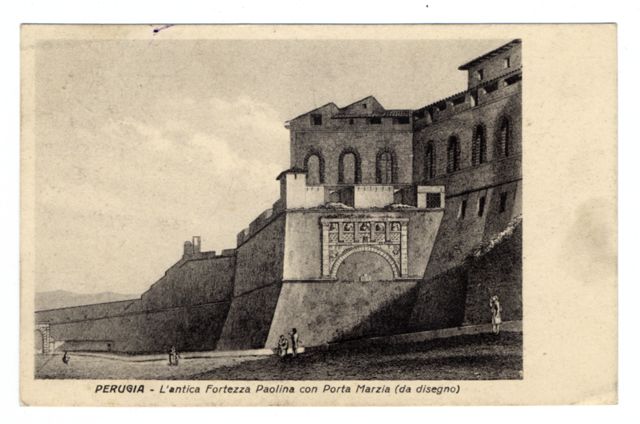
Perugia- L'antica Fortezza Paolina Con Porta Marzia (DA disegno)

#LanticaFortezza #PortaMarzia #Perugia #Umbria #photography #FerroCandilera

https://fotografia.cultura.gov.it/iccd/item/FFC040042

The image depicts an etching or engraving of a historical fortification, specifically "L'antica Fortezza Paolina con Porta Marzia" in Perugia. The structure is shown atop rocky terrain with steps leading down to the lower level where several figures appear: two walking and one standing by a gate labeled as 'Porta Marzia.' It captures the architectural grandeur of what appears to be medieval military architecture, characterized by thick walls, arched openings, towers, and battlements. The etching is monochromatic with shades ranging from light beige to dark gray, emphasizing the textures and contours of the buildings. There are no discernible signs or indicators within this image that would suggest it was created for a specific visual impairment context; such as braille cells or accessibility labels.

FFC040042 Perugia- L'antica Fortezza Paolina Con Porta Ma...

FFC040042 Perugia- L'antica Fortezza Paolina Con Porta Marzia (DA disegno) (fondo Ferro Candilera)
  • Copy link
  • Flag this post
  • Block
Ferro Candilera
Ferro Candilera
@ItalianPostcards@mastodon.ozioso.online  ·  activity timestamp 6 days ago

Perugia- L'antica Fortezza Paolina Con Porta Marzia (DA disegno)

#LanticaFortezza #PortaMarzia #Perugia #Umbria #photography #FerroCandilera

https://fotografia.cultura.gov.it/iccd/item/FFC040042

The image depicts an etching or engraving of a historical fortification, specifically "L'antica Fortezza Paolina con Porta Marzia" in Perugia. The structure is shown atop rocky terrain with steps leading down to the lower level where several figures appear: two walking and one standing by a gate labeled as 'Porta Marzia.' It captures the architectural grandeur of what appears to be medieval military architecture, characterized by thick walls, arched openings, towers, and battlements. The etching is monochromatic with shades ranging from light beige to dark gray, emphasizing the textures and contours of the buildings. There are no discernible signs or indicators within this image that would suggest it was created for a specific visual impairment context; such as braille cells or accessibility labels.

FFC040042 Perugia- L'antica Fortezza Paolina Con Porta Ma...

FFC040042 Perugia- L'antica Fortezza Paolina Con Porta Marzia (DA disegno) (fondo Ferro Candilera)
  • Copy link
  • Flag this post
  • Block
Photography Channel boosted
Ferro Candilera
Ferro Candilera
@ItalianPostcards@mastodon.ozioso.online  ·  activity timestamp 6 days ago

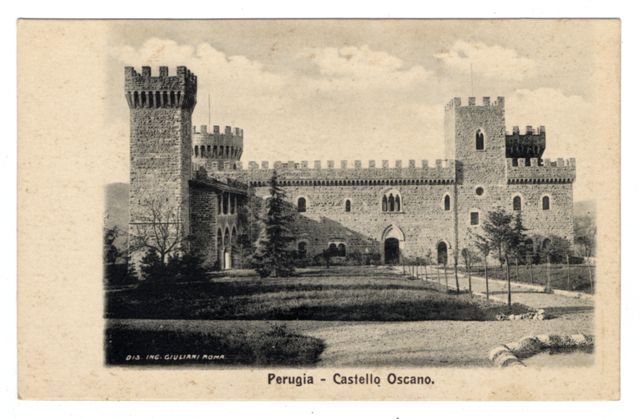
PERUGIA- CASTELLO OSCANO

#CASTELLOOSCANO #CastelloOscano #Perugia #Italian #DSING #GIULIANI #Giuliano #European #Umbria #photography #FerroCandilera

https://fotografia.cultura.gov.it/iccd/item/FFC040043

The image displays a historical black and white photograph of an old stone castle named "Castello Oscano" located in Perugia. It is presented as a postcard, indicating its use for communication or collection purposes during the time it was printed. The architecture features characteristic medieval fortifications with high walls, towers, arched doorways, and small windows typical of castles designed for defense.

The castle's exterior includes multiple buildings connected by passageways and an open courtyard area in front of one section. Surrounding vegetation is sparse but visible around the base of some trees and along a fence or hedge line at the edge of the image. The sky above appears overcast, adding to the historic ambiance captured in this photograph.

The postcard bears markings suggesting its Italian origin: "Perugia - Castello Oscano" with attribution below stating "D.S. ING. GIULIANI / ROMA." This indicates that Giuliano from Rome was involved in creating or publishing the image, likely as a professional photographer or lithographer of that time.

The bottom right corner has additional text which appears to be part of an address or credit line: "[...] di [...]" followed by "... 1865-1904." The exact wording is not fully legible due to resolution constraints and the photograph's age. This date range may refer to a historical context related to Castello Oscano, p [...]
The image displays a historical black and white photograph of an old stone castle named "Castello Oscano" located in Perugia. It is presented as a postcard, indicating its use for communication or collection purposes during the time it was printed. The architecture features characteristic medieval fortifications with high walls, towers, arched doorways, and small windows typical of castles designed for defense. The castle's exterior includes multiple buildings connected by passageways and an open courtyard area in front of one section. Surrounding vegetation is sparse but visible around the base of some trees and along a fence or hedge line at the edge of the image. The sky above appears overcast, adding to the historic ambiance captured in this photograph. The postcard bears markings suggesting its Italian origin: "Perugia - Castello Oscano" with attribution below stating "D.S. ING. GIULIANI / ROMA." This indicates that Giuliano from Rome was involved in creating or publishing the image, likely as a professional photographer or lithographer of that time. The bottom right corner has additional text which appears to be part of an address or credit line: "[...] di [...]" followed by "... 1865-1904." The exact wording is not fully legible due to resolution constraints and the photograph's age. This date range may refer to a historical context related to Castello Oscano, p [...]

FFC040043 PERUGIA- CASTELLO OSCANO

FFC040043 PERUGIA- CASTELLO OSCANO (fondo Ferro Candilera)
  • Copy link
  • Flag this post
  • Block
Ferro Candilera
Ferro Candilera
@ItalianPostcards@mastodon.ozioso.online  ·  activity timestamp 6 days ago

PERUGIA- CASTELLO OSCANO

#CASTELLOOSCANO #CastelloOscano #Perugia #Italian #DSING #GIULIANI #Giuliano #European #Umbria #photography #FerroCandilera

https://fotografia.cultura.gov.it/iccd/item/FFC040043

The image displays a historical black and white photograph of an old stone castle named "Castello Oscano" located in Perugia. It is presented as a postcard, indicating its use for communication or collection purposes during the time it was printed. The architecture features characteristic medieval fortifications with high walls, towers, arched doorways, and small windows typical of castles designed for defense.

The castle's exterior includes multiple buildings connected by passageways and an open courtyard area in front of one section. Surrounding vegetation is sparse but visible around the base of some trees and along a fence or hedge line at the edge of the image. The sky above appears overcast, adding to the historic ambiance captured in this photograph.

The postcard bears markings suggesting its Italian origin: "Perugia - Castello Oscano" with attribution below stating "D.S. ING. GIULIANI / ROMA." This indicates that Giuliano from Rome was involved in creating or publishing the image, likely as a professional photographer or lithographer of that time.

The bottom right corner has additional text which appears to be part of an address or credit line: "[...] di [...]" followed by "... 1865-1904." The exact wording is not fully legible due to resolution constraints and the photograph's age. This date range may refer to a historical context related to Castello Oscano, p [...]
The image displays a historical black and white photograph of an old stone castle named "Castello Oscano" located in Perugia. It is presented as a postcard, indicating its use for communication or collection purposes during the time it was printed. The architecture features characteristic medieval fortifications with high walls, towers, arched doorways, and small windows typical of castles designed for defense. The castle's exterior includes multiple buildings connected by passageways and an open courtyard area in front of one section. Surrounding vegetation is sparse but visible around the base of some trees and along a fence or hedge line at the edge of the image. The sky above appears overcast, adding to the historic ambiance captured in this photograph. The postcard bears markings suggesting its Italian origin: "Perugia - Castello Oscano" with attribution below stating "D.S. ING. GIULIANI / ROMA." This indicates that Giuliano from Rome was involved in creating or publishing the image, likely as a professional photographer or lithographer of that time. The bottom right corner has additional text which appears to be part of an address or credit line: "[...] di [...]" followed by "... 1865-1904." The exact wording is not fully legible due to resolution constraints and the photograph's age. This date range may refer to a historical context related to Castello Oscano, p [...]

FFC040043 PERUGIA- CASTELLO OSCANO

FFC040043 PERUGIA- CASTELLO OSCANO (fondo Ferro Candilera)
  • Copy link
  • Flag this post
  • Block
Photography Channel boosted
Ferro Candilera
Ferro Candilera
@ItalianPostcards@mastodon.ozioso.online  ·  activity timestamp 6 days ago

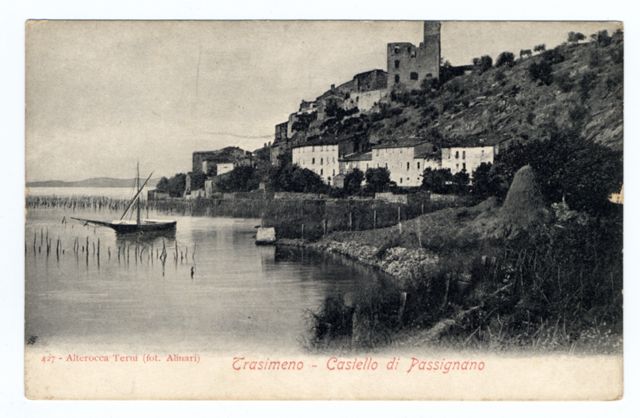
TRASIMENO-CASTELLO DI PASSIGNANO

#Trasimeno #CastleofPassignano #European #AlteroccaTerini #Alinari #Umbria #Perugia #photography #FerroCandilera

https://fotografia.cultura.gov.it/iccd/item/FFC040044

The image displays a sepia-toned photograph of the historical town of Trasimeno, with an emphasis on "Castello di Passignano," which translates to Castle of Passignano. The scene depicts calm waters in the foreground with reflections and wooden stakes poking out from beneath the surface. To the right is land densely populated with trees that cascade down a gentle hill towards more open terrain where buildings are nestled among vegetation, suggesting habitation or an urban area within this town's layout.

Prominent in the backdrop stands "Castello di Passignano," which appears as ruins on top of elevated ground, possibly indicating its historical significance and perhaps even military importance. The architecture suggests European influence with multi-storied structures exhibiting typical masonry work indicative of older construction periods.

The photograph is marked by a handwritten note reading "Alterocca Terini (fot., Alinari)" in red at the bottom left corner, likely identifying the photographer or photographic firm associated with this print. Additional text on the image reads "Trasimeno - Castello di Passignano," reinforcing geographical context and focal point.

The overall aesthetic of the photograph exudes a vintage feel, possibly from an early 20th-century origin given its monochromatic style and paper condition visible at the edges, which could be valuable for  [...]
The image displays a sepia-toned photograph of the historical town of Trasimeno, with an emphasis on "Castello di Passignano," which translates to Castle of Passignano. The scene depicts calm waters in the foreground with reflections and wooden stakes poking out from beneath the surface. To the right is land densely populated with trees that cascade down a gentle hill towards more open terrain where buildings are nestled among vegetation, suggesting habitation or an urban area within this town's layout. Prominent in the backdrop stands "Castello di Passignano," which appears as ruins on top of elevated ground, possibly indicating its historical significance and perhaps even military importance. The architecture suggests European influence with multi-storied structures exhibiting typical masonry work indicative of older construction periods. The photograph is marked by a handwritten note reading "Alterocca Terini (fot., Alinari)" in red at the bottom left corner, likely identifying the photographer or photographic firm associated with this print. Additional text on the image reads "Trasimeno - Castello di Passignano," reinforcing geographical context and focal point. The overall aesthetic of the photograph exudes a vintage feel, possibly from an early 20th-century origin given its monochromatic style and paper condition visible at the edges, which could be valuable for [...]

FFC040044 TRASIMENO-CASTELLO DI PASSIGNANO

FFC040044 TRASIMENO-CASTELLO DI PASSIGNANO (fondo Ferro Candilera)
  • Copy link
  • Flag this post
  • Block
Ferro Candilera
Ferro Candilera
@ItalianPostcards@mastodon.ozioso.online  ·  activity timestamp 6 days ago

TRASIMENO-CASTELLO DI PASSIGNANO

#Trasimeno #CastleofPassignano #European #AlteroccaTerini #Alinari #Umbria #Perugia #photography #FerroCandilera

https://fotografia.cultura.gov.it/iccd/item/FFC040044

The image displays a sepia-toned photograph of the historical town of Trasimeno, with an emphasis on "Castello di Passignano," which translates to Castle of Passignano. The scene depicts calm waters in the foreground with reflections and wooden stakes poking out from beneath the surface. To the right is land densely populated with trees that cascade down a gentle hill towards more open terrain where buildings are nestled among vegetation, suggesting habitation or an urban area within this town's layout.

Prominent in the backdrop stands "Castello di Passignano," which appears as ruins on top of elevated ground, possibly indicating its historical significance and perhaps even military importance. The architecture suggests European influence with multi-storied structures exhibiting typical masonry work indicative of older construction periods.

The photograph is marked by a handwritten note reading "Alterocca Terini (fot., Alinari)" in red at the bottom left corner, likely identifying the photographer or photographic firm associated with this print. Additional text on the image reads "Trasimeno - Castello di Passignano," reinforcing geographical context and focal point.

The overall aesthetic of the photograph exudes a vintage feel, possibly from an early 20th-century origin given its monochromatic style and paper condition visible at the edges, which could be valuable for  [...]
The image displays a sepia-toned photograph of the historical town of Trasimeno, with an emphasis on "Castello di Passignano," which translates to Castle of Passignano. The scene depicts calm waters in the foreground with reflections and wooden stakes poking out from beneath the surface. To the right is land densely populated with trees that cascade down a gentle hill towards more open terrain where buildings are nestled among vegetation, suggesting habitation or an urban area within this town's layout. Prominent in the backdrop stands "Castello di Passignano," which appears as ruins on top of elevated ground, possibly indicating its historical significance and perhaps even military importance. The architecture suggests European influence with multi-storied structures exhibiting typical masonry work indicative of older construction periods. The photograph is marked by a handwritten note reading "Alterocca Terini (fot., Alinari)" in red at the bottom left corner, likely identifying the photographer or photographic firm associated with this print. Additional text on the image reads "Trasimeno - Castello di Passignano," reinforcing geographical context and focal point. The overall aesthetic of the photograph exudes a vintage feel, possibly from an early 20th-century origin given its monochromatic style and paper condition visible at the edges, which could be valuable for [...]

FFC040044 TRASIMENO-CASTELLO DI PASSIGNANO

FFC040044 TRASIMENO-CASTELLO DI PASSIGNANO (fondo Ferro Candilera)
  • Copy link
  • Flag this post
  • Block
Photography Channel boosted
Ferro Candilera
Ferro Candilera
@ItalianPostcards@mastodon.ozioso.online  ·  activity timestamp 6 days ago

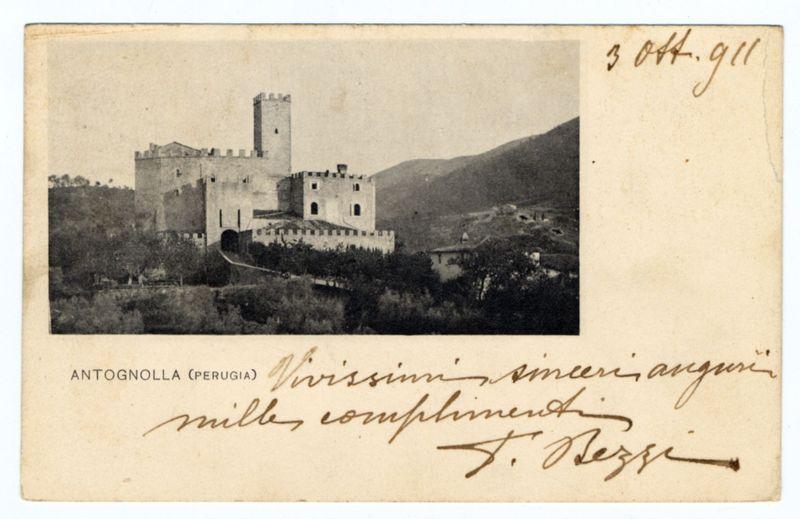
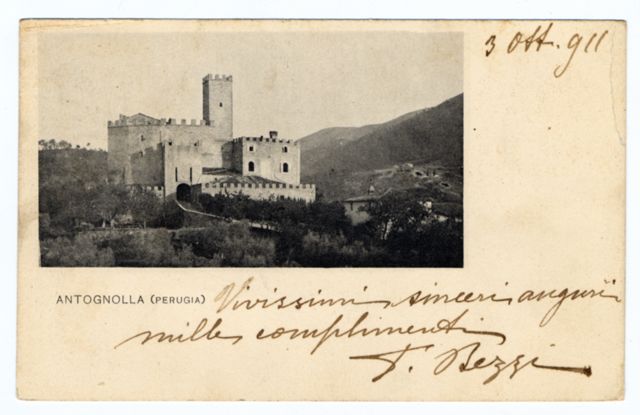
Antognolla

#Antognolla #Perugia #ANTOGNOLLA #PERUGIA #SPazi #Umbria #photography #FerroCandilera

https://fotografia.cultura.gov.it/iccd/item/FFC040126

The image displays a vintage postcard featuring an old photograph of the Antognolla castle in Perugia. The black and white photo captures the fortress-like structure set against rolling hills, which adds to its historical ambiance.

Atop the postcard is handwritten text that appears as "3 ott. g11" on top right corner, indicating a date or possibly an abbreviation for an event related to October 1911.

In bold print at the bottom of the photograph is the inscription: 'ANTOGNOLLA (PERUGIA)' which identifies the location and structure depicted in the image.

Below this title, there's a more elaborate handwritten note that reads "Vivissimi sinceri argenti milesi complimenti" with "millesi complimenti," likely meaning many thanks. It is signed off by 'S. Pazi,' presumably indicating the sender of the postcard.

The overall aesthetic suggests it might be from an early 20th-century collection, possibly used for personal correspondence or as a keepsake to share impressions and memories associated with Antognolla castle.
The image displays a vintage postcard featuring an old photograph of the Antognolla castle in Perugia. The black and white photo captures the fortress-like structure set against rolling hills, which adds to its historical ambiance. Atop the postcard is handwritten text that appears as "3 ott. g11" on top right corner, indicating a date or possibly an abbreviation for an event related to October 1911. In bold print at the bottom of the photograph is the inscription: 'ANTOGNOLLA (PERUGIA)' which identifies the location and structure depicted in the image. Below this title, there's a more elaborate handwritten note that reads "Vivissimi sinceri argenti milesi complimenti" with "millesi complimenti," likely meaning many thanks. It is signed off by 'S. Pazi,' presumably indicating the sender of the postcard. The overall aesthetic suggests it might be from an early 20th-century collection, possibly used for personal correspondence or as a keepsake to share impressions and memories associated with Antognolla castle.

FFC040126 Antognolla

FFC040126 Antognolla (fondo Ferro Candilera)
  • Copy link
  • Flag this post
  • Block
Ferro Candilera
Ferro Candilera
@ItalianPostcards@mastodon.ozioso.online  ·  activity timestamp 6 days ago

Antognolla

#Antognolla #Perugia #ANTOGNOLLA #PERUGIA #SPazi #Umbria #photography #FerroCandilera

https://fotografia.cultura.gov.it/iccd/item/FFC040126

The image displays a vintage postcard featuring an old photograph of the Antognolla castle in Perugia. The black and white photo captures the fortress-like structure set against rolling hills, which adds to its historical ambiance.

Atop the postcard is handwritten text that appears as "3 ott. g11" on top right corner, indicating a date or possibly an abbreviation for an event related to October 1911.

In bold print at the bottom of the photograph is the inscription: 'ANTOGNOLLA (PERUGIA)' which identifies the location and structure depicted in the image.

Below this title, there's a more elaborate handwritten note that reads "Vivissimi sinceri argenti milesi complimenti" with "millesi complimenti," likely meaning many thanks. It is signed off by 'S. Pazi,' presumably indicating the sender of the postcard.

The overall aesthetic suggests it might be from an early 20th-century collection, possibly used for personal correspondence or as a keepsake to share impressions and memories associated with Antognolla castle.
The image displays a vintage postcard featuring an old photograph of the Antognolla castle in Perugia. The black and white photo captures the fortress-like structure set against rolling hills, which adds to its historical ambiance. Atop the postcard is handwritten text that appears as "3 ott. g11" on top right corner, indicating a date or possibly an abbreviation for an event related to October 1911. In bold print at the bottom of the photograph is the inscription: 'ANTOGNOLLA (PERUGIA)' which identifies the location and structure depicted in the image. Below this title, there's a more elaborate handwritten note that reads "Vivissimi sinceri argenti milesi complimenti" with "millesi complimenti," likely meaning many thanks. It is signed off by 'S. Pazi,' presumably indicating the sender of the postcard. The overall aesthetic suggests it might be from an early 20th-century collection, possibly used for personal correspondence or as a keepsake to share impressions and memories associated with Antognolla castle.

FFC040126 Antognolla

FFC040126 Antognolla (fondo Ferro Candilera)
  • Copy link
  • Flag this post
  • Block
Photography Channel boosted
Ferro Candilera
Ferro Candilera
@ItalianPostcards@mastodon.ozioso.online  ·  activity timestamp 6 days ago

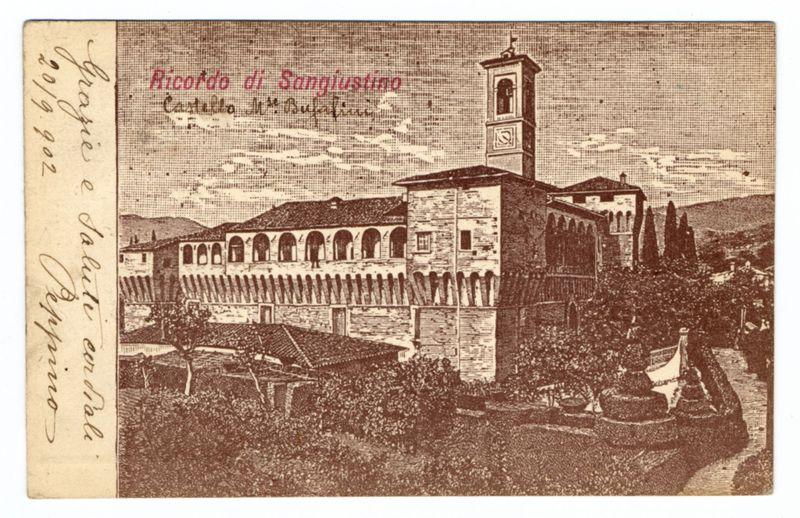
San Giusto (Città di Castello) - Castello del Marchese Bufalini

#SanGiusto #Italian #Renaissance #Italy #Gracie #Umbria #Perugia #CittàdiCastello #photography #FerroCandilera

https://fotografia.cultura.gov.it/iccd/item/FFC040183

This image depicts an illustration of a historic building named "Ricordo di Sangiustino" as indicated by the text at the top. The drawing style is reminiscent of old engravings or woodcuts, with detailed lines and shading that give it a vintage appearance. It shows a large structure with a series of arches on its facade, likely indicating an Italian architectural influence commonly seen in medieval or Renaissance buildings.

A prominent feature is a bell tower rising from the building's right side, suggesting this could be a place like a monastery, abbey, or possibly even a castle. The landscape around the building includes trees and what appears to be terraced land with hedges or fences, typical of an estate setting in Italy.

On the left side, there is handwritten text that reads "Gracie e salute cara" followed by numbers "20/9 1862," which may indicate a date related to when this postcard was created. This could be part of a series given its repeated format on what appears to be a paper or cardstock background.

The image has an aged quality, with varying shades from deep brown at the bottom left corner where it's more worn out and faded towards lighter tones as we move up and across the photo. It suggests that this illustration may have been reproduced multiple times over time, contributing to its historical appeal.
This image depicts an illustration of a historic building named "Ricordo di Sangiustino" as indicated by the text at the top. The drawing style is reminiscent of old engravings or woodcuts, with detailed lines and shading that give it a vintage appearance. It shows a large structure with a series of arches on its facade, likely indicating an Italian architectural influence commonly seen in medieval or Renaissance buildings. A prominent feature is a bell tower rising from the building's right side, suggesting this could be a place like a monastery, abbey, or possibly even a castle. The landscape around the building includes trees and what appears to be terraced land with hedges or fences, typical of an estate setting in Italy. On the left side, there is handwritten text that reads "Gracie e salute cara" followed by numbers "20/9 1862," which may indicate a date related to when this postcard was created. This could be part of a series given its repeated format on what appears to be a paper or cardstock background. The image has an aged quality, with varying shades from deep brown at the bottom left corner where it's more worn out and faded towards lighter tones as we move up and across the photo. It suggests that this illustration may have been reproduced multiple times over time, contributing to its historical appeal.

FFC040183 San Giusto (Città di Castello) - Castello del M...

FFC040183 San Giusto (Città di Castello) - Castello del Marchese Bufalini (fondo Ferro Candilera)
https://mastodon.ozioso.online/tags/Citt%C3%A0diCastello
  • Copy link
  • Flag this post
  • Block
Ferro Candilera
Ferro Candilera
@ItalianPostcards@mastodon.ozioso.online  ·  activity timestamp 6 days ago

San Giusto (Città di Castello) - Castello del Marchese Bufalini

#SanGiusto #Italian #Renaissance #Italy #Gracie #Umbria #Perugia #CittàdiCastello #photography #FerroCandilera

https://fotografia.cultura.gov.it/iccd/item/FFC040183

This image depicts an illustration of a historic building named "Ricordo di Sangiustino" as indicated by the text at the top. The drawing style is reminiscent of old engravings or woodcuts, with detailed lines and shading that give it a vintage appearance. It shows a large structure with a series of arches on its facade, likely indicating an Italian architectural influence commonly seen in medieval or Renaissance buildings.

A prominent feature is a bell tower rising from the building's right side, suggesting this could be a place like a monastery, abbey, or possibly even a castle. The landscape around the building includes trees and what appears to be terraced land with hedges or fences, typical of an estate setting in Italy.

On the left side, there is handwritten text that reads "Gracie e salute cara" followed by numbers "20/9 1862," which may indicate a date related to when this postcard was created. This could be part of a series given its repeated format on what appears to be a paper or cardstock background.

The image has an aged quality, with varying shades from deep brown at the bottom left corner where it's more worn out and faded towards lighter tones as we move up and across the photo. It suggests that this illustration may have been reproduced multiple times over time, contributing to its historical appeal.
This image depicts an illustration of a historic building named "Ricordo di Sangiustino" as indicated by the text at the top. The drawing style is reminiscent of old engravings or woodcuts, with detailed lines and shading that give it a vintage appearance. It shows a large structure with a series of arches on its facade, likely indicating an Italian architectural influence commonly seen in medieval or Renaissance buildings. A prominent feature is a bell tower rising from the building's right side, suggesting this could be a place like a monastery, abbey, or possibly even a castle. The landscape around the building includes trees and what appears to be terraced land with hedges or fences, typical of an estate setting in Italy. On the left side, there is handwritten text that reads "Gracie e salute cara" followed by numbers "20/9 1862," which may indicate a date related to when this postcard was created. This could be part of a series given its repeated format on what appears to be a paper or cardstock background. The image has an aged quality, with varying shades from deep brown at the bottom left corner where it's more worn out and faded towards lighter tones as we move up and across the photo. It suggests that this illustration may have been reproduced multiple times over time, contributing to its historical appeal.

FFC040183 San Giusto (Città di Castello) - Castello del M...

FFC040183 San Giusto (Città di Castello) - Castello del Marchese Bufalini (fondo Ferro Candilera)
https://mastodon.ozioso.online/tags/Citt%C3%A0diCastello
  • Copy link
  • Flag this post
  • Block
Photography Channel boosted
Ferro Candilera
Ferro Candilera
@ItalianPostcards@mastodon.ozioso.online  ·  activity timestamp 6 days ago

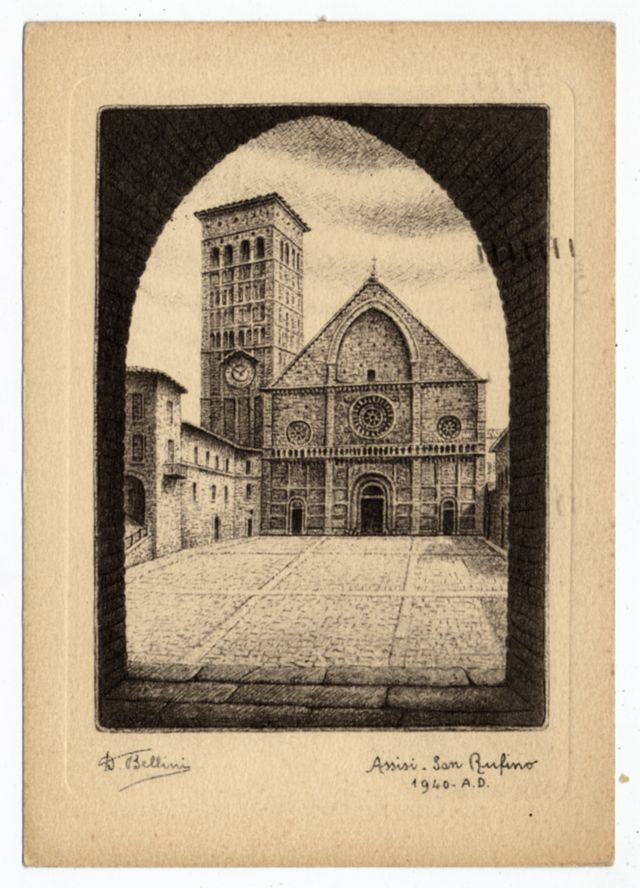
ASSISI - SAN RUFINO

#ASSISI-SANRUFINO #theAssisiCathedral #SanRufino #Bellini #Assisi-SanRufino #Umbria #Perugia #Assisi #photography #FerroCandilera

https://fotografia.cultura.gov.it/iccd/item/FFC044725

The provided image is a black and white engraving of the Assisi Cathedral, specifically San Rufino. This artwork was created by an artist named Bellini in 1940 A.D., as indicated at the bottom right corner where it states "Assisi - San Rufino 1940-A.D." The cathedral's architectural features are prominently displayed: a large arched entrance with two sets of double doors, round and rose windows, and a tower on its left side bearing a clock. It is framed within an arch-like border that gives the impression it’s peering through or around another structure to reveal this historic building.

The texture appears richly detailed in terms of shading which suggests the use of fine lines typical for engraving techniques common during the early 20th century, possibly influenced by artists such as Giovanni Battista Piranesi known for his architectural engravings. The paper on which it is printed shows signs of age with slight discoloration and a textured surface that enhances its antique look.

Further information about this specific artwork can be found at the provided URL (https://images.loener.nl/FerroCandilera/full/6730/6730a66189b10e7a26b6fca0.jpg), which may offer more context or a higher resolution version of this image.
The provided image is a black and white engraving of the Assisi Cathedral, specifically San Rufino. This artwork was created by an artist named Bellini in 1940 A.D., as indicated at the bottom right corner where it states "Assisi - San Rufino 1940-A.D." The cathedral's architectural features are prominently displayed: a large arched entrance with two sets of double doors, round and rose windows, and a tower on its left side bearing a clock. It is framed within an arch-like border that gives the impression it’s peering through or around another structure to reveal this historic building. The texture appears richly detailed in terms of shading which suggests the use of fine lines typical for engraving techniques common during the early 20th century, possibly influenced by artists such as Giovanni Battista Piranesi known for his architectural engravings. The paper on which it is printed shows signs of age with slight discoloration and a textured surface that enhances its antique look. Further information about this specific artwork can be found at the provided URL (https://images.loener.nl/FerroCandilera/full/6730/6730a66189b10e7a26b6fca0.jpg), which may offer more context or a higher resolution version of this image.

FFC044725 ASSISI - SAN RUFINO

FFC044725 ASSISI - SAN RUFINO (fondo Ferro Candilera)
  • Copy link
  • Flag this post
  • Block
Ferro Candilera
Ferro Candilera
@ItalianPostcards@mastodon.ozioso.online  ·  activity timestamp 6 days ago

ASSISI - SAN RUFINO

#ASSISI-SANRUFINO #theAssisiCathedral #SanRufino #Bellini #Assisi-SanRufino #Umbria #Perugia #Assisi #photography #FerroCandilera

https://fotografia.cultura.gov.it/iccd/item/FFC044725

The provided image is a black and white engraving of the Assisi Cathedral, specifically San Rufino. This artwork was created by an artist named Bellini in 1940 A.D., as indicated at the bottom right corner where it states "Assisi - San Rufino 1940-A.D." The cathedral's architectural features are prominently displayed: a large arched entrance with two sets of double doors, round and rose windows, and a tower on its left side bearing a clock. It is framed within an arch-like border that gives the impression it’s peering through or around another structure to reveal this historic building.

The texture appears richly detailed in terms of shading which suggests the use of fine lines typical for engraving techniques common during the early 20th century, possibly influenced by artists such as Giovanni Battista Piranesi known for his architectural engravings. The paper on which it is printed shows signs of age with slight discoloration and a textured surface that enhances its antique look.

Further information about this specific artwork can be found at the provided URL (https://images.loener.nl/FerroCandilera/full/6730/6730a66189b10e7a26b6fca0.jpg), which may offer more context or a higher resolution version of this image.
The provided image is a black and white engraving of the Assisi Cathedral, specifically San Rufino. This artwork was created by an artist named Bellini in 1940 A.D., as indicated at the bottom right corner where it states "Assisi - San Rufino 1940-A.D." The cathedral's architectural features are prominently displayed: a large arched entrance with two sets of double doors, round and rose windows, and a tower on its left side bearing a clock. It is framed within an arch-like border that gives the impression it’s peering through or around another structure to reveal this historic building. The texture appears richly detailed in terms of shading which suggests the use of fine lines typical for engraving techniques common during the early 20th century, possibly influenced by artists such as Giovanni Battista Piranesi known for his architectural engravings. The paper on which it is printed shows signs of age with slight discoloration and a textured surface that enhances its antique look. Further information about this specific artwork can be found at the provided URL (https://images.loener.nl/FerroCandilera/full/6730/6730a66189b10e7a26b6fca0.jpg), which may offer more context or a higher resolution version of this image.

FFC044725 ASSISI - SAN RUFINO

FFC044725 ASSISI - SAN RUFINO (fondo Ferro Candilera)
  • Copy link
  • Flag this post
  • Block
Photography Channel boosted
Ferro Candilera
Ferro Candilera
@ItalianPostcards@mastodon.ozioso.online  ·  activity timestamp 6 days ago

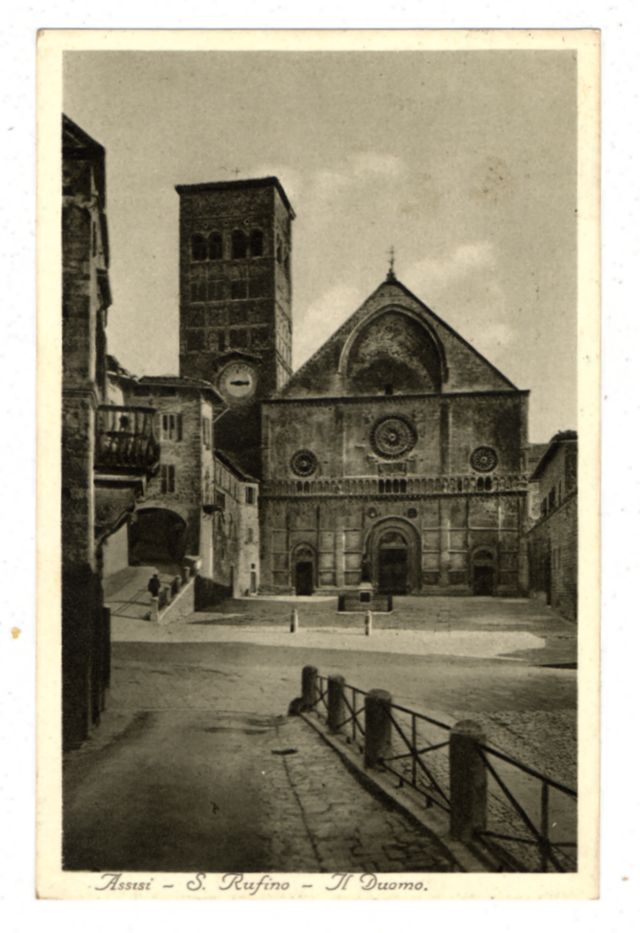
Assisi - Chiesa di S. Rufino - Il Duomo Fotografo: undefined

#Europe #Italy #Assisi #Gothic #Umbria #Perugia #photography #FerroCandilera

https://fotografia.cultura.gov.it/iccd/item/FFC046617

The image displays an aged, black and white photograph of a historic church complex. The architecture suggests it's located in Europe, possibly Italy given the text "Assisi - S. Rufino - Il Duomo" which indicates Assisi is known for its Saint Rufino Cathedral (Duomo). Prominent features include a large Gothic-style cathedral with rounded arches and decorative stonework. A tall bell tower rises above it, featuring rectangular openings near the top. The foreground shows an empty street leading up to the church's entrance, lined by simple fencing on one side and what appears to be a stairway on another. There are no visible people in this scene, emphasizing the historical solitude of the setting. The overall mood is quiet and somber due to both the monochrome palette and absence of contemporary life.

FFC046617 Assisi - Chiesa di S. Rufino - Il Duomo

FFC046617 Assisi - Chiesa di S. Rufino - Il Duomo (fondo Ferro Candilera)
  • Copy link
  • Flag this post
  • Block
Ferro Candilera
Ferro Candilera
@ItalianPostcards@mastodon.ozioso.online  ·  activity timestamp 6 days ago

Assisi - Chiesa di S. Rufino - Il Duomo Fotografo: undefined

#Europe #Italy #Assisi #Gothic #Umbria #Perugia #photography #FerroCandilera

https://fotografia.cultura.gov.it/iccd/item/FFC046617

The image displays an aged, black and white photograph of a historic church complex. The architecture suggests it's located in Europe, possibly Italy given the text "Assisi - S. Rufino - Il Duomo" which indicates Assisi is known for its Saint Rufino Cathedral (Duomo). Prominent features include a large Gothic-style cathedral with rounded arches and decorative stonework. A tall bell tower rises above it, featuring rectangular openings near the top. The foreground shows an empty street leading up to the church's entrance, lined by simple fencing on one side and what appears to be a stairway on another. There are no visible people in this scene, emphasizing the historical solitude of the setting. The overall mood is quiet and somber due to both the monochrome palette and absence of contemporary life.

FFC046617 Assisi - Chiesa di S. Rufino - Il Duomo

FFC046617 Assisi - Chiesa di S. Rufino - Il Duomo (fondo Ferro Candilera)
  • Copy link
  • Flag this post
  • Block
Photography Channel boosted
Ferro Candilera
Ferro Candilera
@ItalianPostcards@mastodon.ozioso.online  ·  activity timestamp 6 days ago

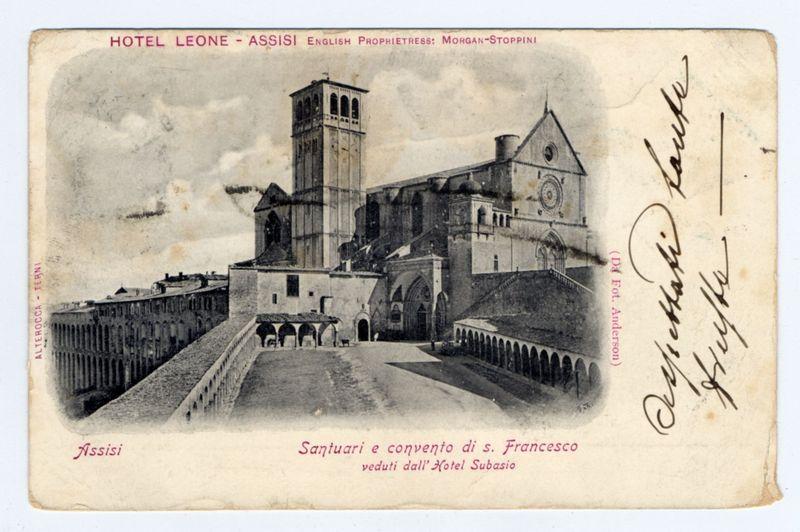
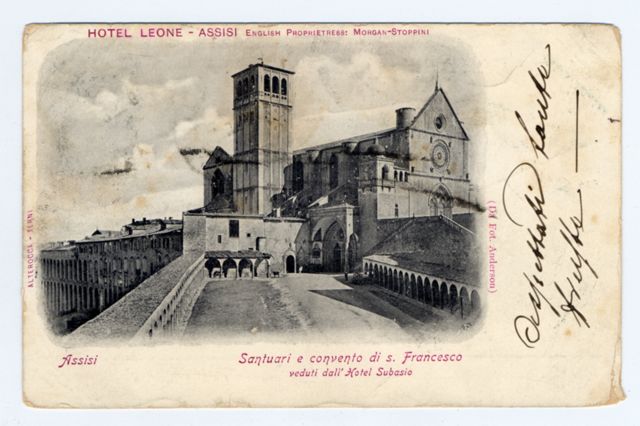
ASSISI - SANTUARI E CONVENTO DI S. FRANCESCO VEDUTI DALL'HOTEL SUBASIO Fotografo: undefined

#ASSISI-SANTUARI #theHotelLeone #Assisi #Italy #Gothic #Morgan-Stoppani #Terni #Santuari #diSFrancesco #Subasio #Umbria #Perugia #photography #FerroCandilera

https://fotografia.cultura.gov.it/iccd/item/FFC046618

The image displays a vintage postcard featuring an old photograph of the Hotel Leone in Assisi, Italy. The architectural elements showcased include a large Gothic-style church with prominent arched windows and intricate stonework on its facade, flanked by two bell towers. A series of arches line what appears to be a cloister or courtyard area leading towards this structure.

The sky is overcast, giving the image a muted tone. The photo bears handwritten annotations in cursive script that likely indicate ownership or personal notes from someone who owned it. The bottom left corner reads "Assisi," while above the photograph on the postcard's background, text states "Hotel Leone - Assisi English Proprietress: Morgan-Stoppani." Additional information includes a note about alterations by Terni and mentions of Santuari e convento di S. Francesco veduti dall'Hotel Subasio with attribution to an unknown photographer.

The vintage nature is emphasized through the postcard's design, including its borders and ornate typography for the title text above. The overall condition appears aged but intact, suggesting it has been preserved over a significant period of time.
The image displays a vintage postcard featuring an old photograph of the Hotel Leone in Assisi, Italy. The architectural elements showcased include a large Gothic-style church with prominent arched windows and intricate stonework on its facade, flanked by two bell towers. A series of arches line what appears to be a cloister or courtyard area leading towards this structure. The sky is overcast, giving the image a muted tone. The photo bears handwritten annotations in cursive script that likely indicate ownership or personal notes from someone who owned it. The bottom left corner reads "Assisi," while above the photograph on the postcard's background, text states "Hotel Leone - Assisi English Proprietress: Morgan-Stoppani." Additional information includes a note about alterations by Terni and mentions of Santuari e convento di S. Francesco veduti dall'Hotel Subasio with attribution to an unknown photographer. The vintage nature is emphasized through the postcard's design, including its borders and ornate typography for the title text above. The overall condition appears aged but intact, suggesting it has been preserved over a significant period of time.

FFC046618 ASSISI - SANTUARI E CONVENTO DI S. FRANCESCO VE...

FFC046618 ASSISI - SANTUARI E CONVENTO DI S. FRANCESCO VEDUTI DALL'HOTEL SUBASIO (fondo Ferro Candilera)
  • Copy link
  • Flag this post
  • Block
Ferro Candilera
Ferro Candilera
@ItalianPostcards@mastodon.ozioso.online  ·  activity timestamp 6 days ago

ASSISI - SANTUARI E CONVENTO DI S. FRANCESCO VEDUTI DALL'HOTEL SUBASIO Fotografo: undefined

#ASSISI-SANTUARI #theHotelLeone #Assisi #Italy #Gothic #Morgan-Stoppani #Terni #Santuari #diSFrancesco #Subasio #Umbria #Perugia #photography #FerroCandilera

https://fotografia.cultura.gov.it/iccd/item/FFC046618

The image displays a vintage postcard featuring an old photograph of the Hotel Leone in Assisi, Italy. The architectural elements showcased include a large Gothic-style church with prominent arched windows and intricate stonework on its facade, flanked by two bell towers. A series of arches line what appears to be a cloister or courtyard area leading towards this structure.

The sky is overcast, giving the image a muted tone. The photo bears handwritten annotations in cursive script that likely indicate ownership or personal notes from someone who owned it. The bottom left corner reads "Assisi," while above the photograph on the postcard's background, text states "Hotel Leone - Assisi English Proprietress: Morgan-Stoppani." Additional information includes a note about alterations by Terni and mentions of Santuari e convento di S. Francesco veduti dall'Hotel Subasio with attribution to an unknown photographer.

The vintage nature is emphasized through the postcard's design, including its borders and ornate typography for the title text above. The overall condition appears aged but intact, suggesting it has been preserved over a significant period of time.
The image displays a vintage postcard featuring an old photograph of the Hotel Leone in Assisi, Italy. The architectural elements showcased include a large Gothic-style church with prominent arched windows and intricate stonework on its facade, flanked by two bell towers. A series of arches line what appears to be a cloister or courtyard area leading towards this structure. The sky is overcast, giving the image a muted tone. The photo bears handwritten annotations in cursive script that likely indicate ownership or personal notes from someone who owned it. The bottom left corner reads "Assisi," while above the photograph on the postcard's background, text states "Hotel Leone - Assisi English Proprietress: Morgan-Stoppani." Additional information includes a note about alterations by Terni and mentions of Santuari e convento di S. Francesco veduti dall'Hotel Subasio with attribution to an unknown photographer. The vintage nature is emphasized through the postcard's design, including its borders and ornate typography for the title text above. The overall condition appears aged but intact, suggesting it has been preserved over a significant period of time.

FFC046618 ASSISI - SANTUARI E CONVENTO DI S. FRANCESCO VE...

FFC046618 ASSISI - SANTUARI E CONVENTO DI S. FRANCESCO VEDUTI DALL'HOTEL SUBASIO (fondo Ferro Candilera)
  • Copy link
  • Flag this post
  • Block
Photography Channel boosted
Ferro Candilera
Ferro Candilera
@ItalianPostcards@mastodon.ozioso.online  ·  activity timestamp 6 days ago

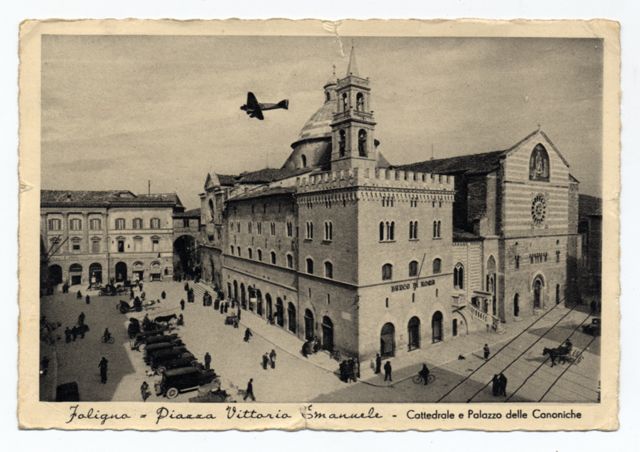
FOLIGNO- PIAZZA VITTORIO EMANUELE- CATTEDRALE E PALAZZO DELLE CANONICHE - PICCOLO AEROPLANO DISEGNATO Fotografo: undefined

#BancodiRoma #Foligno #Umbria #Perugia #photography #FerroCandilera

https://fotografia.cultura.gov.it/iccd/item/FFC046656

The image depicts a historical postcard featuring an old town square with various architectural structures, including what appears to be a cathedral or church on the right side and another prominent building labeled "Banco di Roma" in the center. A small airplane is captured mid-flight above the scene, suggesting early aviation activity. The street below shows people walking, some carriages, and horse-drawn vehicles indicative of an earlier time period. Several cars are also parked along the sides of the square.

The text on the postcard indicates it represents Foligno's Piazza Vittorio Emanuele with a mention of Cattedrale e Palazzo delle Canoniche (Cathedral and Palace of Canons). The photo is credited to an unidentified photographer, as per the URL provided in the image.
The image depicts a historical postcard featuring an old town square with various architectural structures, including what appears to be a cathedral or church on the right side and another prominent building labeled "Banco di Roma" in the center. A small airplane is captured mid-flight above the scene, suggesting early aviation activity. The street below shows people walking, some carriages, and horse-drawn vehicles indicative of an earlier time period. Several cars are also parked along the sides of the square. The text on the postcard indicates it represents Foligno's Piazza Vittorio Emanuele with a mention of Cattedrale e Palazzo delle Canoniche (Cathedral and Palace of Canons). The photo is credited to an unidentified photographer, as per the URL provided in the image.

FFC046656 FOLIGNO- PIAZZA VITTORIO EMANUELE- CATTEDRALE E...

FFC046656 FOLIGNO- PIAZZA VITTORIO EMANUELE- CATTEDRALE E PALAZZO DELLE CANONICHE - PICCOLO AEROPLANO DISEGNATO (fondo Ferro Candilera)
  • Copy link
  • Flag this post
  • Block
Ferro Candilera
Ferro Candilera
@ItalianPostcards@mastodon.ozioso.online  ·  activity timestamp 6 days ago

FOLIGNO- PIAZZA VITTORIO EMANUELE- CATTEDRALE E PALAZZO DELLE CANONICHE - PICCOLO AEROPLANO DISEGNATO Fotografo: undefined

#BancodiRoma #Foligno #Umbria #Perugia #photography #FerroCandilera

https://fotografia.cultura.gov.it/iccd/item/FFC046656

The image depicts a historical postcard featuring an old town square with various architectural structures, including what appears to be a cathedral or church on the right side and another prominent building labeled "Banco di Roma" in the center. A small airplane is captured mid-flight above the scene, suggesting early aviation activity. The street below shows people walking, some carriages, and horse-drawn vehicles indicative of an earlier time period. Several cars are also parked along the sides of the square.

The text on the postcard indicates it represents Foligno's Piazza Vittorio Emanuele with a mention of Cattedrale e Palazzo delle Canoniche (Cathedral and Palace of Canons). The photo is credited to an unidentified photographer, as per the URL provided in the image.
The image depicts a historical postcard featuring an old town square with various architectural structures, including what appears to be a cathedral or church on the right side and another prominent building labeled "Banco di Roma" in the center. A small airplane is captured mid-flight above the scene, suggesting early aviation activity. The street below shows people walking, some carriages, and horse-drawn vehicles indicative of an earlier time period. Several cars are also parked along the sides of the square. The text on the postcard indicates it represents Foligno's Piazza Vittorio Emanuele with a mention of Cattedrale e Palazzo delle Canoniche (Cathedral and Palace of Canons). The photo is credited to an unidentified photographer, as per the URL provided in the image.

FFC046656 FOLIGNO- PIAZZA VITTORIO EMANUELE- CATTEDRALE E...

FFC046656 FOLIGNO- PIAZZA VITTORIO EMANUELE- CATTEDRALE E PALAZZO DELLE CANONICHE - PICCOLO AEROPLANO DISEGNATO (fondo Ferro Candilera)
  • Copy link
  • Flag this post
  • Block
Photography Channel boosted
Ferro Candilera
Ferro Candilera
@ItalianPostcards@mastodon.ozioso.online  ·  activity timestamp 7 days ago

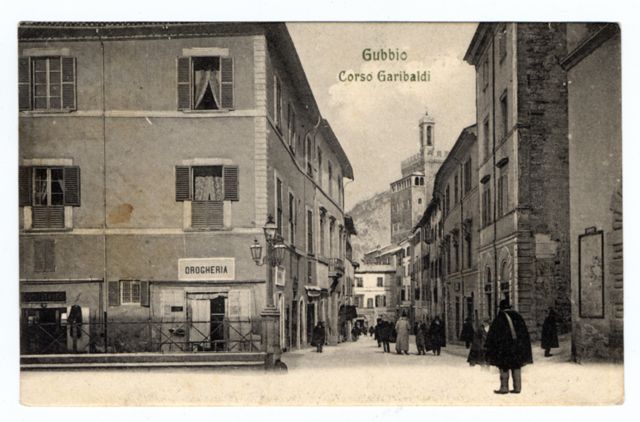
GUBBIO - CORSO GARIBALDI Fotografo: undefined

#Gubbio #Italy #CorsoGaribaldi #Drogheria #European #Umbria #Perugia #photography #FerroCandilera

https://fotografia.cultura.gov.it/iccd/item/FFC046659

The image depicts a vintage black and white street scene from Gubbio, Italy. The focus is on Corso Garibaldi with buildings lining the sides of the narrow street, some displaying signs such as "Drogheria," indicating pharmacies or drugstores. Several individuals are walking along the sidewalk in period attire that suggests an earlier era, possibly early to mid-20th century judging by their clothing and style.

In the background stands a prominent clock tower with multiple levels of arched windows at regular intervals, suggesting it may be part of a church or municipal building. The architecture is typical European town design, featuring shuttered window fronts on both sides of the street which create an inviting atmosphere for pedestrians.
The image depicts a vintage black and white street scene from Gubbio, Italy. The focus is on Corso Garibaldi with buildings lining the sides of the narrow street, some displaying signs such as "Drogheria," indicating pharmacies or drugstores. Several individuals are walking along the sidewalk in period attire that suggests an earlier era, possibly early to mid-20th century judging by their clothing and style. In the background stands a prominent clock tower with multiple levels of arched windows at regular intervals, suggesting it may be part of a church or municipal building. The architecture is typical European town design, featuring shuttered window fronts on both sides of the street which create an inviting atmosphere for pedestrians.

FFC046659 GUBBIO - CORSO GARIBALDI

FFC046659 GUBBIO - CORSO GARIBALDI (fondo Ferro Candilera)
  • Copy link
  • Flag this post
  • Block
Ferro Candilera
Ferro Candilera
@ItalianPostcards@mastodon.ozioso.online  ·  activity timestamp 7 days ago

GUBBIO - CORSO GARIBALDI Fotografo: undefined

#Gubbio #Italy #CorsoGaribaldi #Drogheria #European #Umbria #Perugia #photography #FerroCandilera

https://fotografia.cultura.gov.it/iccd/item/FFC046659

The image depicts a vintage black and white street scene from Gubbio, Italy. The focus is on Corso Garibaldi with buildings lining the sides of the narrow street, some displaying signs such as "Drogheria," indicating pharmacies or drugstores. Several individuals are walking along the sidewalk in period attire that suggests an earlier era, possibly early to mid-20th century judging by their clothing and style.

In the background stands a prominent clock tower with multiple levels of arched windows at regular intervals, suggesting it may be part of a church or municipal building. The architecture is typical European town design, featuring shuttered window fronts on both sides of the street which create an inviting atmosphere for pedestrians.
The image depicts a vintage black and white street scene from Gubbio, Italy. The focus is on Corso Garibaldi with buildings lining the sides of the narrow street, some displaying signs such as "Drogheria," indicating pharmacies or drugstores. Several individuals are walking along the sidewalk in period attire that suggests an earlier era, possibly early to mid-20th century judging by their clothing and style. In the background stands a prominent clock tower with multiple levels of arched windows at regular intervals, suggesting it may be part of a church or municipal building. The architecture is typical European town design, featuring shuttered window fronts on both sides of the street which create an inviting atmosphere for pedestrians.

FFC046659 GUBBIO - CORSO GARIBALDI

FFC046659 GUBBIO - CORSO GARIBALDI (fondo Ferro Candilera)
  • Copy link
  • Flag this post
  • Block

Indieweb Studio

This is a relaxed, online social space for the indieweb community, brought to you by indieweb.social.

Please abide by our code of conduct and have a nice time!

Indieweb Studio: About · Code of conduct · Privacy · Users · Instances
Bonfire social · 1.0.2-alpha.34 no JS en
Automatic federation enabled
Log in Create account
Instance logo
  • Explore
  • About
  • Members
  • Code of Conduct