Discussion
Loading...

#Tag

Log in
  • Sign up
  • About
  • Code of conduct
  • Privacy
  • Users
  • Instances
  • About Bonfire
Humanities Channel boosted

Harald Klinke
Harald Klinke
@HxxxKxxx@det.social  ·  activity timestamp 9 months ago

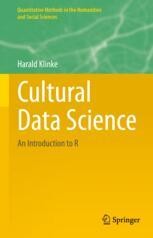
Thrilled to share that my book Cultural Data Science – An Introduction to R is finally out! A journey through digital methods, visual culture & data analysis—made for everyone exploring the intersection of humanities and code.
#DigitalHumanities #CulturalData #RStats #OpenScience

https://link.springer.com/book/10.1007/978-3-031-88130-5

SpringerLink

Cultural Data Science

This book introduces basic concepts in data science, drawing from contextual examples in art history, visual computing, cloud computing, and microservices
  • Copy link
  • Flag this post
  • Block
AI Channel boosted
Ingo Frommholz
Ingo Frommholz
@ingo@idf.social  ·  activity timestamp 22 hours ago

The growing crisis of “AI slop” that endangers scientific publishing.

#FakeScience #InformationOverload #AIEthics #ScientificIntegrity #ResearchQuality #PeerReview #AcademicPublishing #OpenScience #TrustInScience

https://www.theatlantic.com/science/2026/01/ai-slop-science-publishing/685704/

The Atlantic

Science Is Drowning in AI Slop

Peer review has met its match.
  • Copy link
  • Flag this post
  • Block
Ingo Frommholz
Ingo Frommholz
@ingo@idf.social  ·  activity timestamp 22 hours ago

The growing crisis of “AI slop” that endangers scientific publishing.

#FakeScience #InformationOverload #AIEthics #ScientificIntegrity #ResearchQuality #PeerReview #AcademicPublishing #OpenScience #TrustInScience

https://www.theatlantic.com/science/2026/01/ai-slop-science-publishing/685704/

The Atlantic

Science Is Drowning in AI Slop

Peer review has met its match.
  • Copy link
  • Flag this post
  • Block
Humanities Channel boosted
HERMES Datenkompetenzzentrum
@hermes_datenkompetenzzentrum@fedihum.org  ·  activity timestamp 23 hours ago

📣 Ergebnisse des HERMES- #Forschungsstudienprogramm am @ieg_mainz

Im Projekt „Machina Emblematica. Multimodal Information Retrieval Prototype for CH and DH“ wurde die digitale Edition von Camerarius’ Symbola et Emblemata (1668) besser zugänglich und explorierbar gemacht.

🤖 Highlights:
• Chatbot für die direkte Befragung von Emblemen
• Suche nach multimodalen Inhalten
• Weiterentwicklung bestehender DH-Lösungen

🥳 https://zenodo.org/records/17909191

#DigitalHumanities #RAG #OpenScience

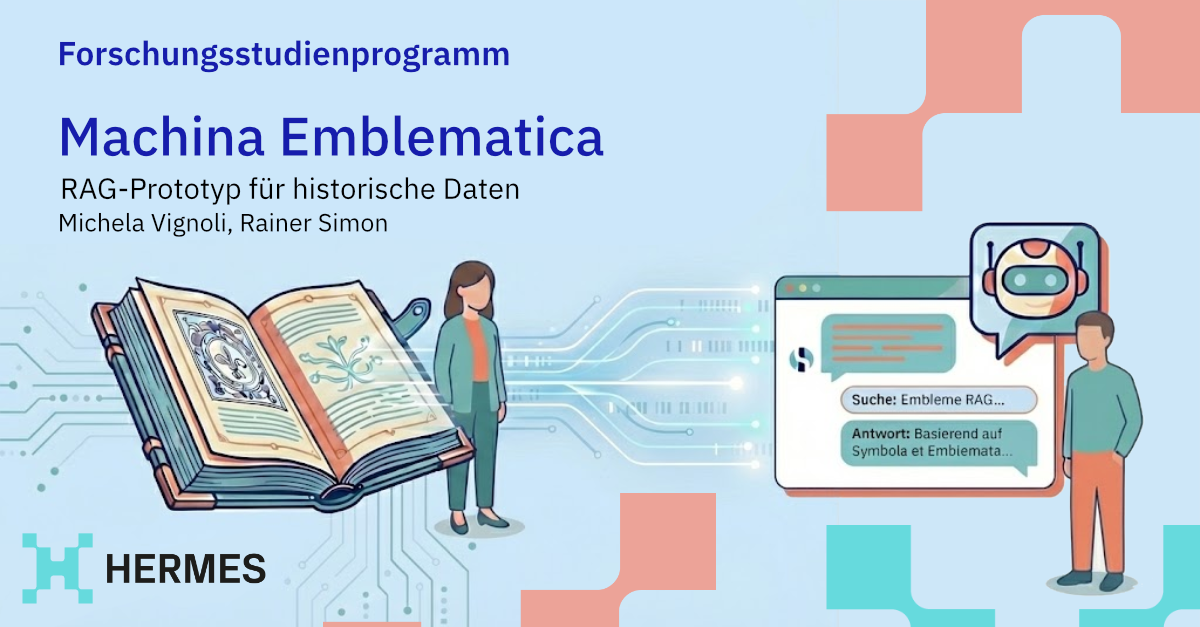
Grafik zur Publikation des Ergebnisses der Forschungsstudie „Machina Emblematica. Multimodal Information Retrieval Prototype for CH and DH“ aus dem HERMES-Forschungsstudienprogramm. Die Studie behandelt die Entwicklung eines RAG-Protoyps für historische Daten und wurde durchgeführt von Michela Vignoli und Rainer Simon. Grafisch steht eine Frau neben einem überdimensionalen geöffneten Buch und ein Mann neben einem Bildschirm, auf dem ein Chat-Bot symbolisiert wird.
Zenodo

Machina Emblematica: Multimodal Information Retrieval Prototype for CH and DH

The goal of Machina Emblematica was to implement a simple state of the art Retrieval Augmented Generation (RAG) system that makes the digital 1668 edition of Joachim Camerarius’ Symbola et Emblemata more accessible and explorable. The team published an innovative, user-friendly chatbot prototype that enables users to ask questions about the emblems and search for related contents in the Symbola et Emblemata. Machina Emblematica innovates access and exploration of the 17th century Latin emblems by providing an assistant that generates user query responses in English based on the most relevant multimodal content retrieved. The prototype advances existing solutions from projects enhancing accessibility and exploration of historical images and texts. This project was funded through the BMFTR joint project HERMES.
  • Copy link
  • Flag this post
  • Block
HERMES Datenkompetenzzentrum
@hermes_datenkompetenzzentrum@fedihum.org  ·  activity timestamp 23 hours ago

📣 Ergebnisse des HERMES- #Forschungsstudienprogramm am @ieg_mainz

Im Projekt „Machina Emblematica. Multimodal Information Retrieval Prototype for CH and DH“ wurde die digitale Edition von Camerarius’ Symbola et Emblemata (1668) besser zugänglich und explorierbar gemacht.

🤖 Highlights:
• Chatbot für die direkte Befragung von Emblemen
• Suche nach multimodalen Inhalten
• Weiterentwicklung bestehender DH-Lösungen

🥳 https://zenodo.org/records/17909191

#DigitalHumanities #RAG #OpenScience

Grafik zur Publikation des Ergebnisses der Forschungsstudie „Machina Emblematica. Multimodal Information Retrieval Prototype for CH and DH“ aus dem HERMES-Forschungsstudienprogramm. Die Studie behandelt die Entwicklung eines RAG-Protoyps für historische Daten und wurde durchgeführt von Michela Vignoli und Rainer Simon. Grafisch steht eine Frau neben einem überdimensionalen geöffneten Buch und ein Mann neben einem Bildschirm, auf dem ein Chat-Bot symbolisiert wird.
Zenodo

Machina Emblematica: Multimodal Information Retrieval Prototype for CH and DH

The goal of Machina Emblematica was to implement a simple state of the art Retrieval Augmented Generation (RAG) system that makes the digital 1668 edition of Joachim Camerarius’ Symbola et Emblemata more accessible and explorable. The team published an innovative, user-friendly chatbot prototype that enables users to ask questions about the emblems and search for related contents in the Symbola et Emblemata. Machina Emblematica innovates access and exploration of the 17th century Latin emblems by providing an assistant that generates user query responses in English based on the most relevant multimodal content retrieved. The prototype advances existing solutions from projects enhancing accessibility and exploration of historical images and texts. This project was funded through the BMFTR joint project HERMES.
  • Copy link
  • Flag this post
  • Block
Humanities Channel boosted
Digital History Berlin
@DigitalHistory@fedihum.org  ·  activity timestamp 24 hours ago

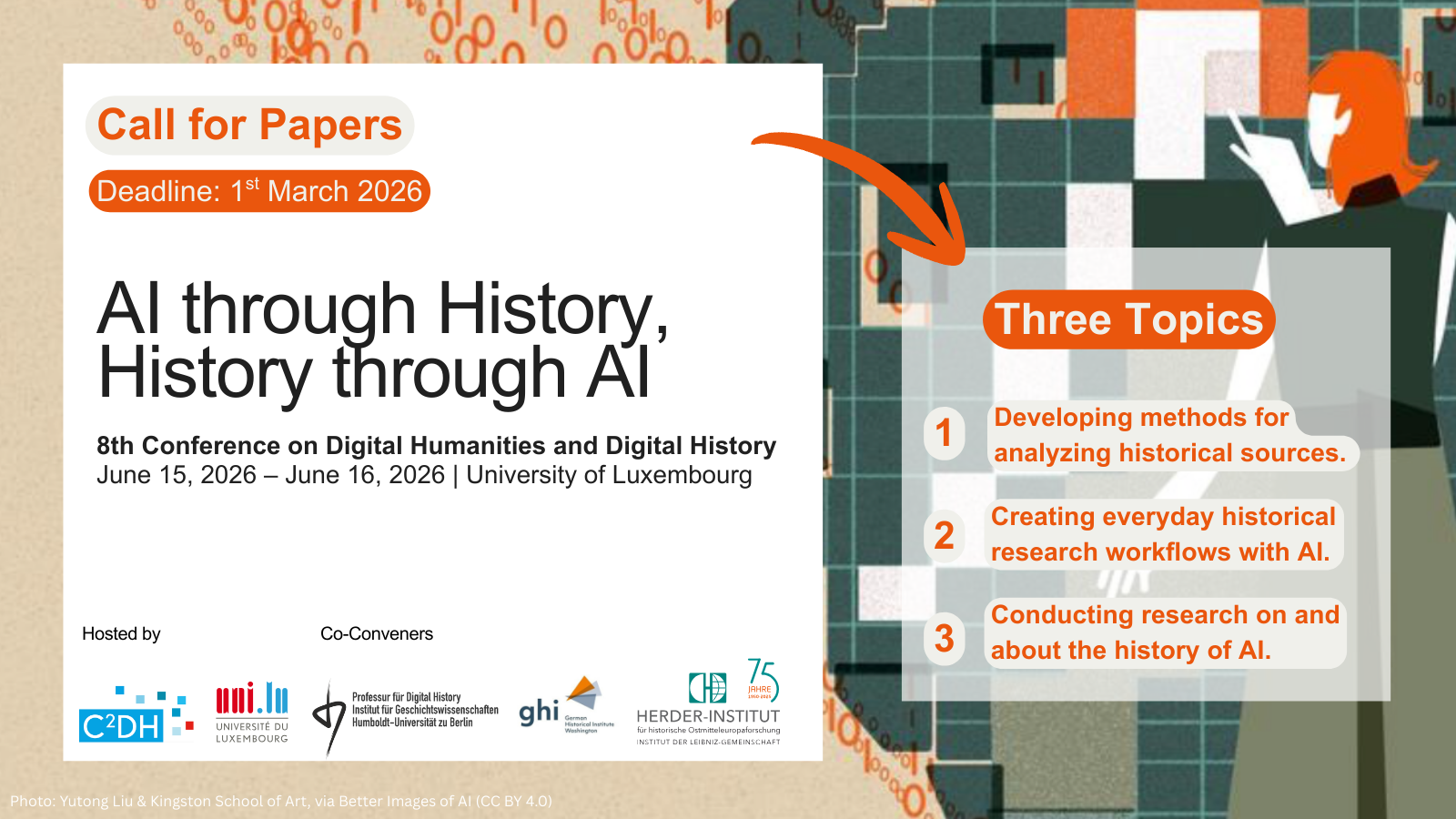
#CallforPapers: How is AI transforming historical practice—from methods and workflows to research questions?

The 8th Conference on #DigitalHumanities & #DigitalHistory, hosted by the Luxembourg Centre for Contemporary and Digital History (C²DH), University of Luxembourg, invites proposals for workshops (90 min) and lectures (20 min).

⏰ Deadline: 01.03.2026
📤 Abstract + CV
💻 Hybrid participation possible
🔗 Call: https://t1p.de/fdwc1

#OpenScience #KI #EarlyCareer #Dhd2026 #DH2026

Sorry, no caption provided by author
C2DH EN

CfP: AI through History, History through AI

The Eighth Conference on Digital Humanities and Digital History hosted by the C²DH in Belval will revolve around Artificial Intelligence in the historical disciplines.
  • Copy link
  • Flag this post
  • Block
Digital History Berlin
@DigitalHistory@fedihum.org  ·  activity timestamp 24 hours ago

#CallforPapers: How is AI transforming historical practice—from methods and workflows to research questions?

The 8th Conference on #DigitalHumanities & #DigitalHistory, hosted by the Luxembourg Centre for Contemporary and Digital History (C²DH), University of Luxembourg, invites proposals for workshops (90 min) and lectures (20 min).

⏰ Deadline: 01.03.2026
📤 Abstract + CV
💻 Hybrid participation possible
🔗 Call: https://t1p.de/fdwc1

#OpenScience #KI #EarlyCareer #Dhd2026 #DH2026

Sorry, no caption provided by author
C2DH EN

CfP: AI through History, History through AI

The Eighth Conference on Digital Humanities and Digital History hosted by the C²DH in Belval will revolve around Artificial Intelligence in the historical disciplines.
  • Copy link
  • Flag this post
  • Block
AI Channel boosted
Open Research DevRoom
@FosdemResearch@fosstodon.org  ·  activity timestamp 3 days ago

Eldar Kurtić will now present:

*Accelerating vLLM Inference with Quantization and Speculative Decoding*

https://fosdem.org/2026/schedule/event/WJUJ3R-accelerating_vllm_inference_with_quantization_and_speculative_decoding/

#LLM #FOSDEM #OpenScience

FOSDEM 2026 - Accelerating vLLM Inference with Quantization and Speculative Decoding

  • Copy link
  • Flag this post
  • Block
Open Research DevRoom
@FosdemResearch@fosstodon.org  ·  activity timestamp 3 days ago

Eldar Kurtić will now present:

*Accelerating vLLM Inference with Quantization and Speculative Decoding*

https://fosdem.org/2026/schedule/event/WJUJ3R-accelerating_vllm_inference_with_quantization_and_speculative_decoding/

#LLM #FOSDEM #OpenScience

FOSDEM 2026 - Accelerating vLLM Inference with Quantization and Speculative Decoding

  • Copy link
  • Flag this post
  • Block

Indieweb Studio

This is a relaxed, online social space for the indieweb community, brought to you by indieweb.social.

Please abide by our code of conduct and have a nice time!

Indieweb Studio: About · Code of conduct · Privacy · Users · Instances
Bonfire social · 1.0.2-alpha.7 no JS en
Automatic federation enabled
Log in Create account
  • Explore
  • About
  • Members
  • Code of Conduct