Discussion
Loading...

#Tag

Log in
  • Sign up
  • About
  • Code of conduct
  • Privacy
  • Users
  • Instances
  • About Bonfire
Photography Channel boosted
Dorothea Lange
Dorothea Lange
@DorotheaLange@mastodon.ozioso.online  ·  activity timestamp 2 days ago

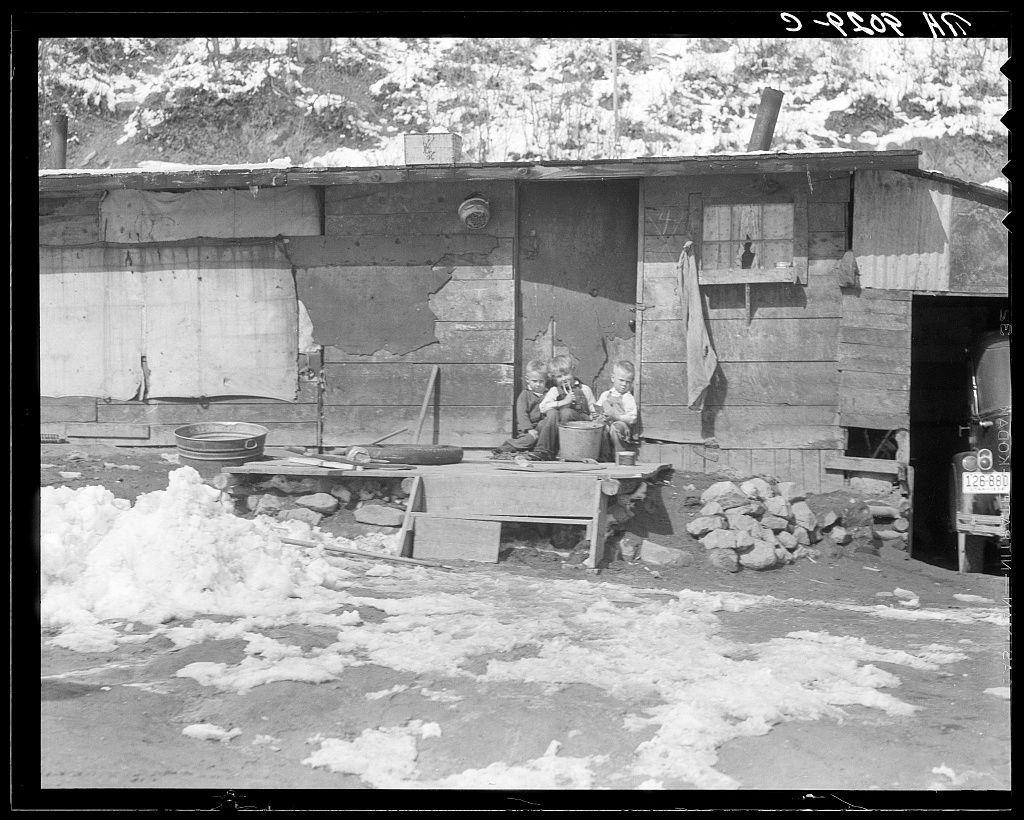
Miner's shack. Blue Blaze coal mine. Consumers, near Price, Utah

#Miner #BlueBlaze #Price #America #DorotheaLanges #NationalArchives #undefined #photography #DorotheaLange

https://www.loc.gov/pictures/item/2017762874/

The image depicts a black and white photograph of what appears to be an old, rustic shack or dwelling. The structure is made primarily from wood with visible cracks in the siding and boarded-up windows indicating it may have been abandoned or not maintained well. In front of this building, there are two children standing on a wooden platform; one holding something that looks like a tin can while the other seems to be interacting with an adult who sits nearby at another table.

A large pile of what could possibly be coal residue is seen in the foreground next to the shack, and scattered snow covers the ground around it. Behind this setting, trees are visible which suggest a rural or remote location. The overall scene gives off a sense of hardship and struggle typical during mining communities in late 19th-century America.

The photograph seems to be part of Dorothea Lange's work as indicated by her watermark on some images from the National Archives collection, specifically related to miners' shacks at Blue Blaze coal mine near Price, Utah.
The image depicts a black and white photograph of what appears to be an old, rustic shack or dwelling. The structure is made primarily from wood with visible cracks in the siding and boarded-up windows indicating it may have been abandoned or not maintained well. In front of this building, there are two children standing on a wooden platform; one holding something that looks like a tin can while the other seems to be interacting with an adult who sits nearby at another table. A large pile of what could possibly be coal residue is seen in the foreground next to the shack, and scattered snow covers the ground around it. Behind this setting, trees are visible which suggest a rural or remote location. The overall scene gives off a sense of hardship and struggle typical during mining communities in late 19th-century America. The photograph seems to be part of Dorothea Lange's work as indicated by her watermark on some images from the National Archives collection, specifically related to miners' shacks at Blue Blaze coal mine near Price, Utah.
  • Copy link
  • Flag this post
  • Block
Dorothea Lange
Dorothea Lange
@DorotheaLange@mastodon.ozioso.online  ·  activity timestamp 2 days ago

Miner's shack. Blue Blaze coal mine. Consumers, near Price, Utah

#Miner #BlueBlaze #Price #America #DorotheaLanges #NationalArchives #undefined #photography #DorotheaLange

https://www.loc.gov/pictures/item/2017762874/

The image depicts a black and white photograph of what appears to be an old, rustic shack or dwelling. The structure is made primarily from wood with visible cracks in the siding and boarded-up windows indicating it may have been abandoned or not maintained well. In front of this building, there are two children standing on a wooden platform; one holding something that looks like a tin can while the other seems to be interacting with an adult who sits nearby at another table.

A large pile of what could possibly be coal residue is seen in the foreground next to the shack, and scattered snow covers the ground around it. Behind this setting, trees are visible which suggest a rural or remote location. The overall scene gives off a sense of hardship and struggle typical during mining communities in late 19th-century America.

The photograph seems to be part of Dorothea Lange's work as indicated by her watermark on some images from the National Archives collection, specifically related to miners' shacks at Blue Blaze coal mine near Price, Utah.
The image depicts a black and white photograph of what appears to be an old, rustic shack or dwelling. The structure is made primarily from wood with visible cracks in the siding and boarded-up windows indicating it may have been abandoned or not maintained well. In front of this building, there are two children standing on a wooden platform; one holding something that looks like a tin can while the other seems to be interacting with an adult who sits nearby at another table. A large pile of what could possibly be coal residue is seen in the foreground next to the shack, and scattered snow covers the ground around it. Behind this setting, trees are visible which suggest a rural or remote location. The overall scene gives off a sense of hardship and struggle typical during mining communities in late 19th-century America. The photograph seems to be part of Dorothea Lange's work as indicated by her watermark on some images from the National Archives collection, specifically related to miners' shacks at Blue Blaze coal mine near Price, Utah.
  • Copy link
  • Flag this post
  • Block
Photography Channel boosted
Dorothea Lange
Dorothea Lange
@DorotheaLange@mastodon.ozioso.online  ·  activity timestamp 2 days ago

Consumers. Blue Blaze coal mine. Near Price, Utah

#BlueBlaze #BlueBlazeCoal #Price #DorotheaLanges #American #undefined #photography #DorotheaLange

https://www.loc.gov/pictures/item/2017762873/

The image is a black and white photograph depicting an industrial structure with the inscription "Blue Blaze Coal" on its side, indicating that it may be associated with coal mining activities. The building has multiple levels connected by elevated platforms or walkways. There are railcars parked underneath one of these structures, suggesting this site might have been used for loading or unloading materials from trains. In the background, a snowy mountainous landscape is visible under an overcast sky. This suggests that the mine could be located in a cold region where snowfall occurs frequently.

The photograph appears to capture a historical moment given its style and content. It's not possible to determine any specific individuals or events without additional context beyond what is depicted here, but it evokes images of industrial labor from an earlier period. The image might also serve as illustrative material for discussions on environmental history, coal mining operations, economic development in rural areas such as Price, Utah, and possibly the impact these industries had on local communities.

For more detailed information or to access higher-resolution versions of this photograph, one could refer to sources like Consumers. Blue Blaze coal mine. Near Price, Utah , which may provide further context about Dorothea Lange's work in documenting American industrial life  [...]
The image is a black and white photograph depicting an industrial structure with the inscription "Blue Blaze Coal" on its side, indicating that it may be associated with coal mining activities. The building has multiple levels connected by elevated platforms or walkways. There are railcars parked underneath one of these structures, suggesting this site might have been used for loading or unloading materials from trains. In the background, a snowy mountainous landscape is visible under an overcast sky. This suggests that the mine could be located in a cold region where snowfall occurs frequently. The photograph appears to capture a historical moment given its style and content. It's not possible to determine any specific individuals or events without additional context beyond what is depicted here, but it evokes images of industrial labor from an earlier period. The image might also serve as illustrative material for discussions on environmental history, coal mining operations, economic development in rural areas such as Price, Utah, and possibly the impact these industries had on local communities. For more detailed information or to access higher-resolution versions of this photograph, one could refer to sources like Consumers. Blue Blaze coal mine. Near Price, Utah , which may provide further context about Dorothea Lange's work in documenting American industrial life [...]
  • Copy link
  • Flag this post
  • Block
Dorothea Lange
Dorothea Lange
@DorotheaLange@mastodon.ozioso.online  ·  activity timestamp 2 days ago

Consumers. Blue Blaze coal mine. Near Price, Utah

#BlueBlaze #BlueBlazeCoal #Price #DorotheaLanges #American #undefined #photography #DorotheaLange

https://www.loc.gov/pictures/item/2017762873/

The image is a black and white photograph depicting an industrial structure with the inscription "Blue Blaze Coal" on its side, indicating that it may be associated with coal mining activities. The building has multiple levels connected by elevated platforms or walkways. There are railcars parked underneath one of these structures, suggesting this site might have been used for loading or unloading materials from trains. In the background, a snowy mountainous landscape is visible under an overcast sky. This suggests that the mine could be located in a cold region where snowfall occurs frequently.

The photograph appears to capture a historical moment given its style and content. It's not possible to determine any specific individuals or events without additional context beyond what is depicted here, but it evokes images of industrial labor from an earlier period. The image might also serve as illustrative material for discussions on environmental history, coal mining operations, economic development in rural areas such as Price, Utah, and possibly the impact these industries had on local communities.

For more detailed information or to access higher-resolution versions of this photograph, one could refer to sources like Consumers. Blue Blaze coal mine. Near Price, Utah , which may provide further context about Dorothea Lange's work in documenting American industrial life  [...]
The image is a black and white photograph depicting an industrial structure with the inscription "Blue Blaze Coal" on its side, indicating that it may be associated with coal mining activities. The building has multiple levels connected by elevated platforms or walkways. There are railcars parked underneath one of these structures, suggesting this site might have been used for loading or unloading materials from trains. In the background, a snowy mountainous landscape is visible under an overcast sky. This suggests that the mine could be located in a cold region where snowfall occurs frequently. The photograph appears to capture a historical moment given its style and content. It's not possible to determine any specific individuals or events without additional context beyond what is depicted here, but it evokes images of industrial labor from an earlier period. The image might also serve as illustrative material for discussions on environmental history, coal mining operations, economic development in rural areas such as Price, Utah, and possibly the impact these industries had on local communities. For more detailed information or to access higher-resolution versions of this photograph, one could refer to sources like Consumers. Blue Blaze coal mine. Near Price, Utah , which may provide further context about Dorothea Lange's work in documenting American industrial life [...]
  • Copy link
  • Flag this post
  • Block
Photography Channel boosted
Dorothea Lange
Dorothea Lange
@DorotheaLange@mastodon.ozioso.online  ·  activity timestamp 2 days ago

Utah coal miner. Consumers, near Price, Utah

#Price #Caucasian #DorotheaLanges #American #undefined #photography #DorotheaLange

https://www.loc.gov/pictures/item/2017762864/

The black and white photograph features a middle-aged Caucasian male standing in front of what appears to be part of heavy industrial machinery, potentially from the rail industry given its robust design. The man wears worn work clothes with significant patches on his jacket indicating frequent use; he has dirty hands and feet suggesting manual labor involvement. He's holding two items: one is an overturned metal bucket, typically used for carrying liquids or debris in mining operations, while the other appears to be a cylindrical object that might be part of machinery maintenance tools.

His clothing includes work boots with dirt stains, indicating recent outdoor activity likely involving physical tasks such as digging or heavy lifting. The background shows more industrial equipment and snowy ground, suggesting a cold environment possibly indicative of winter conditions in coal mining regions during the early 20th century when this photo was captured. His expression is neutral but attentive to something outside of the camera's view.

The visible part of machinery bears markings: "UNITED STATES SAFETY APPLIANCES STANDARD" and below it, "BUILT '19-17," hinting at its age (circa early 20th century) and suggesting a connection with safety protocols typical in mining operations during that era. The image's graininess is indicative of the photography techniques used before dig [...]
The black and white photograph features a middle-aged Caucasian male standing in front of what appears to be part of heavy industrial machinery, potentially from the rail industry given its robust design. The man wears worn work clothes with significant patches on his jacket indicating frequent use; he has dirty hands and feet suggesting manual labor involvement. He's holding two items: one is an overturned metal bucket, typically used for carrying liquids or debris in mining operations, while the other appears to be a cylindrical object that might be part of machinery maintenance tools. His clothing includes work boots with dirt stains, indicating recent outdoor activity likely involving physical tasks such as digging or heavy lifting. The background shows more industrial equipment and snowy ground, suggesting a cold environment possibly indicative of winter conditions in coal mining regions during the early 20th century when this photo was captured. His expression is neutral but attentive to something outside of the camera's view. The visible part of machinery bears markings: "UNITED STATES SAFETY APPLIANCES STANDARD" and below it, "BUILT '19-17," hinting at its age (circa early 20th century) and suggesting a connection with safety protocols typical in mining operations during that era. The image's graininess is indicative of the photography techniques used before dig [...]
  • Copy link
  • Flag this post
  • Block
Dorothea Lange
Dorothea Lange
@DorotheaLange@mastodon.ozioso.online  ·  activity timestamp 2 days ago

Utah coal miner. Consumers, near Price, Utah

#Price #Caucasian #DorotheaLanges #American #undefined #photography #DorotheaLange

https://www.loc.gov/pictures/item/2017762864/

The black and white photograph features a middle-aged Caucasian male standing in front of what appears to be part of heavy industrial machinery, potentially from the rail industry given its robust design. The man wears worn work clothes with significant patches on his jacket indicating frequent use; he has dirty hands and feet suggesting manual labor involvement. He's holding two items: one is an overturned metal bucket, typically used for carrying liquids or debris in mining operations, while the other appears to be a cylindrical object that might be part of machinery maintenance tools.

His clothing includes work boots with dirt stains, indicating recent outdoor activity likely involving physical tasks such as digging or heavy lifting. The background shows more industrial equipment and snowy ground, suggesting a cold environment possibly indicative of winter conditions in coal mining regions during the early 20th century when this photo was captured. His expression is neutral but attentive to something outside of the camera's view.

The visible part of machinery bears markings: "UNITED STATES SAFETY APPLIANCES STANDARD" and below it, "BUILT '19-17," hinting at its age (circa early 20th century) and suggesting a connection with safety protocols typical in mining operations during that era. The image's graininess is indicative of the photography techniques used before dig [...]
The black and white photograph features a middle-aged Caucasian male standing in front of what appears to be part of heavy industrial machinery, potentially from the rail industry given its robust design. The man wears worn work clothes with significant patches on his jacket indicating frequent use; he has dirty hands and feet suggesting manual labor involvement. He's holding two items: one is an overturned metal bucket, typically used for carrying liquids or debris in mining operations, while the other appears to be a cylindrical object that might be part of machinery maintenance tools. His clothing includes work boots with dirt stains, indicating recent outdoor activity likely involving physical tasks such as digging or heavy lifting. The background shows more industrial equipment and snowy ground, suggesting a cold environment possibly indicative of winter conditions in coal mining regions during the early 20th century when this photo was captured. His expression is neutral but attentive to something outside of the camera's view. The visible part of machinery bears markings: "UNITED STATES SAFETY APPLIANCES STANDARD" and below it, "BUILT '19-17," hinting at its age (circa early 20th century) and suggesting a connection with safety protocols typical in mining operations during that era. The image's graininess is indicative of the photography techniques used before dig [...]
  • Copy link
  • Flag this post
  • Block
Photography Channel boosted
Dorothea Lange
Dorothea Lange
@DorotheaLange@mastodon.ozioso.online  ·  activity timestamp 4 days ago

Oregon, Marion county, near West Stayton. Many children work in the bean harvest, as in the Oregon hop harvest. See "Pick for your supper." Sidel, Nation Child Labor Committee. General caption number 46

#Oregon #Marioncounty #WestStayton #Pickfor #DorotheaLanges #undefined #photography #DorotheaLange

https://www.loc.gov/pictures/item/2017772893/

The image is a black and white photograph showing an individual, possibly a young girl or woman, wearing a wide-brimmed straw hat with flowers tied around it. She has on a plaid shirt tucked into dark trousers, suggesting practical workwear suitable for outdoor labor. The person carries a large wooden bucket in one hand and appears to be standing amidst what looks like bean plants filled with beans ready for harvest, indicative of an agricultural setting.

The individual is smiling towards the camera, radiating positivity despite potentially strenuous activity. Her posture suggests she's taking a break or pausing momentarily from her work. The background is blurred but reveals more vegetation and possibly other crops, consistent with a farm environment during harvest season.

Additional context provided indicates that this scene likely takes place in Oregon, Marion county near West Stayton, where children commonly participate in the bean harvest like they do for hop fields as seen in "Pick for your supper." The image is associated with Dorothea Lange's work and carries a general caption number 46. This photograph may be part of her documentation on child labor conditions during that time period.

This setting highlights rural agricultural life, particularly the role women played in farming communities, reflecting historical aspects of farm work and family involvement in a [...]
The image is a black and white photograph showing an individual, possibly a young girl or woman, wearing a wide-brimmed straw hat with flowers tied around it. She has on a plaid shirt tucked into dark trousers, suggesting practical workwear suitable for outdoor labor. The person carries a large wooden bucket in one hand and appears to be standing amidst what looks like bean plants filled with beans ready for harvest, indicative of an agricultural setting. The individual is smiling towards the camera, radiating positivity despite potentially strenuous activity. Her posture suggests she's taking a break or pausing momentarily from her work. The background is blurred but reveals more vegetation and possibly other crops, consistent with a farm environment during harvest season. Additional context provided indicates that this scene likely takes place in Oregon, Marion county near West Stayton, where children commonly participate in the bean harvest like they do for hop fields as seen in "Pick for your supper." The image is associated with Dorothea Lange's work and carries a general caption number 46. This photograph may be part of her documentation on child labor conditions during that time period. This setting highlights rural agricultural life, particularly the role women played in farming communities, reflecting historical aspects of farm work and family involvement in a [...]
  • Copy link
  • Flag this post
  • Block
Dorothea Lange
Dorothea Lange
@DorotheaLange@mastodon.ozioso.online  ·  activity timestamp 4 days ago

Oregon, Marion county, near West Stayton. Many children work in the bean harvest, as in the Oregon hop harvest. See "Pick for your supper." Sidel, Nation Child Labor Committee. General caption number 46

#Oregon #Marioncounty #WestStayton #Pickfor #DorotheaLanges #undefined #photography #DorotheaLange

https://www.loc.gov/pictures/item/2017772893/

The image is a black and white photograph showing an individual, possibly a young girl or woman, wearing a wide-brimmed straw hat with flowers tied around it. She has on a plaid shirt tucked into dark trousers, suggesting practical workwear suitable for outdoor labor. The person carries a large wooden bucket in one hand and appears to be standing amidst what looks like bean plants filled with beans ready for harvest, indicative of an agricultural setting.

The individual is smiling towards the camera, radiating positivity despite potentially strenuous activity. Her posture suggests she's taking a break or pausing momentarily from her work. The background is blurred but reveals more vegetation and possibly other crops, consistent with a farm environment during harvest season.

Additional context provided indicates that this scene likely takes place in Oregon, Marion county near West Stayton, where children commonly participate in the bean harvest like they do for hop fields as seen in "Pick for your supper." The image is associated with Dorothea Lange's work and carries a general caption number 46. This photograph may be part of her documentation on child labor conditions during that time period.

This setting highlights rural agricultural life, particularly the role women played in farming communities, reflecting historical aspects of farm work and family involvement in a [...]
The image is a black and white photograph showing an individual, possibly a young girl or woman, wearing a wide-brimmed straw hat with flowers tied around it. She has on a plaid shirt tucked into dark trousers, suggesting practical workwear suitable for outdoor labor. The person carries a large wooden bucket in one hand and appears to be standing amidst what looks like bean plants filled with beans ready for harvest, indicative of an agricultural setting. The individual is smiling towards the camera, radiating positivity despite potentially strenuous activity. Her posture suggests she's taking a break or pausing momentarily from her work. The background is blurred but reveals more vegetation and possibly other crops, consistent with a farm environment during harvest season. Additional context provided indicates that this scene likely takes place in Oregon, Marion county near West Stayton, where children commonly participate in the bean harvest like they do for hop fields as seen in "Pick for your supper." The image is associated with Dorothea Lange's work and carries a general caption number 46. This photograph may be part of her documentation on child labor conditions during that time period. This setting highlights rural agricultural life, particularly the role women played in farming communities, reflecting historical aspects of farm work and family involvement in a [...]
  • Copy link
  • Flag this post
  • Block

Indieweb Studio

This is a relaxed, online social space for the indieweb community, brought to you by indieweb.social.

Please abide by our code of conduct and have a nice time!

Indieweb Studio: About · Code of conduct · Privacy · Users · Instances
Bonfire social · 1.0.2-alpha.7 no JS en
Automatic federation enabled
Log in Create account
  • Explore
  • About
  • Members
  • Code of Conduct