Discussion
Loading...

#Tag

Log in
  • Sign up
  • About
  • Code of conduct
  • Privacy
  • Users
  • Instances
  • About Bonfire
Photography Channel boosted
Lewis Hine
Lewis Hine
@LewisHine@mastodon.ozioso.online  ·  activity timestamp 7 hours ago

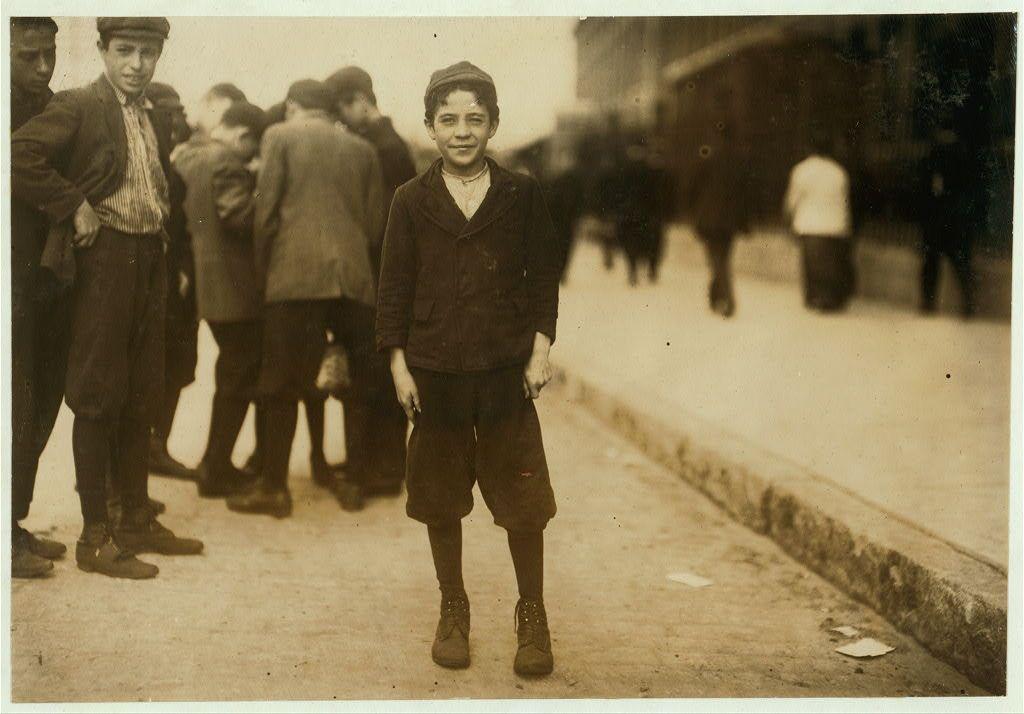
Sam Gangi, 82 Pleasant Valley St., Ayer Mill (See 2502). Location: Lawrence, Massachusetts.

#SamGangi #PleasantValleySt #AyerMill #Lawrence #Massachusetts #LewisHine’s #America #Photography #LewisHine #ChildLabour #ChildLabor

https://www.loc.gov/pictures/item/2018675388/

The image is a historical black and white photograph depicting multiple individuals standing on an outdoor street, with one central figure prominently in focus. The main subject appears to be a young boy dressed in dark clothing, including shorts, boots, and a coat, suggesting early 20th-century fashion for children. His attire looks worn but well-kept.

The background features several other people who seem to be engaged in casual conversation or waiting their turn; they are wearing coats and hats indicative of cold weather. The setting appears urban with cobblestone streets and buildings that have a historical architectural style, potentially from the early 1900s based on clothing styles and photographic quality.

There's an air of informality to the scene as people gather in groups or stand alone. Notably, there is no modern technology visible which supports its older time period setting. The image captures a candid moment that could be part of Lewis Hine’s work documenting child labor conditions during his tenure with the National Child Labor Committee.

The photograph conveys a sense of historical context regarding social history and urban life in early 20th-century America, specifically focusing on children's lives and experiences at that time.
The image is a historical black and white photograph depicting multiple individuals standing on an outdoor street, with one central figure prominently in focus. The main subject appears to be a young boy dressed in dark clothing, including shorts, boots, and a coat, suggesting early 20th-century fashion for children. His attire looks worn but well-kept. The background features several other people who seem to be engaged in casual conversation or waiting their turn; they are wearing coats and hats indicative of cold weather. The setting appears urban with cobblestone streets and buildings that have a historical architectural style, potentially from the early 1900s based on clothing styles and photographic quality. There's an air of informality to the scene as people gather in groups or stand alone. Notably, there is no modern technology visible which supports its older time period setting. The image captures a candid moment that could be part of Lewis Hine’s work documenting child labor conditions during his tenure with the National Child Labor Committee. The photograph conveys a sense of historical context regarding social history and urban life in early 20th-century America, specifically focusing on children's lives and experiences at that time.
  • Copy link
  • Flag this post
  • Block
Lewis Hine
Lewis Hine
@LewisHine@mastodon.ozioso.online  ·  activity timestamp 7 hours ago

Sam Gangi, 82 Pleasant Valley St., Ayer Mill (See 2502). Location: Lawrence, Massachusetts.

#SamGangi #PleasantValleySt #AyerMill #Lawrence #Massachusetts #LewisHine’s #America #Photography #LewisHine #ChildLabour #ChildLabor

https://www.loc.gov/pictures/item/2018675388/

The image is a historical black and white photograph depicting multiple individuals standing on an outdoor street, with one central figure prominently in focus. The main subject appears to be a young boy dressed in dark clothing, including shorts, boots, and a coat, suggesting early 20th-century fashion for children. His attire looks worn but well-kept.

The background features several other people who seem to be engaged in casual conversation or waiting their turn; they are wearing coats and hats indicative of cold weather. The setting appears urban with cobblestone streets and buildings that have a historical architectural style, potentially from the early 1900s based on clothing styles and photographic quality.

There's an air of informality to the scene as people gather in groups or stand alone. Notably, there is no modern technology visible which supports its older time period setting. The image captures a candid moment that could be part of Lewis Hine’s work documenting child labor conditions during his tenure with the National Child Labor Committee.

The photograph conveys a sense of historical context regarding social history and urban life in early 20th-century America, specifically focusing on children's lives and experiences at that time.
The image is a historical black and white photograph depicting multiple individuals standing on an outdoor street, with one central figure prominently in focus. The main subject appears to be a young boy dressed in dark clothing, including shorts, boots, and a coat, suggesting early 20th-century fashion for children. His attire looks worn but well-kept. The background features several other people who seem to be engaged in casual conversation or waiting their turn; they are wearing coats and hats indicative of cold weather. The setting appears urban with cobblestone streets and buildings that have a historical architectural style, potentially from the early 1900s based on clothing styles and photographic quality. There's an air of informality to the scene as people gather in groups or stand alone. Notably, there is no modern technology visible which supports its older time period setting. The image captures a candid moment that could be part of Lewis Hine’s work documenting child labor conditions during his tenure with the National Child Labor Committee. The photograph conveys a sense of historical context regarding social history and urban life in early 20th-century America, specifically focusing on children's lives and experiences at that time.
  • Copy link
  • Flag this post
  • Block
Photography Channel boosted
Sigmanphi
Sigmanphi
@sigmanphi.bsky.social@bsky.brid.gy  ·  activity timestamp 5 months ago

#photo #photography #photographers #art #picture #artwork #artists #designers #design #pics #photos #history #america #paint #painting #vr #vrchat #virtualreality

View
View
View
View
  • Copy link
  • Flag this post
  • Block
Photography Channel boosted
Lewis Hine
Lewis Hine
@LewisHine@mastodon.ozioso.online  ·  activity timestamp 19 hours ago

Joey Stubeck, five years old. Shucks some at Pass Christian. Location: Pass Christian, Mississippi.

#JoeyStubeck #PassChristian #Christian #Mississippi #LewisHine #America #Photography #LewisHine #ChildLabour #ChildLabor

https://www.loc.gov/pictures/item/2018675363/

The image is a sepia-toned vintage photograph featuring two young boys in an outdoor setting, possibly from the early 20th century. The boy standing in the center appears to be approximately five years old and wearing a striped shirt with rolled-up sleeves, dark trousers, shoes, and a flat cap. He stands upright with his hands by his sides and looks directly at the camera with a neutral expression.

In contrast, another young child is seated on the ground to the left side of the frame, partially out of focus, suggesting they might be looking away from or avoiding direct engagement with the photographer. The setting includes wooden structures that resemble old sheds or storage units lined up in rows along both sides, creating an alleyway effect.

The area between these wood-planked structures is uneven and appears to have debris scattered across it, indicative of a somewhat neglected environment. Natural light filters through gaps among the lines of wooden panels above them, indicating trees are present beyond this immediate setting but not directly visible within the frame.

Given context from the provided source link, it's likely that these boys were photographed by Lewis Hine for his work documenting child labor in America during the early 20th century. However, without specific photographic metadata or knowledge of individual subjects, any further details about their i [...]

The image is a sepia-toned vintage photograph featuring two young boys in an outdoor setting, possibly from the early 20th century. The boy standing in the center appears to be approximately five years old and wearing a striped shirt with rolled-up sleeves, dark trousers, shoes, and a flat cap. He stands upright with his hands by his sides and looks directly at the camera with a neutral expression. In contrast, another young child is seated on the ground to the left side of the frame, partially out of focus, suggesting they might be looking away from or avoiding direct engagement with the photographer. The setting includes wooden structures that resemble old sheds or storage units lined up in rows along both sides, creating an alleyway effect. The area between these wood-planked structures is uneven and appears to have debris scattered across it, indicative of a somewhat neglected environment. Natural light filters through gaps among the lines of wooden panels above them, indicating trees are present beyond this immediate setting but not directly visible within the frame. Given context from the provided source link, it's likely that these boys were photographed by Lewis Hine for his work documenting child labor in America during the early 20th century. However, without specific photographic metadata or knowledge of individual subjects, any further details about their i [...]
  • Copy link
  • Flag this post
  • Block
Lewis Hine
Lewis Hine
@LewisHine@mastodon.ozioso.online  ·  activity timestamp 19 hours ago

Joey Stubeck, five years old. Shucks some at Pass Christian. Location: Pass Christian, Mississippi.

#JoeyStubeck #PassChristian #Christian #Mississippi #LewisHine #America #Photography #LewisHine #ChildLabour #ChildLabor

https://www.loc.gov/pictures/item/2018675363/

The image is a sepia-toned vintage photograph featuring two young boys in an outdoor setting, possibly from the early 20th century. The boy standing in the center appears to be approximately five years old and wearing a striped shirt with rolled-up sleeves, dark trousers, shoes, and a flat cap. He stands upright with his hands by his sides and looks directly at the camera with a neutral expression.

In contrast, another young child is seated on the ground to the left side of the frame, partially out of focus, suggesting they might be looking away from or avoiding direct engagement with the photographer. The setting includes wooden structures that resemble old sheds or storage units lined up in rows along both sides, creating an alleyway effect.

The area between these wood-planked structures is uneven and appears to have debris scattered across it, indicative of a somewhat neglected environment. Natural light filters through gaps among the lines of wooden panels above them, indicating trees are present beyond this immediate setting but not directly visible within the frame.

Given context from the provided source link, it's likely that these boys were photographed by Lewis Hine for his work documenting child labor in America during the early 20th century. However, without specific photographic metadata or knowledge of individual subjects, any further details about their i [...]
The image is a sepia-toned vintage photograph featuring two young boys in an outdoor setting, possibly from the early 20th century. The boy standing in the center appears to be approximately five years old and wearing a striped shirt with rolled-up sleeves, dark trousers, shoes, and a flat cap. He stands upright with his hands by his sides and looks directly at the camera with a neutral expression. In contrast, another young child is seated on the ground to the left side of the frame, partially out of focus, suggesting they might be looking away from or avoiding direct engagement with the photographer. The setting includes wooden structures that resemble old sheds or storage units lined up in rows along both sides, creating an alleyway effect. The area between these wood-planked structures is uneven and appears to have debris scattered across it, indicative of a somewhat neglected environment. Natural light filters through gaps among the lines of wooden panels above them, indicating trees are present beyond this immediate setting but not directly visible within the frame. Given context from the provided source link, it's likely that these boys were photographed by Lewis Hine for his work documenting child labor in America during the early 20th century. However, without specific photographic metadata or knowledge of individual subjects, any further details about their i [...]
  • Copy link
  • Flag this post
  • Block
Photography Channel boosted
Dorothea Lange
Dorothea Lange
@DorotheaLange@mastodon.ozioso.online  ·  activity timestamp yesterday

Consumers, near Price, Utah. Company housing in coal town

#Price #DorotheaLange #American #America #Lange #undefined #photography #DorotheaLange

https://www.loc.gov/pictures/item/2017762881/

The image is a black and white photograph depicting an impoverished rural area covered in snow. The landscape shows barren trees with no leaves, indicative of winter or early spring conditions, scattered across the hillside behind some dilapidated wooden structures that appear to be small cabins or houses. In the foreground, there's a mound of freshly plowed snow leading towards these buildings. A rough fence made up of tree branches runs along one side of the scene, separating it from an area with more cluttered vegetation and possibly abandoned household items like barrels.

The terrain is uneven and unkempt, suggesting neglect or disuse. There are no visible signs of modern amenities such as roads, electricity lines, or vehicles, which may suggest a remote location that's not well connected to urban infrastructure. The photograph seems aged due to its monochromatic quality and the condition of both natural elements (snow) and man-made structures.

Atop the image is handwritten text "STOP" in large letters followed by what appears to be illegible shorthand or code, possibly indicating a note left for someone associated with photography equipment used during travels. The overall atmosphere conveyed is one of desolation and hardship, likely capturing conditions experienced within rural mining communities like those found around Price, Utah.

In terms of historical context [...]
The image is a black and white photograph depicting an impoverished rural area covered in snow. The landscape shows barren trees with no leaves, indicative of winter or early spring conditions, scattered across the hillside behind some dilapidated wooden structures that appear to be small cabins or houses. In the foreground, there's a mound of freshly plowed snow leading towards these buildings. A rough fence made up of tree branches runs along one side of the scene, separating it from an area with more cluttered vegetation and possibly abandoned household items like barrels. The terrain is uneven and unkempt, suggesting neglect or disuse. There are no visible signs of modern amenities such as roads, electricity lines, or vehicles, which may suggest a remote location that's not well connected to urban infrastructure. The photograph seems aged due to its monochromatic quality and the condition of both natural elements (snow) and man-made structures. Atop the image is handwritten text "STOP" in large letters followed by what appears to be illegible shorthand or code, possibly indicating a note left for someone associated with photography equipment used during travels. The overall atmosphere conveyed is one of desolation and hardship, likely capturing conditions experienced within rural mining communities like those found around Price, Utah. In terms of historical context [...]
  • Copy link
  • Flag this post
  • Block
Dorothea Lange
Dorothea Lange
@DorotheaLange@mastodon.ozioso.online  ·  activity timestamp yesterday

Consumers, near Price, Utah. Company housing in coal town

#Price #DorotheaLange #American #America #Lange #undefined #photography #DorotheaLange

https://www.loc.gov/pictures/item/2017762881/

The image is a black and white photograph depicting an impoverished rural area covered in snow. The landscape shows barren trees with no leaves, indicative of winter or early spring conditions, scattered across the hillside behind some dilapidated wooden structures that appear to be small cabins or houses. In the foreground, there's a mound of freshly plowed snow leading towards these buildings. A rough fence made up of tree branches runs along one side of the scene, separating it from an area with more cluttered vegetation and possibly abandoned household items like barrels.

The terrain is uneven and unkempt, suggesting neglect or disuse. There are no visible signs of modern amenities such as roads, electricity lines, or vehicles, which may suggest a remote location that's not well connected to urban infrastructure. The photograph seems aged due to its monochromatic quality and the condition of both natural elements (snow) and man-made structures.

Atop the image is handwritten text "STOP" in large letters followed by what appears to be illegible shorthand or code, possibly indicating a note left for someone associated with photography equipment used during travels. The overall atmosphere conveyed is one of desolation and hardship, likely capturing conditions experienced within rural mining communities like those found around Price, Utah.

In terms of historical context [...]
The image is a black and white photograph depicting an impoverished rural area covered in snow. The landscape shows barren trees with no leaves, indicative of winter or early spring conditions, scattered across the hillside behind some dilapidated wooden structures that appear to be small cabins or houses. In the foreground, there's a mound of freshly plowed snow leading towards these buildings. A rough fence made up of tree branches runs along one side of the scene, separating it from an area with more cluttered vegetation and possibly abandoned household items like barrels. The terrain is uneven and unkempt, suggesting neglect or disuse. There are no visible signs of modern amenities such as roads, electricity lines, or vehicles, which may suggest a remote location that's not well connected to urban infrastructure. The photograph seems aged due to its monochromatic quality and the condition of both natural elements (snow) and man-made structures. Atop the image is handwritten text "STOP" in large letters followed by what appears to be illegible shorthand or code, possibly indicating a note left for someone associated with photography equipment used during travels. The overall atmosphere conveyed is one of desolation and hardship, likely capturing conditions experienced within rural mining communities like those found around Price, Utah. In terms of historical context [...]
  • Copy link
  • Flag this post
  • Block
Photography Channel boosted
Dorothea Lange
Dorothea Lange
@DorotheaLange@mastodon.ozioso.online  ·  activity timestamp yesterday

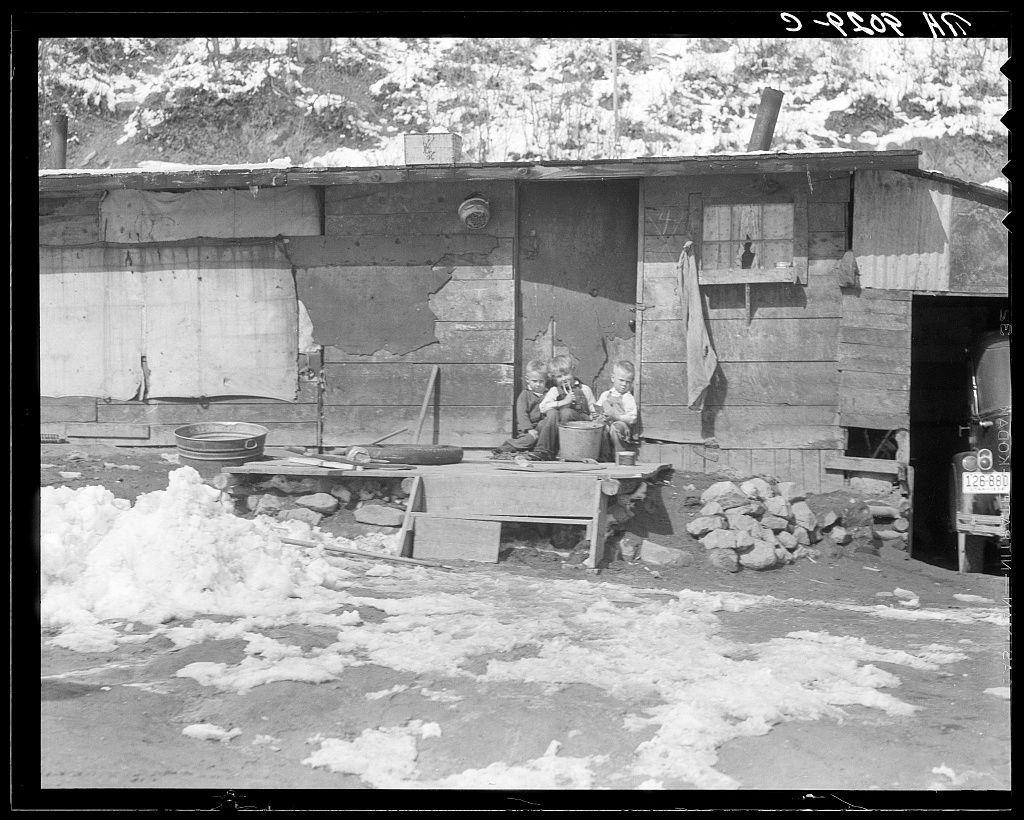
Miner's shack. Blue Blaze coal mine. Consumers, near Price, Utah

#Miner #BlueBlaze #Price #America #DorotheaLanges #NationalArchives #undefined #photography #DorotheaLange

https://www.loc.gov/pictures/item/2017762874/

The image depicts a black and white photograph of what appears to be an old, rustic shack or dwelling. The structure is made primarily from wood with visible cracks in the siding and boarded-up windows indicating it may have been abandoned or not maintained well. In front of this building, there are two children standing on a wooden platform; one holding something that looks like a tin can while the other seems to be interacting with an adult who sits nearby at another table.

A large pile of what could possibly be coal residue is seen in the foreground next to the shack, and scattered snow covers the ground around it. Behind this setting, trees are visible which suggest a rural or remote location. The overall scene gives off a sense of hardship and struggle typical during mining communities in late 19th-century America.

The photograph seems to be part of Dorothea Lange's work as indicated by her watermark on some images from the National Archives collection, specifically related to miners' shacks at Blue Blaze coal mine near Price, Utah.
The image depicts a black and white photograph of what appears to be an old, rustic shack or dwelling. The structure is made primarily from wood with visible cracks in the siding and boarded-up windows indicating it may have been abandoned or not maintained well. In front of this building, there are two children standing on a wooden platform; one holding something that looks like a tin can while the other seems to be interacting with an adult who sits nearby at another table. A large pile of what could possibly be coal residue is seen in the foreground next to the shack, and scattered snow covers the ground around it. Behind this setting, trees are visible which suggest a rural or remote location. The overall scene gives off a sense of hardship and struggle typical during mining communities in late 19th-century America. The photograph seems to be part of Dorothea Lange's work as indicated by her watermark on some images from the National Archives collection, specifically related to miners' shacks at Blue Blaze coal mine near Price, Utah.
  • Copy link
  • Flag this post
  • Block
Dorothea Lange
Dorothea Lange
@DorotheaLange@mastodon.ozioso.online  ·  activity timestamp yesterday

Miner's shack. Blue Blaze coal mine. Consumers, near Price, Utah

#Miner #BlueBlaze #Price #America #DorotheaLanges #NationalArchives #undefined #photography #DorotheaLange

https://www.loc.gov/pictures/item/2017762874/

The image depicts a black and white photograph of what appears to be an old, rustic shack or dwelling. The structure is made primarily from wood with visible cracks in the siding and boarded-up windows indicating it may have been abandoned or not maintained well. In front of this building, there are two children standing on a wooden platform; one holding something that looks like a tin can while the other seems to be interacting with an adult who sits nearby at another table.

A large pile of what could possibly be coal residue is seen in the foreground next to the shack, and scattered snow covers the ground around it. Behind this setting, trees are visible which suggest a rural or remote location. The overall scene gives off a sense of hardship and struggle typical during mining communities in late 19th-century America.

The photograph seems to be part of Dorothea Lange's work as indicated by her watermark on some images from the National Archives collection, specifically related to miners' shacks at Blue Blaze coal mine near Price, Utah.
The image depicts a black and white photograph of what appears to be an old, rustic shack or dwelling. The structure is made primarily from wood with visible cracks in the siding and boarded-up windows indicating it may have been abandoned or not maintained well. In front of this building, there are two children standing on a wooden platform; one holding something that looks like a tin can while the other seems to be interacting with an adult who sits nearby at another table. A large pile of what could possibly be coal residue is seen in the foreground next to the shack, and scattered snow covers the ground around it. Behind this setting, trees are visible which suggest a rural or remote location. The overall scene gives off a sense of hardship and struggle typical during mining communities in late 19th-century America. The photograph seems to be part of Dorothea Lange's work as indicated by her watermark on some images from the National Archives collection, specifically related to miners' shacks at Blue Blaze coal mine near Price, Utah.
  • Copy link
  • Flag this post
  • Block
Photography Channel boosted
Lewis Hine
Lewis Hine
@LewisHine@mastodon.ozioso.online  ·  activity timestamp yesterday

Noon hour, Holden-Leonard Co., Bennington, Vt. Some of the youngsters working there. Work was slack, and the force small. Bennington, Vermont.

#Holden-LeonardCo #Bennington #Vermont #second #third #LewisHine #America #Photography #LewisHine #ChildLabour #ChildLabor

https://www.loc.gov/pictures/item/2018675343/

The image is a historical black-and-white photograph depicting six individuals standing at the entrance of what appears to be an old brick building. The group consists of three boys and three girls, all dressed in early 20th-century attire indicative of rural or working-class families from that era.

From left to right: 
- A young boy wearing a dark jacket with rolled-up sleeves, trousers, shoes, and a cap stands against the wall.
- Next is another male child with short hair, crossed arms, smiling slightly. He wears a coat, boots, and seems in a relaxed posture.
- The second girl from left has her hands on hips, dressed in an apron over a dark skirt and blouse; she sports a boyish haircut typical for the time.

In contrast to these three children:
The group's composition features two older girls with their arms around each other. They wear modest dresses: one is wrapped up in suspenders under her outfit while holding what seems like a basket, indicating some work or domestic activity.
- The third girl stands slightly apart from them, dressed similarly but without the apron.

Their poses and attire suggest they are part of an extended family unit with children who may be working. In the backdrop is ivy-covered brickwork that adds to the quaintness of this snapshot in time which captures a moment likely during 'Noon Hour' as mentioned in Noon hour, Holden-Leonard Co., Benni [...]
The image is a historical black-and-white photograph depicting six individuals standing at the entrance of what appears to be an old brick building. The group consists of three boys and three girls, all dressed in early 20th-century attire indicative of rural or working-class families from that era. From left to right: - A young boy wearing a dark jacket with rolled-up sleeves, trousers, shoes, and a cap stands against the wall. - Next is another male child with short hair, crossed arms, smiling slightly. He wears a coat, boots, and seems in a relaxed posture. - The second girl from left has her hands on hips, dressed in an apron over a dark skirt and blouse; she sports a boyish haircut typical for the time. In contrast to these three children: The group's composition features two older girls with their arms around each other. They wear modest dresses: one is wrapped up in suspenders under her outfit while holding what seems like a basket, indicating some work or domestic activity. - The third girl stands slightly apart from them, dressed similarly but without the apron. Their poses and attire suggest they are part of an extended family unit with children who may be working. In the backdrop is ivy-covered brickwork that adds to the quaintness of this snapshot in time which captures a moment likely during 'Noon Hour' as mentioned in Noon hour, Holden-Leonard Co., Benni [...]
  • Copy link
  • Flag this post
  • Block
Lewis Hine
Lewis Hine
@LewisHine@mastodon.ozioso.online  ·  activity timestamp yesterday

Noon hour, Holden-Leonard Co., Bennington, Vt. Some of the youngsters working there. Work was slack, and the force small. Bennington, Vermont.

#Holden-LeonardCo #Bennington #Vermont #second #third #LewisHine #America #Photography #LewisHine #ChildLabour #ChildLabor

https://www.loc.gov/pictures/item/2018675343/

The image is a historical black-and-white photograph depicting six individuals standing at the entrance of what appears to be an old brick building. The group consists of three boys and three girls, all dressed in early 20th-century attire indicative of rural or working-class families from that era.

From left to right: 
- A young boy wearing a dark jacket with rolled-up sleeves, trousers, shoes, and a cap stands against the wall.
- Next is another male child with short hair, crossed arms, smiling slightly. He wears a coat, boots, and seems in a relaxed posture.
- The second girl from left has her hands on hips, dressed in an apron over a dark skirt and blouse; she sports a boyish haircut typical for the time.

In contrast to these three children:
The group's composition features two older girls with their arms around each other. They wear modest dresses: one is wrapped up in suspenders under her outfit while holding what seems like a basket, indicating some work or domestic activity.
- The third girl stands slightly apart from them, dressed similarly but without the apron.

Their poses and attire suggest they are part of an extended family unit with children who may be working. In the backdrop is ivy-covered brickwork that adds to the quaintness of this snapshot in time which captures a moment likely during 'Noon Hour' as mentioned in Noon hour, Holden-Leonard Co., Benni [...]
The image is a historical black-and-white photograph depicting six individuals standing at the entrance of what appears to be an old brick building. The group consists of three boys and three girls, all dressed in early 20th-century attire indicative of rural or working-class families from that era. From left to right: - A young boy wearing a dark jacket with rolled-up sleeves, trousers, shoes, and a cap stands against the wall. - Next is another male child with short hair, crossed arms, smiling slightly. He wears a coat, boots, and seems in a relaxed posture. - The second girl from left has her hands on hips, dressed in an apron over a dark skirt and blouse; she sports a boyish haircut typical for the time. In contrast to these three children: The group's composition features two older girls with their arms around each other. They wear modest dresses: one is wrapped up in suspenders under her outfit while holding what seems like a basket, indicating some work or domestic activity. - The third girl stands slightly apart from them, dressed similarly but without the apron. Their poses and attire suggest they are part of an extended family unit with children who may be working. In the backdrop is ivy-covered brickwork that adds to the quaintness of this snapshot in time which captures a moment likely during 'Noon Hour' as mentioned in Noon hour, Holden-Leonard Co., Benni [...]
  • Copy link
  • Flag this post
  • Block
Photography Channel boosted
Dorothea Lange
Dorothea Lange
@DorotheaLange@mastodon.ozioso.online  ·  activity timestamp 2 days ago

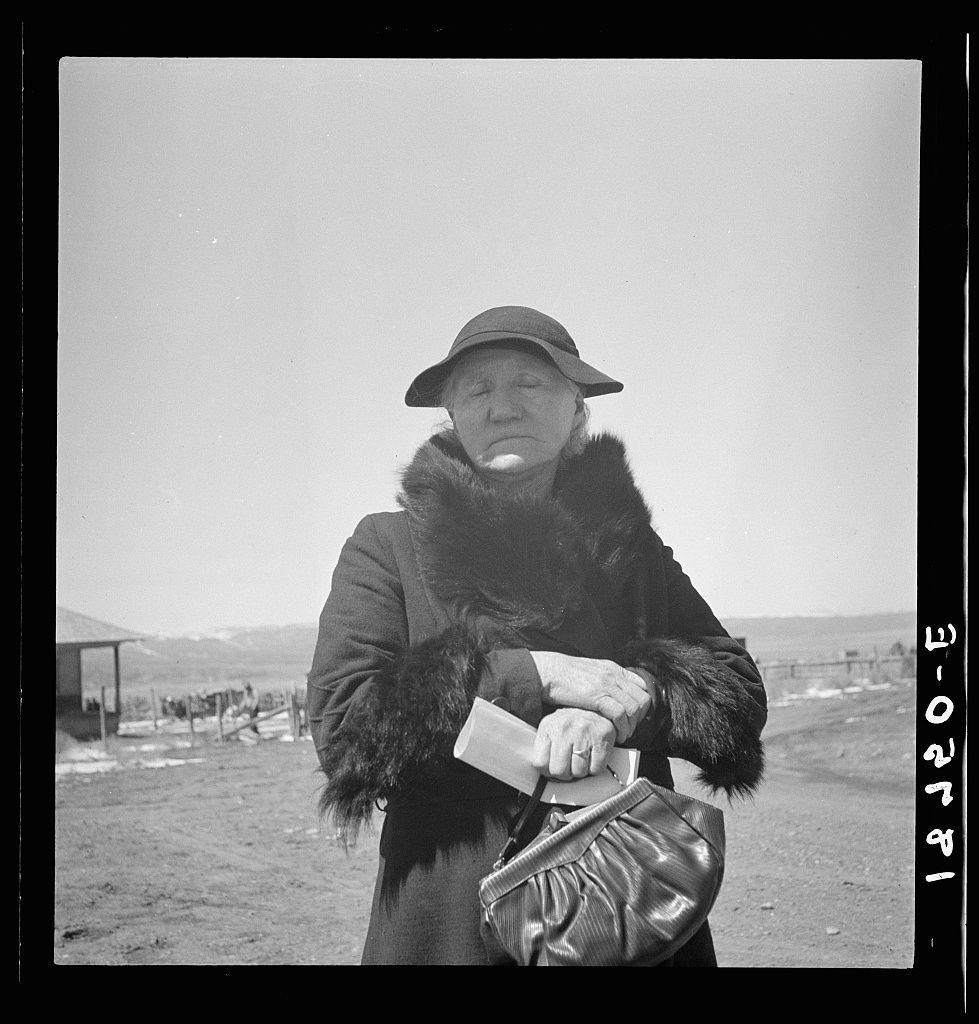
Widtsoe, Utah. Morman i.e. Mormon woman, native of Denmark, receiving her first old age assistance check

#Widtsoe #Morman #Mormon #Denmark #first #DorotheaLange #FranklinDRoosevelts #America #undefined #photography #DorotheaLange

https://www.loc.gov/pictures/item/2017771146/

The image is a black and white photograph depicting an elderly woman standing outdoors. She wears a dark coat adorned with fur trim, including the collar and cuffs, suggesting cold weather attire typical of early to mid-20th century fashion. The woman has her eyes closed or squinting slightly, appears in profile view from behind a barrier such as a gate or fence, which is visible extending into the distance on both sides.
She wears a broad-brimmed hat and carries two items: one small object tucked under her arm that could be money or another item of interest to her, and a shiny leather handbag with noticeable stitching. The setting looks barren; there's an open field behind her with faint outlines suggesting farm structures like sheds in the distance.
The image has visible textual metadata overlays indicating it was taken on April 12th at Widtsoe, Utah by Dorothea Lange for the Farm Security Administration (FSA), a program of the U.S. Department of Agriculture during Franklin D. Roosevelt's New Deal initiative. The photo captures an everyday moment with historical context related to social security and rural life in America during that era.
The image is a black and white photograph depicting an elderly woman standing outdoors. She wears a dark coat adorned with fur trim, including the collar and cuffs, suggesting cold weather attire typical of early to mid-20th century fashion. The woman has her eyes closed or squinting slightly, appears in profile view from behind a barrier such as a gate or fence, which is visible extending into the distance on both sides. She wears a broad-brimmed hat and carries two items: one small object tucked under her arm that could be money or another item of interest to her, and a shiny leather handbag with noticeable stitching. The setting looks barren; there's an open field behind her with faint outlines suggesting farm structures like sheds in the distance. The image has visible textual metadata overlays indicating it was taken on April 12th at Widtsoe, Utah by Dorothea Lange for the Farm Security Administration (FSA), a program of the U.S. Department of Agriculture during Franklin D. Roosevelt's New Deal initiative. The photo captures an everyday moment with historical context related to social security and rural life in America during that era.
  • Copy link
  • Flag this post
  • Block
Dorothea Lange
Dorothea Lange
@DorotheaLange@mastodon.ozioso.online  ·  activity timestamp 2 days ago

Widtsoe, Utah. Morman i.e. Mormon woman, native of Denmark, receiving her first old age assistance check

#Widtsoe #Morman #Mormon #Denmark #first #DorotheaLange #FranklinDRoosevelts #America #undefined #photography #DorotheaLange

https://www.loc.gov/pictures/item/2017771146/

The image is a black and white photograph depicting an elderly woman standing outdoors. She wears a dark coat adorned with fur trim, including the collar and cuffs, suggesting cold weather attire typical of early to mid-20th century fashion. The woman has her eyes closed or squinting slightly, appears in profile view from behind a barrier such as a gate or fence, which is visible extending into the distance on both sides.
She wears a broad-brimmed hat and carries two items: one small object tucked under her arm that could be money or another item of interest to her, and a shiny leather handbag with noticeable stitching. The setting looks barren; there's an open field behind her with faint outlines suggesting farm structures like sheds in the distance.
The image has visible textual metadata overlays indicating it was taken on April 12th at Widtsoe, Utah by Dorothea Lange for the Farm Security Administration (FSA), a program of the U.S. Department of Agriculture during Franklin D. Roosevelt's New Deal initiative. The photo captures an everyday moment with historical context related to social security and rural life in America during that era.
The image is a black and white photograph depicting an elderly woman standing outdoors. She wears a dark coat adorned with fur trim, including the collar and cuffs, suggesting cold weather attire typical of early to mid-20th century fashion. The woman has her eyes closed or squinting slightly, appears in profile view from behind a barrier such as a gate or fence, which is visible extending into the distance on both sides. She wears a broad-brimmed hat and carries two items: one small object tucked under her arm that could be money or another item of interest to her, and a shiny leather handbag with noticeable stitching. The setting looks barren; there's an open field behind her with faint outlines suggesting farm structures like sheds in the distance. The image has visible textual metadata overlays indicating it was taken on April 12th at Widtsoe, Utah by Dorothea Lange for the Farm Security Administration (FSA), a program of the U.S. Department of Agriculture during Franklin D. Roosevelt's New Deal initiative. The photo captures an everyday moment with historical context related to social security and rural life in America during that era.
  • Copy link
  • Flag this post
  • Block
Photography Channel boosted
Dorothea Lange
Dorothea Lange
@DorotheaLange@mastodon.ozioso.online  ·  activity timestamp 2 days ago

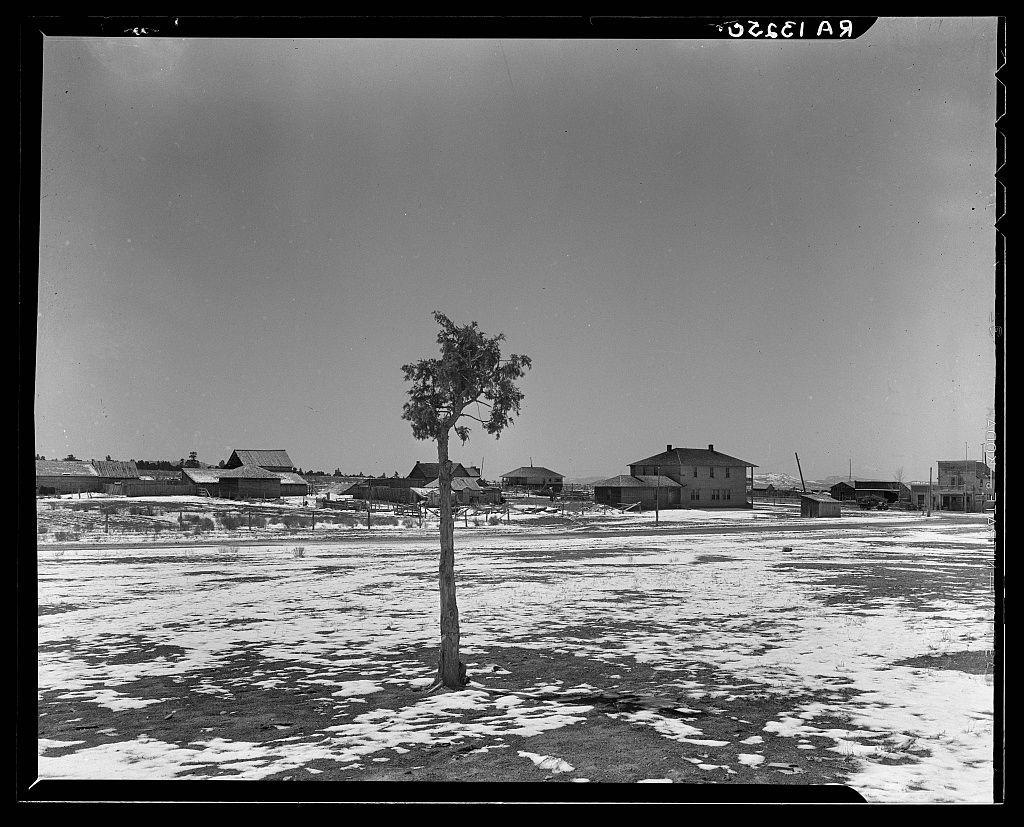
The town of Widtsoe, Utah

#Widtsoe #America #DorotheaLange #undefined #photography #DorotheaLange

https://www.loc.gov/pictures/item/2017759435/

The black and white photograph shows a landscape with sparse snow patches on the ground, indicating early spring or late winter. A lone tree stands prominently in the foreground of an otherwise open area that looks like it could be fields or undeveloped land. In the background is what appears to be a rural community with several farm-like structures such as barns and houses scattered across the scene under a clear sky. The town's name, Widtsoe, Utah, suggests this image might have historical significance related to agricultural life in that region during early 20th century America when Dorothea Lange photographed it for her work documenting rural communities and social issues of the time through the Farm Security Administration (FSA).
  • Copy link
  • Flag this post
  • Block
Dorothea Lange
Dorothea Lange
@DorotheaLange@mastodon.ozioso.online  ·  activity timestamp 2 days ago

The town of Widtsoe, Utah

#Widtsoe #America #DorotheaLange #undefined #photography #DorotheaLange

https://www.loc.gov/pictures/item/2017759435/

The black and white photograph shows a landscape with sparse snow patches on the ground, indicating early spring or late winter. A lone tree stands prominently in the foreground of an otherwise open area that looks like it could be fields or undeveloped land. In the background is what appears to be a rural community with several farm-like structures such as barns and houses scattered across the scene under a clear sky. The town's name, Widtsoe, Utah, suggests this image might have historical significance related to agricultural life in that region during early 20th century America when Dorothea Lange photographed it for her work documenting rural communities and social issues of the time through the Farm Security Administration (FSA).
  • Copy link
  • Flag this post
  • Block
Photography Channel boosted
Dorothea Lange
Dorothea Lange
@DorotheaLange@mastodon.ozioso.online  ·  activity timestamp 2 days ago

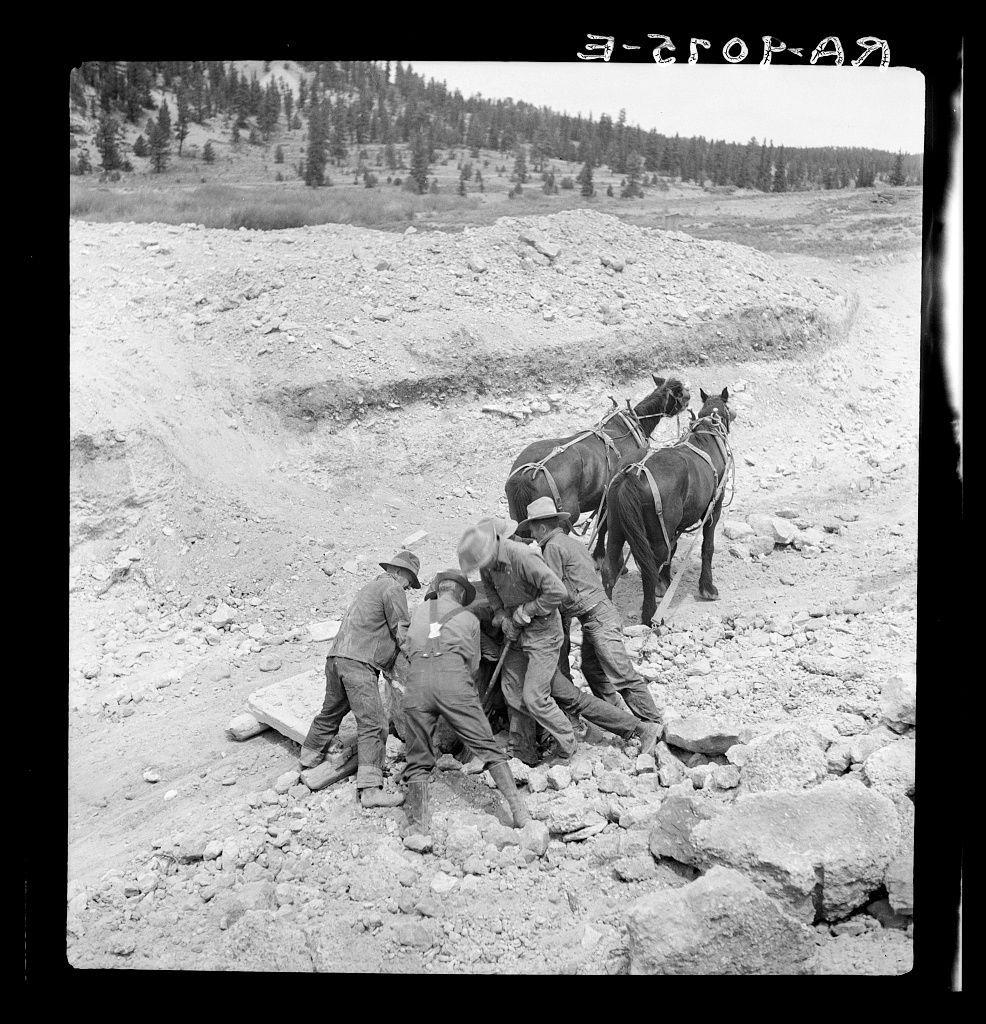
Widtsoe land use adjustment project. Garfield County, Utah. Loading boulder on stone boat, while excavating new spillway of Tropic Dam

#Widtsoe #GarfieldCounty #TropicDam #America #undefined #photography #DorotheaLange

https://www.loc.gov/pictures/item/2017762898/

The image captures a black and white moment from the Widtsoe land use adjustment project in Garfield County, Utah. It shows six workers, likely miners or laborers based on their attire of hats, boots, and work clothes, gathered around two horses hitched to a small cart. The men are actively engaged in loading boulders onto what appears to be a stone boat—a device used for transporting materials across the Tropic Dam spillway during construction. Their posture suggests they might have just heaved or are readying themselves to move another heavy rock, indicating physical labor and teamwork. In the background, we see an expansive landscape of rocky terrain with sparse vegetation leading up to a forested hillside under a clear sky. The photograph's historical context is further supported by its grainy quality and monochrome palette, typical of early 20th-century photography documenting rural development projects in America.
  • Copy link
  • Flag this post
  • Block
Dorothea Lange
Dorothea Lange
@DorotheaLange@mastodon.ozioso.online  ·  activity timestamp 2 days ago

Widtsoe land use adjustment project. Garfield County, Utah. Loading boulder on stone boat, while excavating new spillway of Tropic Dam

#Widtsoe #GarfieldCounty #TropicDam #America #undefined #photography #DorotheaLange

https://www.loc.gov/pictures/item/2017762898/

The image captures a black and white moment from the Widtsoe land use adjustment project in Garfield County, Utah. It shows six workers, likely miners or laborers based on their attire of hats, boots, and work clothes, gathered around two horses hitched to a small cart. The men are actively engaged in loading boulders onto what appears to be a stone boat—a device used for transporting materials across the Tropic Dam spillway during construction. Their posture suggests they might have just heaved or are readying themselves to move another heavy rock, indicating physical labor and teamwork. In the background, we see an expansive landscape of rocky terrain with sparse vegetation leading up to a forested hillside under a clear sky. The photograph's historical context is further supported by its grainy quality and monochrome palette, typical of early 20th-century photography documenting rural development projects in America.
  • Copy link
  • Flag this post
  • Block
Photography Channel boosted
Lewis Hine
Lewis Hine
@LewisHine@mastodon.ozioso.online  ·  activity timestamp 3 days ago

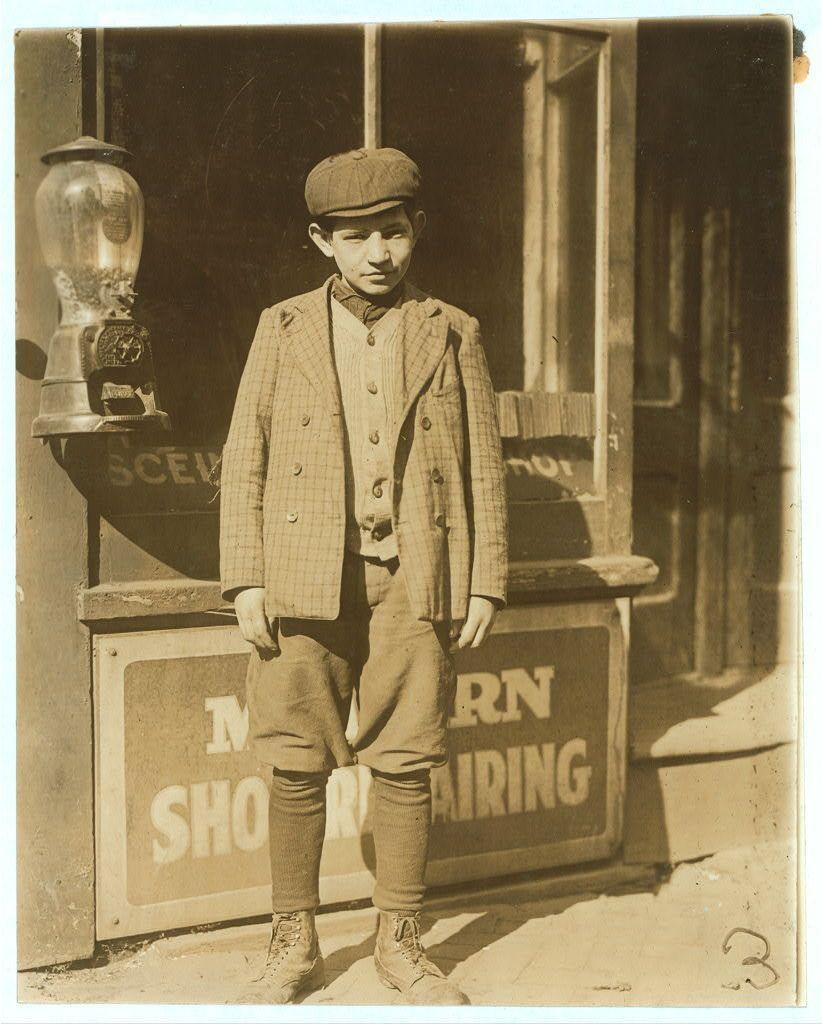
Cocoanut Shaver - Kibbe's Factory. Jacob Futterman, 16 years, 108 Sharon St. Location: Boston, Massachusetts.

#JacobFutterman #SharonStLocation #Boston #Massachusetts #MERNSHORRIRING #America #LewisHine #Photography #LewisHine #ChildLabour #ChildLabor

https://www.loc.gov/pictures/item/2018675488/

The image is a sepia-toned photograph of a young boy standing in front of an old-fashioned dispenser, which appears to be for selling gum or candy. The boy wears a tweed jacket with large buttons and pockets, knitted knee-high socks, and lace-up boots. His posture is upright but his expression seems contemplative as he looks off into the distance rather than directly at the camera.

He stands in front of what looks like an old-fashioned barbershop sign that reads "MERN SHORRIRING," suggesting a vintage setting possibly from early 20th-century America, based on his clothing style and the quality of the photograph. The texture of the image shows signs of age with wear at the corners.

In terms of historical context, this photo is associated with Jacob Futterman who was sixteen years old when captured in Boston, Massachusetts as per provided information from Cocoanut Shaver - Kibbe's Factory by Lewis Hine on archive.org.
The image is a sepia-toned photograph of a young boy standing in front of an old-fashioned dispenser, which appears to be for selling gum or candy. The boy wears a tweed jacket with large buttons and pockets, knitted knee-high socks, and lace-up boots. His posture is upright but his expression seems contemplative as he looks off into the distance rather than directly at the camera. He stands in front of what looks like an old-fashioned barbershop sign that reads "MERN SHORRIRING," suggesting a vintage setting possibly from early 20th-century America, based on his clothing style and the quality of the photograph. The texture of the image shows signs of age with wear at the corners. In terms of historical context, this photo is associated with Jacob Futterman who was sixteen years old when captured in Boston, Massachusetts as per provided information from Cocoanut Shaver - Kibbe's Factory by Lewis Hine on archive.org.
  • Copy link
  • Flag this post
  • Block
Lewis Hine
Lewis Hine
@LewisHine@mastodon.ozioso.online  ·  activity timestamp 3 days ago

Cocoanut Shaver - Kibbe's Factory. Jacob Futterman, 16 years, 108 Sharon St. Location: Boston, Massachusetts.

#JacobFutterman #SharonStLocation #Boston #Massachusetts #MERNSHORRIRING #America #LewisHine #Photography #LewisHine #ChildLabour #ChildLabor

https://www.loc.gov/pictures/item/2018675488/

The image is a sepia-toned photograph of a young boy standing in front of an old-fashioned dispenser, which appears to be for selling gum or candy. The boy wears a tweed jacket with large buttons and pockets, knitted knee-high socks, and lace-up boots. His posture is upright but his expression seems contemplative as he looks off into the distance rather than directly at the camera.

He stands in front of what looks like an old-fashioned barbershop sign that reads "MERN SHORRIRING," suggesting a vintage setting possibly from early 20th-century America, based on his clothing style and the quality of the photograph. The texture of the image shows signs of age with wear at the corners.

In terms of historical context, this photo is associated with Jacob Futterman who was sixteen years old when captured in Boston, Massachusetts as per provided information from Cocoanut Shaver - Kibbe's Factory by Lewis Hine on archive.org.
The image is a sepia-toned photograph of a young boy standing in front of an old-fashioned dispenser, which appears to be for selling gum or candy. The boy wears a tweed jacket with large buttons and pockets, knitted knee-high socks, and lace-up boots. His posture is upright but his expression seems contemplative as he looks off into the distance rather than directly at the camera. He stands in front of what looks like an old-fashioned barbershop sign that reads "MERN SHORRIRING," suggesting a vintage setting possibly from early 20th-century America, based on his clothing style and the quality of the photograph. The texture of the image shows signs of age with wear at the corners. In terms of historical context, this photo is associated with Jacob Futterman who was sixteen years old when captured in Boston, Massachusetts as per provided information from Cocoanut Shaver - Kibbe's Factory by Lewis Hine on archive.org.
  • Copy link
  • Flag this post
  • Block
Photography Channel boosted
Lewis Hine
Lewis Hine
@LewisHine@mastodon.ozioso.online  ·  activity timestamp 3 days ago

Young boy polishing marble in Vermont Marble Co., Centre Rutland, Vt. Most of these are illiterate. Location: Centre Rutland, Vermont.

#VermontMarbleCo #CentreRutland #Vermont #second #America #LewisHine #American #CentreRutland #LewisHines #Photography #LewisHine #ChildLabour #ChildLabor

https://www.loc.gov/pictures/item/2018675433/

The image depicts a sepia-toned photograph of two young boys working in what appears to be an industrial setting. The boy on the left, wearing suspenders and a hat, is engaged with some kind of tool or equipment that he's holding between his hands while standing over a workbench filled with various items such as blocks of marble or stone, tools, and possibly scraps from their work.

The second young boy, in the background, seems to be handling larger pieces of wood or timber. He appears focused on moving these materials around within what looks like a workshop environment, characterized by wooden beams overhead which suggest an old-fashioned construction typical for such facilities during that era.

Both boys are dressed in working clothes indicative of manual labor: one has suspenders over his shirt and trousers rolled up to the knee level while the other wears simple work shirts. The lighting is natural but somewhat diffused through what seems like a window, casting soft shadows on their figures which adds depth to this candid snapshot from history.

This image carries with it an air of authenticity that speaks volumes about labor conditions possibly in early 20th-century America. It's part of the extensive works by Lewis Hine who documented various aspects of American society including child labor during his work as a photojournalist for The National Child Labor Commit [...]
The image depicts a sepia-toned photograph of two young boys working in what appears to be an industrial setting. The boy on the left, wearing suspenders and a hat, is engaged with some kind of tool or equipment that he's holding between his hands while standing over a workbench filled with various items such as blocks of marble or stone, tools, and possibly scraps from their work. The second young boy, in the background, seems to be handling larger pieces of wood or timber. He appears focused on moving these materials around within what looks like a workshop environment, characterized by wooden beams overhead which suggest an old-fashioned construction typical for such facilities during that era. Both boys are dressed in working clothes indicative of manual labor: one has suspenders over his shirt and trousers rolled up to the knee level while the other wears simple work shirts. The lighting is natural but somewhat diffused through what seems like a window, casting soft shadows on their figures which adds depth to this candid snapshot from history. This image carries with it an air of authenticity that speaks volumes about labor conditions possibly in early 20th-century America. It's part of the extensive works by Lewis Hine who documented various aspects of American society including child labor during his work as a photojournalist for The National Child Labor Commit [...]
  • Copy link
  • Flag this post
  • Block

Indieweb Studio

This is a relaxed, online social space for the indieweb community, brought to you by indieweb.social.

Please abide by our code of conduct and have a nice time!

Indieweb Studio: About · Code of conduct · Privacy · Users · Instances
Bonfire social · 1.0.2-alpha.7 no JS en
Automatic federation enabled
Log in Create account
  • Explore
  • About
  • Members
  • Code of Conduct