Discussion
Loading...

#Tag

Log in
  • Sign up
  • About
  • Code of conduct
  • Privacy
  • Users
  • Instances
  • About Bonfire
Photography Channel boosted
Lewis Hine
Lewis Hine
@LewisHine@mastodon.ozioso.online  ·  activity timestamp 4 days ago

Noon hour, King Mfg. Co., Augusta, Ga. See photos 500 to 509. Location: Augusta, Georgia.

#KingMfgCo #Augusta #Georgia #LewisHine #Photography #LewisHine #ChildLabour #ChildLabor

https://www.loc.gov/pictures/item/2018675015/

The image is a sepia-toned photograph depicting several individuals in an outdoor urban setting, possibly from the early 1900s given its style and clothing. The scene appears to be taking place on a street or courtyard with tall brick buildings on either side, indicative of industrial-era architecture common during that time period.

In the foreground, there is a group of people who seem to be children based on their size and attire—short pants for boys and long dresses with bonnets for girls. Some are walking while others appear to be playing or running around energetically. Their clothing styles suggest practical workwear suited for laborious activities, likely related to the manufacturing industry given the context.

Among them is an adult figure who seems to be supervising or engaging in conversation with the children. In contrast, another group of adults and a child are standing on the side, possibly observing from a distance.

The lighting conditions suggest either early morning or late afternoon as it casts elongated shadows on the ground, which adds depth to the scene. The overall composition captures everyday life within an industrial environment in Augusta, Georgia, during what could be considered a break time given their relaxed postures and activities—hence the reference to "noon hour" mentioned in the caption.

This photograph is part of a collection by Lewis [...]

The image is a sepia-toned photograph depicting several individuals in an outdoor urban setting, possibly from the early 1900s given its style and clothing. The scene appears to be taking place on a street or courtyard with tall brick buildings on either side, indicative of industrial-era architecture common during that time period. In the foreground, there is a group of people who seem to be children based on their size and attire—short pants for boys and long dresses with bonnets for girls. Some are walking while others appear to be playing or running around energetically. Their clothing styles suggest practical workwear suited for laborious activities, likely related to the manufacturing industry given the context. Among them is an adult figure who seems to be supervising or engaging in conversation with the children. In contrast, another group of adults and a child are standing on the side, possibly observing from a distance. The lighting conditions suggest either early morning or late afternoon as it casts elongated shadows on the ground, which adds depth to the scene. The overall composition captures everyday life within an industrial environment in Augusta, Georgia, during what could be considered a break time given their relaxed postures and activities—hence the reference to "noon hour" mentioned in the caption. This photograph is part of a collection by Lewis [...]
  • Copy link
  • Flag this post
  • Block
Lewis Hine
Lewis Hine
@LewisHine@mastodon.ozioso.online  ·  activity timestamp 4 days ago

Noon hour, King Mfg. Co., Augusta, Ga. See photos 500 to 509. Location: Augusta, Georgia.

#KingMfgCo #Augusta #Georgia #LewisHine #Photography #LewisHine #ChildLabour #ChildLabor

https://www.loc.gov/pictures/item/2018675015/

The image is a sepia-toned photograph depicting several individuals in an outdoor urban setting, possibly from the early 1900s given its style and clothing. The scene appears to be taking place on a street or courtyard with tall brick buildings on either side, indicative of industrial-era architecture common during that time period.

In the foreground, there is a group of people who seem to be children based on their size and attire—short pants for boys and long dresses with bonnets for girls. Some are walking while others appear to be playing or running around energetically. Their clothing styles suggest practical workwear suited for laborious activities, likely related to the manufacturing industry given the context.

Among them is an adult figure who seems to be supervising or engaging in conversation with the children. In contrast, another group of adults and a child are standing on the side, possibly observing from a distance.

The lighting conditions suggest either early morning or late afternoon as it casts elongated shadows on the ground, which adds depth to the scene. The overall composition captures everyday life within an industrial environment in Augusta, Georgia, during what could be considered a break time given their relaxed postures and activities—hence the reference to "noon hour" mentioned in the caption.

This photograph is part of a collection by Lewis [...]
The image is a sepia-toned photograph depicting several individuals in an outdoor urban setting, possibly from the early 1900s given its style and clothing. The scene appears to be taking place on a street or courtyard with tall brick buildings on either side, indicative of industrial-era architecture common during that time period. In the foreground, there is a group of people who seem to be children based on their size and attire—short pants for boys and long dresses with bonnets for girls. Some are walking while others appear to be playing or running around energetically. Their clothing styles suggest practical workwear suited for laborious activities, likely related to the manufacturing industry given the context. Among them is an adult figure who seems to be supervising or engaging in conversation with the children. In contrast, another group of adults and a child are standing on the side, possibly observing from a distance. The lighting conditions suggest either early morning or late afternoon as it casts elongated shadows on the ground, which adds depth to the scene. The overall composition captures everyday life within an industrial environment in Augusta, Georgia, during what could be considered a break time given their relaxed postures and activities—hence the reference to "noon hour" mentioned in the caption. This photograph is part of a collection by Lewis [...]
  • Copy link
  • Flag this post
  • Block
Photography Channel boosted
Lewis Hine
Lewis Hine
@LewisHine@mastodon.ozioso.online  ·  activity timestamp 4 days ago

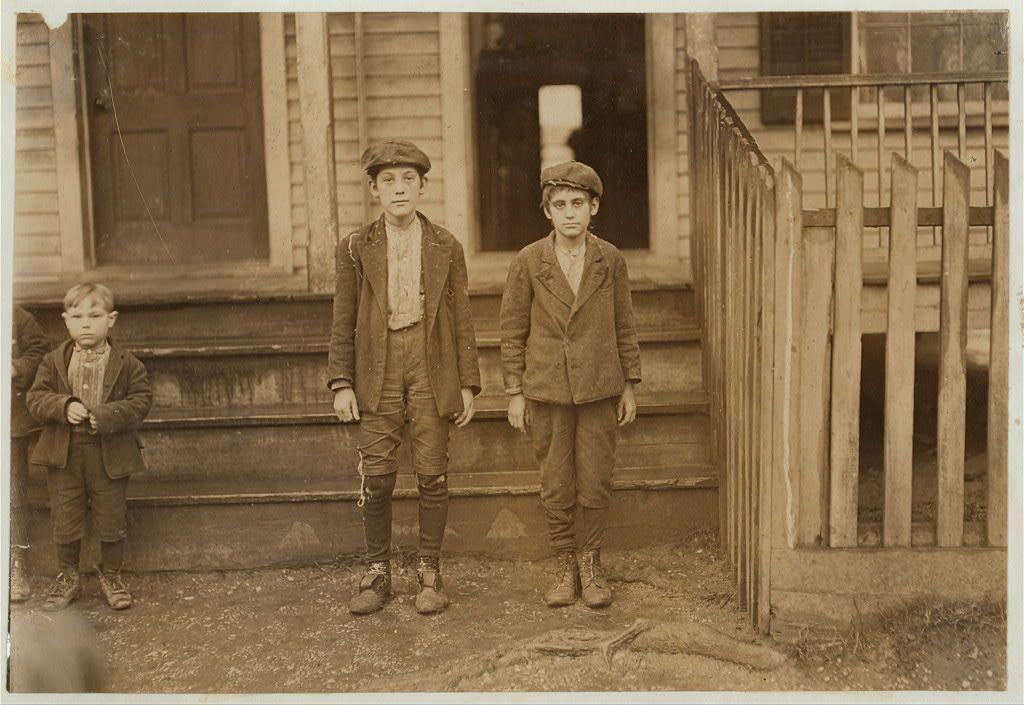
Wallace Pollard--In Mill for several years. Smaller one--Otis Pollard--2 years in King Mfg. Co., Augusta, Ga. Sat. Jan. 16, 1909. Location: Augusta, Georgia.

#WallacePollard #KingMfgCo #Augusta #Georgia #America #Photography #LewisHine #ChildLabour #ChildLabor

https://www.loc.gov/pictures/item/2018675017/

The image depicts three young boys standing in front of an old house with a wooden porch and railing. The setting appears to be rural or small-town America, based on the architecture and weathered appearance of the building. Two older boys are wearing worn-out clothing suitable for hard work; one has leg braces, suggesting he may have had polio as a child. A younger boy stands beside them with his hands clasped in front. All three exhibit somber expressions. The sepia-toned photograph is indicative of early 20th-century America and reflects the socio-economic conditions during that period.
  • Copy link
  • Flag this post
  • Block
Lewis Hine
Lewis Hine
@LewisHine@mastodon.ozioso.online  ·  activity timestamp 4 days ago

Wallace Pollard--In Mill for several years. Smaller one--Otis Pollard--2 years in King Mfg. Co., Augusta, Ga. Sat. Jan. 16, 1909. Location: Augusta, Georgia.

#WallacePollard #KingMfgCo #Augusta #Georgia #America #Photography #LewisHine #ChildLabour #ChildLabor

https://www.loc.gov/pictures/item/2018675017/

The image depicts three young boys standing in front of an old house with a wooden porch and railing. The setting appears to be rural or small-town America, based on the architecture and weathered appearance of the building. Two older boys are wearing worn-out clothing suitable for hard work; one has leg braces, suggesting he may have had polio as a child. A younger boy stands beside them with his hands clasped in front. All three exhibit somber expressions. The sepia-toned photograph is indicative of early 20th-century America and reflects the socio-economic conditions during that period.
  • Copy link
  • Flag this post
  • Block
Photography Channel boosted
Lewis Hine
Lewis Hine
@LewisHine@mastodon.ozioso.online  ·  activity timestamp 5 days ago

Taller girl Eunice Lambert. Other--Nellie McKinney. Been in King Mill for 2 years. Location: Augusta, Georgia.

#EuniceLambert #NellieMcKinney #Augusta #Georgia #Eunice #America #KingMill #LewisHine #Photography #LewisHine #ChildLabour #ChildLabor

https://www.loc.gov/pictures/item/2018675048/

The image is a historical black and white photograph depicting two young girls standing on the porch of an older residential building. They appear to be wearing early 20th-century clothing, including long-sleeved dresses with plaid patterns and dark stockings or leggings.

Eunice Lambert stands slightly behind Nellie McKinney, who appears taller than Eunice. Both are looking directly at the camera with neutral expressions. The girls' attire suggests they may be working-class children from an urban area during a time when such photographs were often used to document social conditions and labor subjects in America.

The setting includes visible wooden railings on the porch's railing, and shutters can be seen on the windows of the house beside them. Bare trees indicate that it could possibly be late fall or winter. There are hints of other buildings in the background but they're out of focus. The image conveys a sense of modesty and simplicity reflective of working-class life during its time period.

Additional context provided: Eunice Lambert is identified as being from King Mill, which indicates she was likely part of the textile industry prevalent at that location around Augusta, Georgia in 1906-1935. Nellie McKinney had been living there for two years and her photo may have been taken during a period when Lewis Hine documented child laborers through his work as an invest [...]
The image is a historical black and white photograph depicting two young girls standing on the porch of an older residential building. They appear to be wearing early 20th-century clothing, including long-sleeved dresses with plaid patterns and dark stockings or leggings. Eunice Lambert stands slightly behind Nellie McKinney, who appears taller than Eunice. Both are looking directly at the camera with neutral expressions. The girls' attire suggests they may be working-class children from an urban area during a time when such photographs were often used to document social conditions and labor subjects in America. The setting includes visible wooden railings on the porch's railing, and shutters can be seen on the windows of the house beside them. Bare trees indicate that it could possibly be late fall or winter. There are hints of other buildings in the background but they're out of focus. The image conveys a sense of modesty and simplicity reflective of working-class life during its time period. Additional context provided: Eunice Lambert is identified as being from King Mill, which indicates she was likely part of the textile industry prevalent at that location around Augusta, Georgia in 1906-1935. Nellie McKinney had been living there for two years and her photo may have been taken during a period when Lewis Hine documented child laborers through his work as an invest [...]
  • Copy link
  • Flag this post
  • Block
Lewis Hine
Lewis Hine
@LewisHine@mastodon.ozioso.online  ·  activity timestamp 5 days ago

Taller girl Eunice Lambert. Other--Nellie McKinney. Been in King Mill for 2 years. Location: Augusta, Georgia.

#EuniceLambert #NellieMcKinney #Augusta #Georgia #Eunice #America #KingMill #LewisHine #Photography #LewisHine #ChildLabour #ChildLabor

https://www.loc.gov/pictures/item/2018675048/

The image is a historical black and white photograph depicting two young girls standing on the porch of an older residential building. They appear to be wearing early 20th-century clothing, including long-sleeved dresses with plaid patterns and dark stockings or leggings.

Eunice Lambert stands slightly behind Nellie McKinney, who appears taller than Eunice. Both are looking directly at the camera with neutral expressions. The girls' attire suggests they may be working-class children from an urban area during a time when such photographs were often used to document social conditions and labor subjects in America.

The setting includes visible wooden railings on the porch's railing, and shutters can be seen on the windows of the house beside them. Bare trees indicate that it could possibly be late fall or winter. There are hints of other buildings in the background but they're out of focus. The image conveys a sense of modesty and simplicity reflective of working-class life during its time period.

Additional context provided: Eunice Lambert is identified as being from King Mill, which indicates she was likely part of the textile industry prevalent at that location around Augusta, Georgia in 1906-1935. Nellie McKinney had been living there for two years and her photo may have been taken during a period when Lewis Hine documented child laborers through his work as an invest [...]
The image is a historical black and white photograph depicting two young girls standing on the porch of an older residential building. They appear to be wearing early 20th-century clothing, including long-sleeved dresses with plaid patterns and dark stockings or leggings. Eunice Lambert stands slightly behind Nellie McKinney, who appears taller than Eunice. Both are looking directly at the camera with neutral expressions. The girls' attire suggests they may be working-class children from an urban area during a time when such photographs were often used to document social conditions and labor subjects in America. The setting includes visible wooden railings on the porch's railing, and shutters can be seen on the windows of the house beside them. Bare trees indicate that it could possibly be late fall or winter. There are hints of other buildings in the background but they're out of focus. The image conveys a sense of modesty and simplicity reflective of working-class life during its time period. Additional context provided: Eunice Lambert is identified as being from King Mill, which indicates she was likely part of the textile industry prevalent at that location around Augusta, Georgia in 1906-1935. Nellie McKinney had been living there for two years and her photo may have been taken during a period when Lewis Hine documented child laborers through his work as an invest [...]
  • Copy link
  • Flag this post
  • Block

Indieweb Studio

This is a relaxed, online social space for the indieweb community, brought to you by indieweb.social.

Please abide by our code of conduct and have a nice time!

Indieweb Studio: About · Code of conduct · Privacy · Users · Instances
Bonfire social · 1.0.2-alpha.7 no JS en
Automatic federation enabled
Log in Create account
  • Explore
  • About
  • Members
  • Code of Conduct