Discussion
Loading...

#Tag

Log in
  • Sign up
  • About
  • Code of conduct
  • Privacy
  • Users
  • Instances
  • About Bonfire
Photography Channel boosted
Lewis Hine
Lewis Hine
@LewisHine@mastodon.ozioso.online  ·  activity timestamp 4 days ago

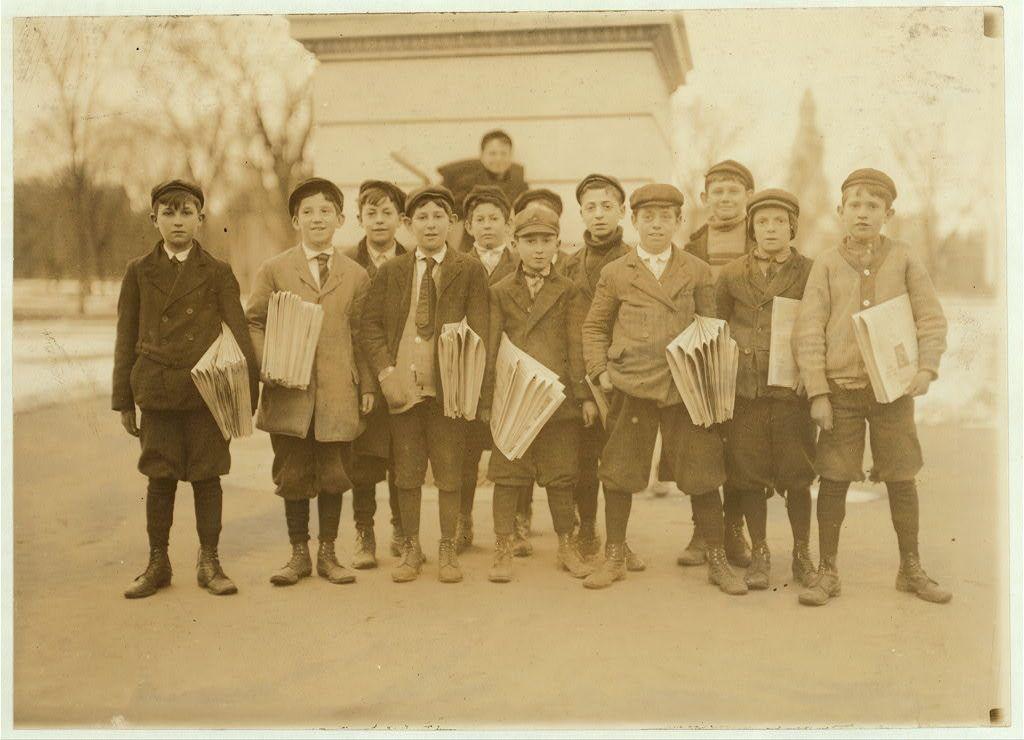
New Haven, Conn. Smallest boy 10 years old been at it a year and half, sells until 6 or 7 P.M. Location: New Haven, Connecticut.

#NewHaven #Connecticut #America #Photography #LewisHine #ChildLabour #ChildLabor

https://www.loc.gov/pictures/item/2018675100/

The image depicts a group of eleven young boys standing together outdoors with an urban structure in the background. They are holding folded newspapers or booklets, suggesting they may be newspaper delivery boys from early 20th-century America. The black and white photograph has a vintage feel due to its sepia tone. Each boy is wearing different styles of hats—both flat caps and round hats—and varied clothing including jackets, coats, ties, pants, shorts, and boots, indicating diverse fashions typical for the era depicted.

The largest boys are standing in front with their newspapers more prominently displayed than those behind them. The smallest boy appears to be on the far left, dressed differently from his peers—wearing a darker jacket compared to light-colored jackets of most others—and is notably shorter in stature. His posture suggests he may have been tasked with carrying fewer papers or being considered less experienced.

The image has an old-fashioned appearance, which can imply historical context about child labor during that period and the working conditions for young boys at early age. The location mentioned as New Haven, Connecticut adds geographical detail to this setting, potentially allowing viewers interested in history a point of reference.

The image depicts a group of eleven young boys standing together outdoors with an urban structure in the background. They are holding folded newspapers or booklets, suggesting they may be newspaper delivery boys from early 20th-century America. The black and white photograph has a vintage feel due to its sepia tone. Each boy is wearing different styles of hats—both flat caps and round hats—and varied clothing including jackets, coats, ties, pants, shorts, and boots, indicating diverse fashions typical for the era depicted. The largest boys are standing in front with their newspapers more prominently displayed than those behind them. The smallest boy appears to be on the far left, dressed differently from his peers—wearing a darker jacket compared to light-colored jackets of most others—and is notably shorter in stature. His posture suggests he may have been tasked with carrying fewer papers or being considered less experienced. The image has an old-fashioned appearance, which can imply historical context about child labor during that period and the working conditions for young boys at early age. The location mentioned as New Haven, Connecticut adds geographical detail to this setting, potentially allowing viewers interested in history a point of reference.
  • Copy link
  • Flag this post
  • Block
Lewis Hine
Lewis Hine
@LewisHine@mastodon.ozioso.online  ·  activity timestamp 4 days ago

New Haven, Conn. Smallest boy 10 years old been at it a year and half, sells until 6 or 7 P.M. Location: New Haven, Connecticut.

#NewHaven #Connecticut #America #Photography #LewisHine #ChildLabour #ChildLabor

https://www.loc.gov/pictures/item/2018675100/

The image depicts a group of eleven young boys standing together outdoors with an urban structure in the background. They are holding folded newspapers or booklets, suggesting they may be newspaper delivery boys from early 20th-century America. The black and white photograph has a vintage feel due to its sepia tone. Each boy is wearing different styles of hats—both flat caps and round hats—and varied clothing including jackets, coats, ties, pants, shorts, and boots, indicating diverse fashions typical for the era depicted.

The largest boys are standing in front with their newspapers more prominently displayed than those behind them. The smallest boy appears to be on the far left, dressed differently from his peers—wearing a darker jacket compared to light-colored jackets of most others—and is notably shorter in stature. His posture suggests he may have been tasked with carrying fewer papers or being considered less experienced.

The image has an old-fashioned appearance, which can imply historical context about child labor during that period and the working conditions for young boys at early age. The location mentioned as New Haven, Connecticut adds geographical detail to this setting, potentially allowing viewers interested in history a point of reference.
The image depicts a group of eleven young boys standing together outdoors with an urban structure in the background. They are holding folded newspapers or booklets, suggesting they may be newspaper delivery boys from early 20th-century America. The black and white photograph has a vintage feel due to its sepia tone. Each boy is wearing different styles of hats—both flat caps and round hats—and varied clothing including jackets, coats, ties, pants, shorts, and boots, indicating diverse fashions typical for the era depicted. The largest boys are standing in front with their newspapers more prominently displayed than those behind them. The smallest boy appears to be on the far left, dressed differently from his peers—wearing a darker jacket compared to light-colored jackets of most others—and is notably shorter in stature. His posture suggests he may have been tasked with carrying fewer papers or being considered less experienced. The image has an old-fashioned appearance, which can imply historical context about child labor during that period and the working conditions for young boys at early age. The location mentioned as New Haven, Connecticut adds geographical detail to this setting, potentially allowing viewers interested in history a point of reference.
  • Copy link
  • Flag this post
  • Block
Photography Channel boosted
Lewis Hine
Lewis Hine
@LewisHine@mastodon.ozioso.online  ·  activity timestamp 4 days ago

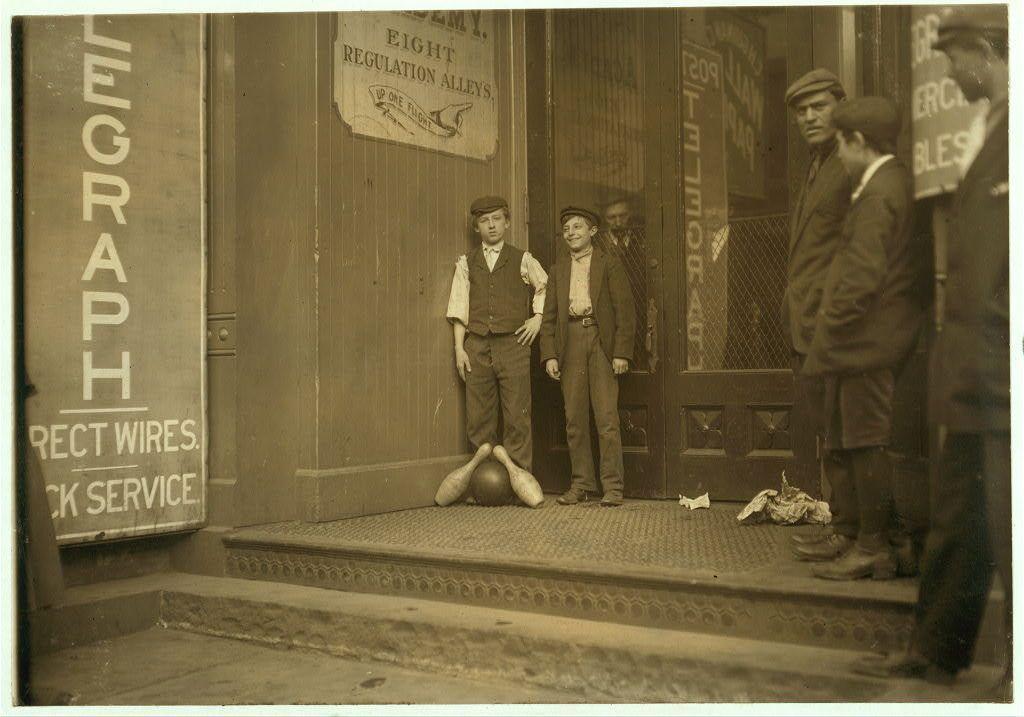
Bowling alley boys, New Haven, Conn. Many of these work until late at night. Location: New Haven, Connecticut.

#NewHaven #Connecticut #LewisHine #Photography #LewisHine #ChildLabour #ChildLabor

https://www.loc.gov/pictures/item/2018675095/

The image depicts a vintage scene of young boys in an urban setting at the entrance to what appears to be a regulation alley. The boys are dressed in early 20th-century attire, with one standing and another sitting on steps holding bowling shoes, suggesting they may have been involved in some recreational activity prior to this moment.

The surroundings include various signs indicating businesses such as "Legraph" (possibly related to telegraph services) and a reference to regulation alleys. The photograph is black and white, indicative of its historical context, likely taken during the early part of the 20th century when Lewis Hine was active in documenting child labor.

The boys are standing on steps with one boy seated prominently holding bowling shoes, which could imply they were at a nearby bowling alley before this moment. The image conveys a sense of daily life and work for young individuals during that era.
The image depicts a vintage scene of young boys in an urban setting at the entrance to what appears to be a regulation alley. The boys are dressed in early 20th-century attire, with one standing and another sitting on steps holding bowling shoes, suggesting they may have been involved in some recreational activity prior to this moment. The surroundings include various signs indicating businesses such as "Legraph" (possibly related to telegraph services) and a reference to regulation alleys. The photograph is black and white, indicative of its historical context, likely taken during the early part of the 20th century when Lewis Hine was active in documenting child labor. The boys are standing on steps with one boy seated prominently holding bowling shoes, which could imply they were at a nearby bowling alley before this moment. The image conveys a sense of daily life and work for young individuals during that era.
  • Copy link
  • Flag this post
  • Block
Lewis Hine
Lewis Hine
@LewisHine@mastodon.ozioso.online  ·  activity timestamp 4 days ago

Bowling alley boys, New Haven, Conn. Many of these work until late at night. Location: New Haven, Connecticut.

#NewHaven #Connecticut #LewisHine #Photography #LewisHine #ChildLabour #ChildLabor

https://www.loc.gov/pictures/item/2018675095/

The image depicts a vintage scene of young boys in an urban setting at the entrance to what appears to be a regulation alley. The boys are dressed in early 20th-century attire, with one standing and another sitting on steps holding bowling shoes, suggesting they may have been involved in some recreational activity prior to this moment.

The surroundings include various signs indicating businesses such as "Legraph" (possibly related to telegraph services) and a reference to regulation alleys. The photograph is black and white, indicative of its historical context, likely taken during the early part of the 20th century when Lewis Hine was active in documenting child labor.

The boys are standing on steps with one boy seated prominently holding bowling shoes, which could imply they were at a nearby bowling alley before this moment. The image conveys a sense of daily life and work for young individuals during that era.
The image depicts a vintage scene of young boys in an urban setting at the entrance to what appears to be a regulation alley. The boys are dressed in early 20th-century attire, with one standing and another sitting on steps holding bowling shoes, suggesting they may have been involved in some recreational activity prior to this moment. The surroundings include various signs indicating businesses such as "Legraph" (possibly related to telegraph services) and a reference to regulation alleys. The photograph is black and white, indicative of its historical context, likely taken during the early part of the 20th century when Lewis Hine was active in documenting child labor. The boys are standing on steps with one boy seated prominently holding bowling shoes, which could imply they were at a nearby bowling alley before this moment. The image conveys a sense of daily life and work for young individuals during that era.
  • Copy link
  • Flag this post
  • Block
Photography Channel boosted
Lewis Hine
Lewis Hine
@LewisHine@mastodon.ozioso.online  ·  activity timestamp 4 days ago

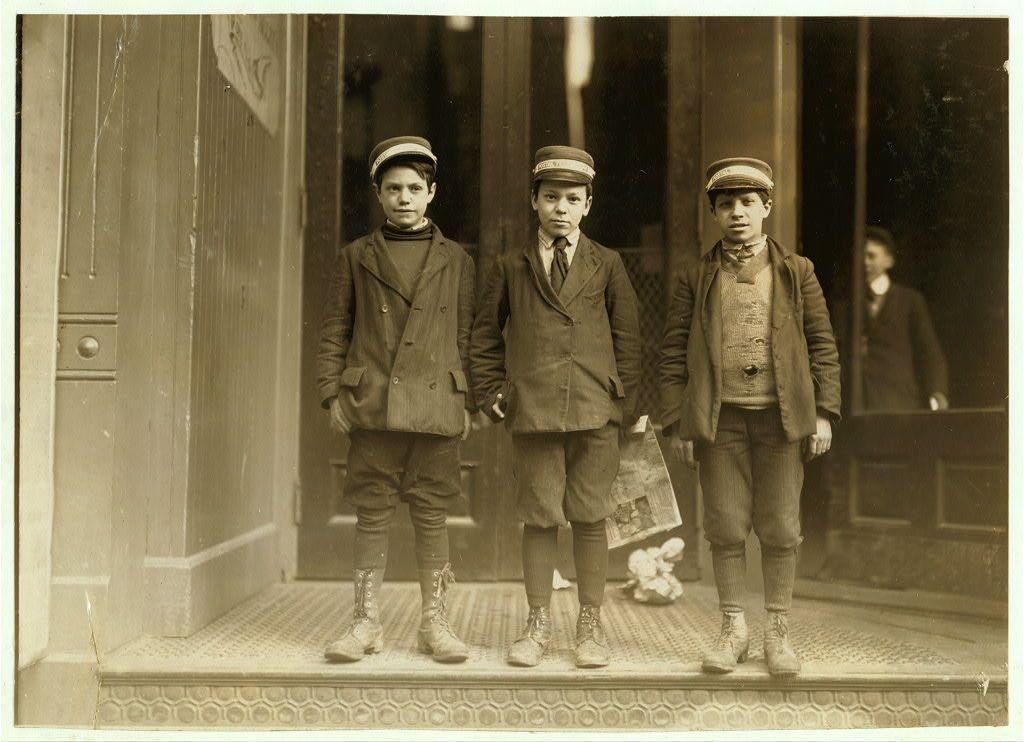
New Haven, Conn., March 8, 1909. Messenger boys. They work until 11 P.M. Location: New Haven, Connecticut.

#NewHaven #Messenger #Connecticut #Photography #LewisHine #ChildLabour #ChildLabor

https://www.loc.gov/pictures/item/2018675094/

The image shows three boys standing on a step in front of what appears to be an entrance, possibly to their workplace. They are dressed in work attire from the early 20th century, consisting of dark coats, trousers, and boots with socks. Each boy wears a cap or hat; two have caps similar in style but different colors while one has a more textured jacket-like garment over his headwear.

The middle boy is holding papers under his arm, suggesting he may be involved in delivering newspapers as part of their job responsibilities. The boys are looking directly at the camera with neutral expressions. Their posture and attire suggest they could be newsboys or messenger boys from around 1909.

Behind them, there's a faintly visible figure inside the building entrance, indicating others might be present within. There is also an indistinct object on the ground near their feet which appears to be flowers in a vase or container. The overall setting and clothing style are indicative of early urban life during that era.
The image shows three boys standing on a step in front of what appears to be an entrance, possibly to their workplace. They are dressed in work attire from the early 20th century, consisting of dark coats, trousers, and boots with socks. Each boy wears a cap or hat; two have caps similar in style but different colors while one has a more textured jacket-like garment over his headwear. The middle boy is holding papers under his arm, suggesting he may be involved in delivering newspapers as part of their job responsibilities. The boys are looking directly at the camera with neutral expressions. Their posture and attire suggest they could be newsboys or messenger boys from around 1909. Behind them, there's a faintly visible figure inside the building entrance, indicating others might be present within. There is also an indistinct object on the ground near their feet which appears to be flowers in a vase or container. The overall setting and clothing style are indicative of early urban life during that era.
  • Copy link
  • Flag this post
  • Block
Lewis Hine
Lewis Hine
@LewisHine@mastodon.ozioso.online  ·  activity timestamp 4 days ago

New Haven, Conn., March 8, 1909. Messenger boys. They work until 11 P.M. Location: New Haven, Connecticut.

#NewHaven #Messenger #Connecticut #Photography #LewisHine #ChildLabour #ChildLabor

https://www.loc.gov/pictures/item/2018675094/

The image shows three boys standing on a step in front of what appears to be an entrance, possibly to their workplace. They are dressed in work attire from the early 20th century, consisting of dark coats, trousers, and boots with socks. Each boy wears a cap or hat; two have caps similar in style but different colors while one has a more textured jacket-like garment over his headwear.

The middle boy is holding papers under his arm, suggesting he may be involved in delivering newspapers as part of their job responsibilities. The boys are looking directly at the camera with neutral expressions. Their posture and attire suggest they could be newsboys or messenger boys from around 1909.

Behind them, there's a faintly visible figure inside the building entrance, indicating others might be present within. There is also an indistinct object on the ground near their feet which appears to be flowers in a vase or container. The overall setting and clothing style are indicative of early urban life during that era.
The image shows three boys standing on a step in front of what appears to be an entrance, possibly to their workplace. They are dressed in work attire from the early 20th century, consisting of dark coats, trousers, and boots with socks. Each boy wears a cap or hat; two have caps similar in style but different colors while one has a more textured jacket-like garment over his headwear. The middle boy is holding papers under his arm, suggesting he may be involved in delivering newspapers as part of their job responsibilities. The boys are looking directly at the camera with neutral expressions. Their posture and attire suggest they could be newsboys or messenger boys from around 1909. Behind them, there's a faintly visible figure inside the building entrance, indicating others might be present within. There is also an indistinct object on the ground near their feet which appears to be flowers in a vase or container. The overall setting and clothing style are indicative of early urban life during that era.
  • Copy link
  • Flag this post
  • Block
Photography Channel boosted
Lewis Hine
Lewis Hine
@LewisHine@mastodon.ozioso.online  ·  activity timestamp 4 days ago

United Workers Boy's Club, New Haven, Conn. In the gymnasium. Location: New Haven, Connecticut.

#UnitedWorkers #NewHaven #Connecticut #Photography #LewisHine #ChildLabour #ChildLabor

https://www.loc.gov/pictures/item/2018675091/

The image depicts a group of individuals engaged in what appears to be a physical exercise or drill session. The setting is an indoor gymnasium with high ceilings, large arched doorways, and wooden flooring that shows signs of wear.

In the foreground, six men are prominently positioned; each holds their right hand above their head while stretching upwards. They all seem focused on this task. These individuals are dressed in a mix of light-colored shirts—some white or beige—and darker trousers or shorts, with varying lengths ranging from knee-length to ankle-length pants. Some wear ties.

Behind them stands an elongated line of approximately twenty people mirroring the action of raising their right hands above their heads and stretching upwards towards something not visible within this frame. The individuals in the rear row are slightly less pronounced due to perspective but still participate actively, with many extending both arms overhead.

The lighting is dim yet sufficient enough to discern details; it's likely artificial given the indoor setting. There’s a wall-mounted light fixture casting shadows and adding texture on parts of their clothing and surroundings.

This image appears historical in nature, indicated by its sepia tone typical of early 20th-century photographs. The gymnasium is devoid of modern amenities or decorations, suggesting an institutional environm [...]
The image depicts a group of individuals engaged in what appears to be a physical exercise or drill session. The setting is an indoor gymnasium with high ceilings, large arched doorways, and wooden flooring that shows signs of wear. In the foreground, six men are prominently positioned; each holds their right hand above their head while stretching upwards. They all seem focused on this task. These individuals are dressed in a mix of light-colored shirts—some white or beige—and darker trousers or shorts, with varying lengths ranging from knee-length to ankle-length pants. Some wear ties. Behind them stands an elongated line of approximately twenty people mirroring the action of raising their right hands above their heads and stretching upwards towards something not visible within this frame. The individuals in the rear row are slightly less pronounced due to perspective but still participate actively, with many extending both arms overhead. The lighting is dim yet sufficient enough to discern details; it's likely artificial given the indoor setting. There’s a wall-mounted light fixture casting shadows and adding texture on parts of their clothing and surroundings. This image appears historical in nature, indicated by its sepia tone typical of early 20th-century photographs. The gymnasium is devoid of modern amenities or decorations, suggesting an institutional environm [...]
  • Copy link
  • Flag this post
  • Block
Lewis Hine
Lewis Hine
@LewisHine@mastodon.ozioso.online  ·  activity timestamp 4 days ago

United Workers Boy's Club, New Haven, Conn. In the gymnasium. Location: New Haven, Connecticut.

#UnitedWorkers #NewHaven #Connecticut #Photography #LewisHine #ChildLabour #ChildLabor

https://www.loc.gov/pictures/item/2018675091/

The image depicts a group of individuals engaged in what appears to be a physical exercise or drill session. The setting is an indoor gymnasium with high ceilings, large arched doorways, and wooden flooring that shows signs of wear.

In the foreground, six men are prominently positioned; each holds their right hand above their head while stretching upwards. They all seem focused on this task. These individuals are dressed in a mix of light-colored shirts—some white or beige—and darker trousers or shorts, with varying lengths ranging from knee-length to ankle-length pants. Some wear ties.

Behind them stands an elongated line of approximately twenty people mirroring the action of raising their right hands above their heads and stretching upwards towards something not visible within this frame. The individuals in the rear row are slightly less pronounced due to perspective but still participate actively, with many extending both arms overhead.

The lighting is dim yet sufficient enough to discern details; it's likely artificial given the indoor setting. There’s a wall-mounted light fixture casting shadows and adding texture on parts of their clothing and surroundings.

This image appears historical in nature, indicated by its sepia tone typical of early 20th-century photographs. The gymnasium is devoid of modern amenities or decorations, suggesting an institutional environm [...]
The image depicts a group of individuals engaged in what appears to be a physical exercise or drill session. The setting is an indoor gymnasium with high ceilings, large arched doorways, and wooden flooring that shows signs of wear. In the foreground, six men are prominently positioned; each holds their right hand above their head while stretching upwards. They all seem focused on this task. These individuals are dressed in a mix of light-colored shirts—some white or beige—and darker trousers or shorts, with varying lengths ranging from knee-length to ankle-length pants. Some wear ties. Behind them stands an elongated line of approximately twenty people mirroring the action of raising their right hands above their heads and stretching upwards towards something not visible within this frame. The individuals in the rear row are slightly less pronounced due to perspective but still participate actively, with many extending both arms overhead. The lighting is dim yet sufficient enough to discern details; it's likely artificial given the indoor setting. There’s a wall-mounted light fixture casting shadows and adding texture on parts of their clothing and surroundings. This image appears historical in nature, indicated by its sepia tone typical of early 20th-century photographs. The gymnasium is devoid of modern amenities or decorations, suggesting an institutional environm [...]
  • Copy link
  • Flag this post
  • Block
Photography Channel boosted
Lewis Hine
Lewis Hine
@LewisHine@mastodon.ozioso.online  ·  activity timestamp 5 days ago

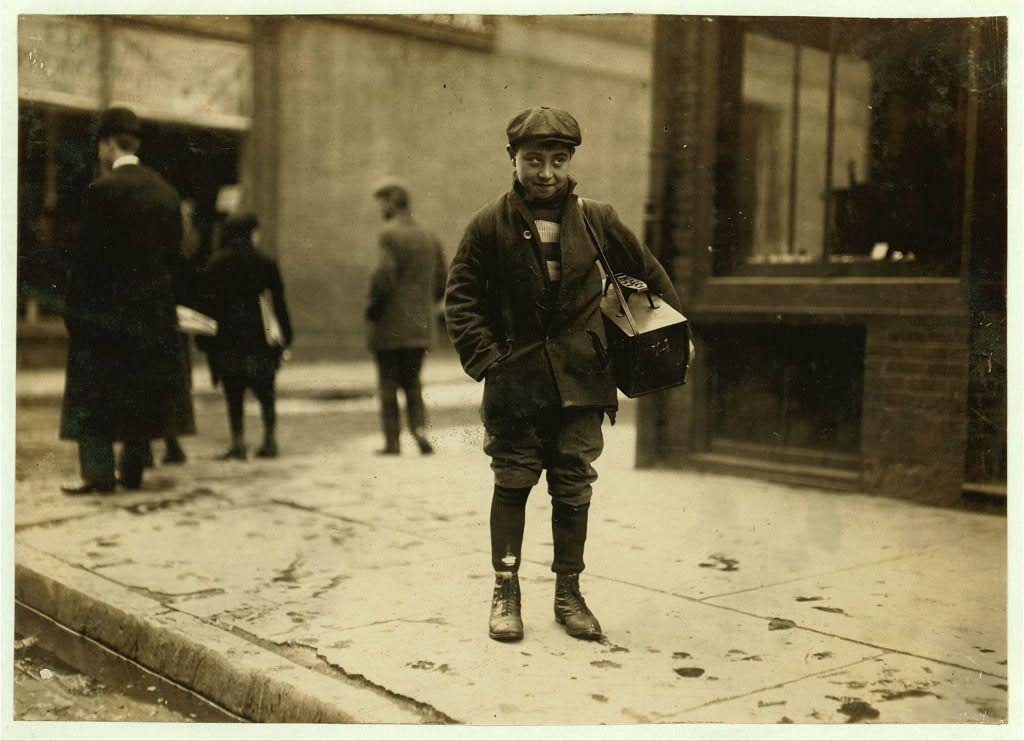
One of the boot-blacks. Location: New Haven, Connecticut.

#NewHaven #Connecticut #LewisHines #Photography #LewisHine #ChildLabour #ChildLabor

https://www.loc.gov/pictures/item/2018675086/

The image depicts a young man standing on an urban sidewalk during what appears to be the early 1900s, based on his attire and style of photography. He is dressed in work clothes with layers indicating colder weather; he wears trousers rolled up near knee-high boots, suggesting practicality for physical labor or outdoor tasks. His outfit includes a cap that was common at the time among workers to protect from elements like wind or snow. In one hand, he carries what looks like a bucket or container possibly used in his job as described by "One of the boot-blacks." The setting shows other individuals walking on the street and storefronts with large windows, indicative of a commercial area. This photograph is part of Lewis Hine's collection located at One of the boot-blacks., illustrating everyday life during that era through portraits like this one from New Haven, Connecticut.
  • Copy link
  • Flag this post
  • Block
Lewis Hine
Lewis Hine
@LewisHine@mastodon.ozioso.online  ·  activity timestamp 5 days ago

One of the boot-blacks. Location: New Haven, Connecticut.

#NewHaven #Connecticut #LewisHines #Photography #LewisHine #ChildLabour #ChildLabor

https://www.loc.gov/pictures/item/2018675086/

The image depicts a young man standing on an urban sidewalk during what appears to be the early 1900s, based on his attire and style of photography. He is dressed in work clothes with layers indicating colder weather; he wears trousers rolled up near knee-high boots, suggesting practicality for physical labor or outdoor tasks. His outfit includes a cap that was common at the time among workers to protect from elements like wind or snow. In one hand, he carries what looks like a bucket or container possibly used in his job as described by "One of the boot-blacks." The setting shows other individuals walking on the street and storefronts with large windows, indicative of a commercial area. This photograph is part of Lewis Hine's collection located at One of the boot-blacks., illustrating everyday life during that era through portraits like this one from New Haven, Connecticut.
  • Copy link
  • Flag this post
  • Block

Indieweb Studio

This is a relaxed, online social space for the indieweb community, brought to you by indieweb.social.

Please abide by our code of conduct and have a nice time!

Indieweb Studio: About · Code of conduct · Privacy · Users · Instances
Bonfire social · 1.0.2-alpha.7 no JS en
Automatic federation enabled
Log in Create account
  • Explore
  • About
  • Members
  • Code of Conduct