Discussion
Loading...

#Tag

Log in
  • Sign up
  • About
  • Code of conduct
  • Privacy
  • Users
  • Instances
  • About Bonfire
Photography Channel boosted
Dorothea Lange
Dorothea Lange
@DorotheaLange@mastodon.ozioso.online  ·  activity timestamp 4 days ago

Mrs. Soper tells how it was when they first came. Willow Creek area, Malheur County, Oregon. General caption number 72

#Soper #first #WillowCreek #MalheurCounty #Oregon #theDustBowl #American #theGreatDepression #undefined #photography #DorotheaLange

https://www.loc.gov/pictures/item/2017773671/

This black and white photograph captures a moment from the Dust Bowl era, depicting an individual standing in what appears to be a rural outdoor setting. The person is dressed in simple clothing with plaid patterns on both the top and bottom garment. They are holding onto their chin with one hand while supporting themselves against another object with the other, seemingly deep in thought or contemplation.
In the background, clotheslines stretch across the image, bearing what seem to be sheets of fabric drying in the sun. Another person is visible standing at a distance on the left side, engaged in an activity that's not entirely clear from this perspective.
The overall scene suggests hardship and survival during challenging times, likely relating to the migration patterns associated with droughts and dust storms prevalent in the American West during the Great Depression era.
This black and white photograph captures a moment from the Dust Bowl era, depicting an individual standing in what appears to be a rural outdoor setting. The person is dressed in simple clothing with plaid patterns on both the top and bottom garment. They are holding onto their chin with one hand while supporting themselves against another object with the other, seemingly deep in thought or contemplation. In the background, clotheslines stretch across the image, bearing what seem to be sheets of fabric drying in the sun. Another person is visible standing at a distance on the left side, engaged in an activity that's not entirely clear from this perspective. The overall scene suggests hardship and survival during challenging times, likely relating to the migration patterns associated with droughts and dust storms prevalent in the American West during the Great Depression era.
  • Copy link
  • Flag this post
  • Block
Dorothea Lange
Dorothea Lange
@DorotheaLange@mastodon.ozioso.online  ·  activity timestamp 4 days ago

Mrs. Soper tells how it was when they first came. Willow Creek area, Malheur County, Oregon. General caption number 72

#Soper #first #WillowCreek #MalheurCounty #Oregon #theDustBowl #American #theGreatDepression #undefined #photography #DorotheaLange

https://www.loc.gov/pictures/item/2017773671/

This black and white photograph captures a moment from the Dust Bowl era, depicting an individual standing in what appears to be a rural outdoor setting. The person is dressed in simple clothing with plaid patterns on both the top and bottom garment. They are holding onto their chin with one hand while supporting themselves against another object with the other, seemingly deep in thought or contemplation.
In the background, clotheslines stretch across the image, bearing what seem to be sheets of fabric drying in the sun. Another person is visible standing at a distance on the left side, engaged in an activity that's not entirely clear from this perspective.
The overall scene suggests hardship and survival during challenging times, likely relating to the migration patterns associated with droughts and dust storms prevalent in the American West during the Great Depression era.
This black and white photograph captures a moment from the Dust Bowl era, depicting an individual standing in what appears to be a rural outdoor setting. The person is dressed in simple clothing with plaid patterns on both the top and bottom garment. They are holding onto their chin with one hand while supporting themselves against another object with the other, seemingly deep in thought or contemplation. In the background, clotheslines stretch across the image, bearing what seem to be sheets of fabric drying in the sun. Another person is visible standing at a distance on the left side, engaged in an activity that's not entirely clear from this perspective. The overall scene suggests hardship and survival during challenging times, likely relating to the migration patterns associated with droughts and dust storms prevalent in the American West during the Great Depression era.
  • Copy link
  • Flag this post
  • Block
Photography Channel boosted
Dorothea Lange
Dorothea Lange
@DorotheaLange@mastodon.ozioso.online  ·  activity timestamp 4 days ago

Mrs. Soper with youngest child at the well. Willow creek area, Malheur County, Oregon

#Soper #MalheurCounty #Oregon #America #WillowCreek #DustBowl #undefined #photography #DorotheaLange

https://www.loc.gov/pictures/item/2017773669/

The image is a black and white photograph depicting an outdoor scene from the past. It shows two individuals, likely named Mrs. Soper with her youngest child at what appears to be a well or pump in a rural setting.

In the foreground on the right side of the photo stands a woman bending slightly as she operates a hand-operated pump mechanism connected by tubes and wires leading up into an unseen apparatus above. She is wearing practical, modest clothing indicative of mid-20th-century attire: plaid shorts and a long-sleeve shirt or dress.

The child on her left side appears to be engaging with something at the well; it seems like they are examining what might be water or sand in a container placed near their feet. The child is dressed similarly, suggesting that the clothing was suitable for outdoor work tasks as much of America experienced an era when both men and women worked outside.

The landscape behind them includes open fields under a clear sky with some distant trees and structures, typical of rural Oregon during this period. There are no visible modern amenities or buildings indicating urban development; it seems like they might be in the Willow Creek area within Malheur County, Oregon based on historical context provided by Mrs. Soper's name.

The image exudes a sense of everyday life from an earlier era where such scenes were common and perhaps expected as part o [...]
The image is a black and white photograph depicting an outdoor scene from the past. It shows two individuals, likely named Mrs. Soper with her youngest child at what appears to be a well or pump in a rural setting. In the foreground on the right side of the photo stands a woman bending slightly as she operates a hand-operated pump mechanism connected by tubes and wires leading up into an unseen apparatus above. She is wearing practical, modest clothing indicative of mid-20th-century attire: plaid shorts and a long-sleeve shirt or dress. The child on her left side appears to be engaging with something at the well; it seems like they are examining what might be water or sand in a container placed near their feet. The child is dressed similarly, suggesting that the clothing was suitable for outdoor work tasks as much of America experienced an era when both men and women worked outside. The landscape behind them includes open fields under a clear sky with some distant trees and structures, typical of rural Oregon during this period. There are no visible modern amenities or buildings indicating urban development; it seems like they might be in the Willow Creek area within Malheur County, Oregon based on historical context provided by Mrs. Soper's name. The image exudes a sense of everyday life from an earlier era where such scenes were common and perhaps expected as part o [...]
  • Copy link
  • Flag this post
  • Block
Dorothea Lange
Dorothea Lange
@DorotheaLange@mastodon.ozioso.online  ·  activity timestamp 4 days ago

Mrs. Soper with youngest child at the well. Willow creek area, Malheur County, Oregon

#Soper #MalheurCounty #Oregon #America #WillowCreek #DustBowl #undefined #photography #DorotheaLange

https://www.loc.gov/pictures/item/2017773669/

The image is a black and white photograph depicting an outdoor scene from the past. It shows two individuals, likely named Mrs. Soper with her youngest child at what appears to be a well or pump in a rural setting.

In the foreground on the right side of the photo stands a woman bending slightly as she operates a hand-operated pump mechanism connected by tubes and wires leading up into an unseen apparatus above. She is wearing practical, modest clothing indicative of mid-20th-century attire: plaid shorts and a long-sleeve shirt or dress.

The child on her left side appears to be engaging with something at the well; it seems like they are examining what might be water or sand in a container placed near their feet. The child is dressed similarly, suggesting that the clothing was suitable for outdoor work tasks as much of America experienced an era when both men and women worked outside.

The landscape behind them includes open fields under a clear sky with some distant trees and structures, typical of rural Oregon during this period. There are no visible modern amenities or buildings indicating urban development; it seems like they might be in the Willow Creek area within Malheur County, Oregon based on historical context provided by Mrs. Soper's name.

The image exudes a sense of everyday life from an earlier era where such scenes were common and perhaps expected as part o [...]
The image is a black and white photograph depicting an outdoor scene from the past. It shows two individuals, likely named Mrs. Soper with her youngest child at what appears to be a well or pump in a rural setting. In the foreground on the right side of the photo stands a woman bending slightly as she operates a hand-operated pump mechanism connected by tubes and wires leading up into an unseen apparatus above. She is wearing practical, modest clothing indicative of mid-20th-century attire: plaid shorts and a long-sleeve shirt or dress. The child on her left side appears to be engaging with something at the well; it seems like they are examining what might be water or sand in a container placed near their feet. The child is dressed similarly, suggesting that the clothing was suitable for outdoor work tasks as much of America experienced an era when both men and women worked outside. The landscape behind them includes open fields under a clear sky with some distant trees and structures, typical of rural Oregon during this period. There are no visible modern amenities or buildings indicating urban development; it seems like they might be in the Willow Creek area within Malheur County, Oregon based on historical context provided by Mrs. Soper's name. The image exudes a sense of everyday life from an earlier era where such scenes were common and perhaps expected as part o [...]
  • Copy link
  • Flag this post
  • Block
Photography Channel boosted
Dorothea Lange
Dorothea Lange
@DorotheaLange@mastodon.ozioso.online  ·  activity timestamp 4 days ago

Exterior of Soper house, just finished painting. For a long time only one side was painted. Willow Creek area, Malheur County, Oregon. General caption number 72

#Soper #WillowCreek #MalheurCounty #Oregon #second #undefined #photography #DorotheaLange

https://www.loc.gov/pictures/item/2017773666/

The image depicts a two-story wooden house with white siding, situated in an open field. The architecture is simple and functional, featuring a gable roof with shingles visible on the top part of the structure. There are several windows evenly spaced across both levels, some with shutters indicating areas where additional protection from weather or privacy may be desired.

The foundation appears to have been reinforced at certain points, suggesting possible repairs or adjustments made over time. A ladder leans against one side of the house near a window on the second floor, possibly used for maintenance purposes such as cleaning gutters or painting. In front of the house is an open field with dry grass, and there are no visible plants in immediate proximity to enhance aesthetic appeal.

The sky is clear without any clouds, indicating fair weather conditions at the time when this photograph was taken. The overall setting suggests a rural environment, possibly during mid-day due to the absence of long shadows which would be indicative of morning or evening light.
The image depicts a two-story wooden house with white siding, situated in an open field. The architecture is simple and functional, featuring a gable roof with shingles visible on the top part of the structure. There are several windows evenly spaced across both levels, some with shutters indicating areas where additional protection from weather or privacy may be desired. The foundation appears to have been reinforced at certain points, suggesting possible repairs or adjustments made over time. A ladder leans against one side of the house near a window on the second floor, possibly used for maintenance purposes such as cleaning gutters or painting. In front of the house is an open field with dry grass, and there are no visible plants in immediate proximity to enhance aesthetic appeal. The sky is clear without any clouds, indicating fair weather conditions at the time when this photograph was taken. The overall setting suggests a rural environment, possibly during mid-day due to the absence of long shadows which would be indicative of morning or evening light.
  • Copy link
  • Flag this post
  • Block
Dorothea Lange
Dorothea Lange
@DorotheaLange@mastodon.ozioso.online  ·  activity timestamp 4 days ago

Exterior of Soper house, just finished painting. For a long time only one side was painted. Willow Creek area, Malheur County, Oregon. General caption number 72

#Soper #WillowCreek #MalheurCounty #Oregon #second #undefined #photography #DorotheaLange

https://www.loc.gov/pictures/item/2017773666/

The image depicts a two-story wooden house with white siding, situated in an open field. The architecture is simple and functional, featuring a gable roof with shingles visible on the top part of the structure. There are several windows evenly spaced across both levels, some with shutters indicating areas where additional protection from weather or privacy may be desired.

The foundation appears to have been reinforced at certain points, suggesting possible repairs or adjustments made over time. A ladder leans against one side of the house near a window on the second floor, possibly used for maintenance purposes such as cleaning gutters or painting. In front of the house is an open field with dry grass, and there are no visible plants in immediate proximity to enhance aesthetic appeal.

The sky is clear without any clouds, indicating fair weather conditions at the time when this photograph was taken. The overall setting suggests a rural environment, possibly during mid-day due to the absence of long shadows which would be indicative of morning or evening light.
The image depicts a two-story wooden house with white siding, situated in an open field. The architecture is simple and functional, featuring a gable roof with shingles visible on the top part of the structure. There are several windows evenly spaced across both levels, some with shutters indicating areas where additional protection from weather or privacy may be desired. The foundation appears to have been reinforced at certain points, suggesting possible repairs or adjustments made over time. A ladder leans against one side of the house near a window on the second floor, possibly used for maintenance purposes such as cleaning gutters or painting. In front of the house is an open field with dry grass, and there are no visible plants in immediate proximity to enhance aesthetic appeal. The sky is clear without any clouds, indicating fair weather conditions at the time when this photograph was taken. The overall setting suggests a rural environment, possibly during mid-day due to the absence of long shadows which would be indicative of morning or evening light.
  • Copy link
  • Flag this post
  • Block
Photography Channel boosted
Dorothea Lange
Dorothea Lange
@DorotheaLange@mastodon.ozioso.online  ·  activity timestamp 5 days ago

Another corner of the Soper kitchen. Willow Creek area, Malheur County, Oregon. General caption number 72

#Soper #WillowCreek #MalheurCounty #Oregon #DorotheaLanges #Lange #undefined #photography #DorotheaLange

https://www.loc.gov/pictures/item/2017773645/

This black and white photograph captures a quaint kitchen scene, seemingly from the early to mid-20th century. The room is filled with various cooking utensils, pots, pans, and containers indicative of regular use and domestic life. Prominently featured in the center is an old-fashioned wood-burning stove, with metal pots perched atop its surface, suggesting recent or ongoing meal preparation activities.

The walls are lined with wooden cabinets brimming with bottles and other items that imply a self-sufficient lifestyle reliant on home-cured goods and prepared foods. Various kitchen tools such as spoons, ladles, and strainers hang from hooks attached to the wall above the stove, emphasizing functionality over aesthetics in this utilitarian space.

On the left side of the image, we see another corner with more cooking implements including a large metal pot resting on a heating source possibly made for canning. A wooden chair stands near a bucket, hinting at manual labor or outdoor activities being part of daily routines within this household.

The floor is bare and appears to be in need of repair, adding an authentic touch to the scene that speaks volumes about the socio-economic conditions reflected by such settings during Dorothea Lange's documentation era. The photograph itself bears a watermark indicating it was taken for "SIX HUNDRED E" which might refer to a particu [...]

This black and white photograph captures a quaint kitchen scene, seemingly from the early to mid-20th century. The room is filled with various cooking utensils, pots, pans, and containers indicative of regular use and domestic life. Prominently featured in the center is an old-fashioned wood-burning stove, with metal pots perched atop its surface, suggesting recent or ongoing meal preparation activities. The walls are lined with wooden cabinets brimming with bottles and other items that imply a self-sufficient lifestyle reliant on home-cured goods and prepared foods. Various kitchen tools such as spoons, ladles, and strainers hang from hooks attached to the wall above the stove, emphasizing functionality over aesthetics in this utilitarian space. On the left side of the image, we see another corner with more cooking implements including a large metal pot resting on a heating source possibly made for canning. A wooden chair stands near a bucket, hinting at manual labor or outdoor activities being part of daily routines within this household. The floor is bare and appears to be in need of repair, adding an authentic touch to the scene that speaks volumes about the socio-economic conditions reflected by such settings during Dorothea Lange's documentation era. The photograph itself bears a watermark indicating it was taken for "SIX HUNDRED E" which might refer to a particu [...]
  • Copy link
  • Flag this post
  • Block
Dorothea Lange
Dorothea Lange
@DorotheaLange@mastodon.ozioso.online  ·  activity timestamp 5 days ago

Another corner of the Soper kitchen. Willow Creek area, Malheur County, Oregon. General caption number 72

#Soper #WillowCreek #MalheurCounty #Oregon #DorotheaLanges #Lange #undefined #photography #DorotheaLange

https://www.loc.gov/pictures/item/2017773645/

This black and white photograph captures a quaint kitchen scene, seemingly from the early to mid-20th century. The room is filled with various cooking utensils, pots, pans, and containers indicative of regular use and domestic life. Prominently featured in the center is an old-fashioned wood-burning stove, with metal pots perched atop its surface, suggesting recent or ongoing meal preparation activities.

The walls are lined with wooden cabinets brimming with bottles and other items that imply a self-sufficient lifestyle reliant on home-cured goods and prepared foods. Various kitchen tools such as spoons, ladles, and strainers hang from hooks attached to the wall above the stove, emphasizing functionality over aesthetics in this utilitarian space.

On the left side of the image, we see another corner with more cooking implements including a large metal pot resting on a heating source possibly made for canning. A wooden chair stands near a bucket, hinting at manual labor or outdoor activities being part of daily routines within this household.

The floor is bare and appears to be in need of repair, adding an authentic touch to the scene that speaks volumes about the socio-economic conditions reflected by such settings during Dorothea Lange's documentation era. The photograph itself bears a watermark indicating it was taken for "SIX HUNDRED E" which might refer to a particu [...]
This black and white photograph captures a quaint kitchen scene, seemingly from the early to mid-20th century. The room is filled with various cooking utensils, pots, pans, and containers indicative of regular use and domestic life. Prominently featured in the center is an old-fashioned wood-burning stove, with metal pots perched atop its surface, suggesting recent or ongoing meal preparation activities. The walls are lined with wooden cabinets brimming with bottles and other items that imply a self-sufficient lifestyle reliant on home-cured goods and prepared foods. Various kitchen tools such as spoons, ladles, and strainers hang from hooks attached to the wall above the stove, emphasizing functionality over aesthetics in this utilitarian space. On the left side of the image, we see another corner with more cooking implements including a large metal pot resting on a heating source possibly made for canning. A wooden chair stands near a bucket, hinting at manual labor or outdoor activities being part of daily routines within this household. The floor is bare and appears to be in need of repair, adding an authentic touch to the scene that speaks volumes about the socio-economic conditions reflected by such settings during Dorothea Lange's documentation era. The photograph itself bears a watermark indicating it was taken for "SIX HUNDRED E" which might refer to a particu [...]
  • Copy link
  • Flag this post
  • Block
Photography Channel boosted
Dorothea Lange
Dorothea Lange
@DorotheaLange@mastodon.ozioso.online  ·  activity timestamp 5 days ago

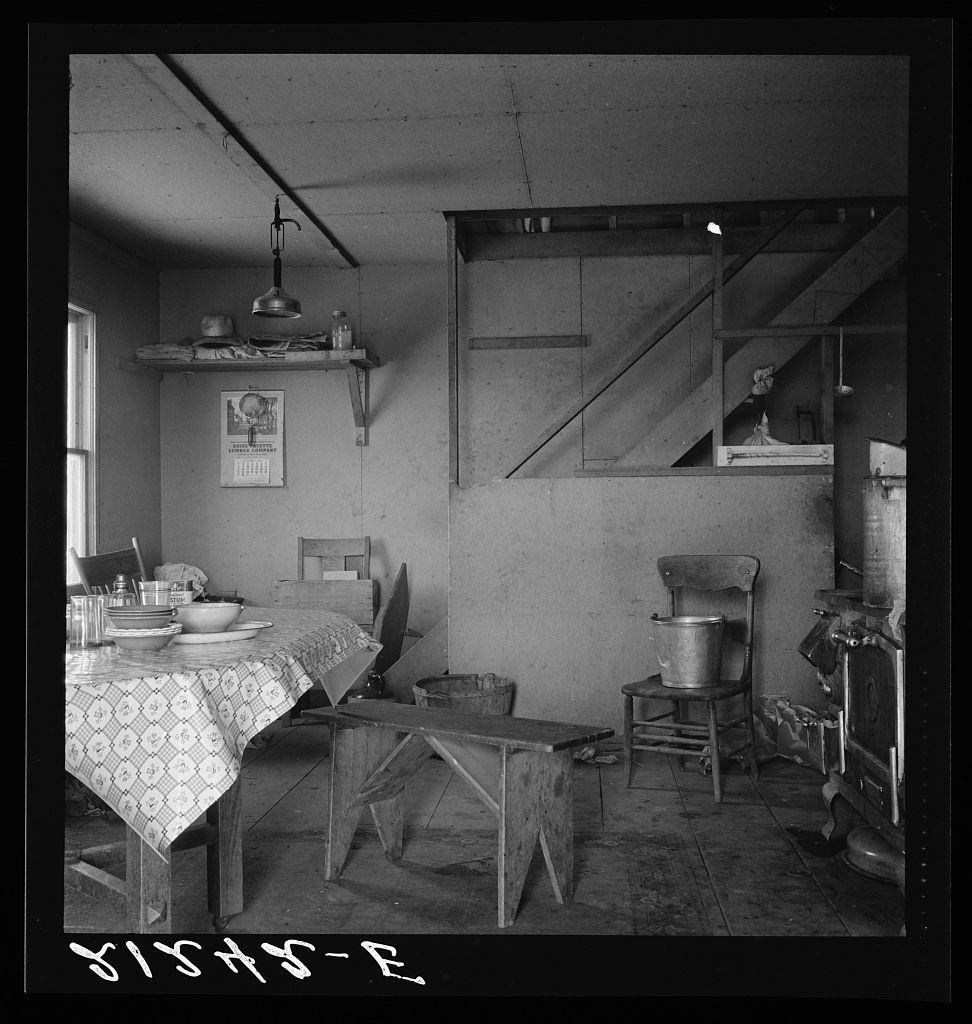
Soper kitchen, unfinished. Willow Creek area, Mulheur County, Oregon. Genral caption number 72

#Soper #WillowCreek #MulheurCounty #Oregon #Genral #undefined #photography #DorotheaLange

https://www.loc.gov/pictures/item/2017773644/

The image depicts a vintage kitchen setting in monochrome. The space is modest, featuring basic furniture and appliances indicative of an earlier era. A table with a patterned cloth dominates the foreground, adorned with various dishes including bowls and utensils. Against one wall stands a solitary chair beside which rests a metal bucket on the floor near a wooden bench-like stool. Another similar stool sits at the end of another visible workbench or counter. The room's architecture includes exposed beams painted darkly in contrast to the lighter walls, suggesting an unfinished or rustic aesthetic common in early 20th-century farmhouses. A hanging light fixture hangs from one corner while a calendar is affixed above it on the wall, adding personal touches amid utilitarian furnishings like an old-fashioned stove and what appears to be laundry equipment with hanging clothes visible through a window at upper right.
  • Copy link
  • Flag this post
  • Block
Dorothea Lange
Dorothea Lange
@DorotheaLange@mastodon.ozioso.online  ·  activity timestamp 5 days ago

Soper kitchen, unfinished. Willow Creek area, Mulheur County, Oregon. Genral caption number 72

#Soper #WillowCreek #MulheurCounty #Oregon #Genral #undefined #photography #DorotheaLange

https://www.loc.gov/pictures/item/2017773644/

The image depicts a vintage kitchen setting in monochrome. The space is modest, featuring basic furniture and appliances indicative of an earlier era. A table with a patterned cloth dominates the foreground, adorned with various dishes including bowls and utensils. Against one wall stands a solitary chair beside which rests a metal bucket on the floor near a wooden bench-like stool. Another similar stool sits at the end of another visible workbench or counter. The room's architecture includes exposed beams painted darkly in contrast to the lighter walls, suggesting an unfinished or rustic aesthetic common in early 20th-century farmhouses. A hanging light fixture hangs from one corner while a calendar is affixed above it on the wall, adding personal touches amid utilitarian furnishings like an old-fashioned stove and what appears to be laundry equipment with hanging clothes visible through a window at upper right.
  • Copy link
  • Flag this post
  • Block
Photography Channel boosted
Dorothea Lange
Dorothea Lange
@DorotheaLange@mastodon.ozioso.online  ·  activity timestamp 5 days ago

Another corner of Soper kitchen. Willow Creek area, Malheur County, Oregon. General caption number 72

#Soper #WillowCreek #MalheurCounty #Oregon #DorotheaLange #LibraryofCongress #undefined #photography #DorotheaLange

https://www.loc.gov/pictures/item/2017773643/

The image is a black and white photograph of an interior scene, likely from the early to mid-20th century judging by its style. It depicts what appears to be a corner section of a kitchen or utility room with various objects that suggest domestic use.

In this space, there are two brooms hanging on the wall: one is upright with its handle extending towards the top left and another is laid down horizontally beside it. Above these, attached directly to the wall, hangs a towel draped over an object which could be part of a sink or a basin cabinet; only partial reflections can be seen in what appears to be a small mirror above this setup.

On a wooden surface that seems like a countertop or perhaps a low table with drawers below it sits another bowl and a pail. The pail is metal, possibly copper as indicated by its reddish tone typical of aged brasswork, which suggests the photo was taken in an era before modern synthetic materials were widely used.

The overall condition indicates usage over time; there are signs like wear on the wooden surface suggesting it's not newly made or refurbished but rather has historical significance. The image is labeled with a date "3-18-20" and another mark that appears to be a signature, possibly of Dorothea Lange.

The caption suggests this scene could have been taken in Malheur County, Oregon during the early 20th century as part of a series [...]
The image is a black and white photograph of an interior scene, likely from the early to mid-20th century judging by its style. It depicts what appears to be a corner section of a kitchen or utility room with various objects that suggest domestic use. In this space, there are two brooms hanging on the wall: one is upright with its handle extending towards the top left and another is laid down horizontally beside it. Above these, attached directly to the wall, hangs a towel draped over an object which could be part of a sink or a basin cabinet; only partial reflections can be seen in what appears to be a small mirror above this setup. On a wooden surface that seems like a countertop or perhaps a low table with drawers below it sits another bowl and a pail. The pail is metal, possibly copper as indicated by its reddish tone typical of aged brasswork, which suggests the photo was taken in an era before modern synthetic materials were widely used. The overall condition indicates usage over time; there are signs like wear on the wooden surface suggesting it's not newly made or refurbished but rather has historical significance. The image is labeled with a date "3-18-20" and another mark that appears to be a signature, possibly of Dorothea Lange. The caption suggests this scene could have been taken in Malheur County, Oregon during the early 20th century as part of a series [...]
  • Copy link
  • Flag this post
  • Block
Dorothea Lange
Dorothea Lange
@DorotheaLange@mastodon.ozioso.online  ·  activity timestamp 5 days ago

Another corner of Soper kitchen. Willow Creek area, Malheur County, Oregon. General caption number 72

#Soper #WillowCreek #MalheurCounty #Oregon #DorotheaLange #LibraryofCongress #undefined #photography #DorotheaLange

https://www.loc.gov/pictures/item/2017773643/

The image is a black and white photograph of an interior scene, likely from the early to mid-20th century judging by its style. It depicts what appears to be a corner section of a kitchen or utility room with various objects that suggest domestic use.

In this space, there are two brooms hanging on the wall: one is upright with its handle extending towards the top left and another is laid down horizontally beside it. Above these, attached directly to the wall, hangs a towel draped over an object which could be part of a sink or a basin cabinet; only partial reflections can be seen in what appears to be a small mirror above this setup.

On a wooden surface that seems like a countertop or perhaps a low table with drawers below it sits another bowl and a pail. The pail is metal, possibly copper as indicated by its reddish tone typical of aged brasswork, which suggests the photo was taken in an era before modern synthetic materials were widely used.

The overall condition indicates usage over time; there are signs like wear on the wooden surface suggesting it's not newly made or refurbished but rather has historical significance. The image is labeled with a date "3-18-20" and another mark that appears to be a signature, possibly of Dorothea Lange.

The caption suggests this scene could have been taken in Malheur County, Oregon during the early 20th century as part of a series [...]
The image is a black and white photograph of an interior scene, likely from the early to mid-20th century judging by its style. It depicts what appears to be a corner section of a kitchen or utility room with various objects that suggest domestic use. In this space, there are two brooms hanging on the wall: one is upright with its handle extending towards the top left and another is laid down horizontally beside it. Above these, attached directly to the wall, hangs a towel draped over an object which could be part of a sink or a basin cabinet; only partial reflections can be seen in what appears to be a small mirror above this setup. On a wooden surface that seems like a countertop or perhaps a low table with drawers below it sits another bowl and a pail. The pail is metal, possibly copper as indicated by its reddish tone typical of aged brasswork, which suggests the photo was taken in an era before modern synthetic materials were widely used. The overall condition indicates usage over time; there are signs like wear on the wooden surface suggesting it's not newly made or refurbished but rather has historical significance. The image is labeled with a date "3-18-20" and another mark that appears to be a signature, possibly of Dorothea Lange. The caption suggests this scene could have been taken in Malheur County, Oregon during the early 20th century as part of a series [...]
  • Copy link
  • Flag this post
  • Block
Photography Channel boosted
Dorothea Lange
Dorothea Lange
@DorotheaLange@mastodon.ozioso.online  ·  activity timestamp 5 days ago

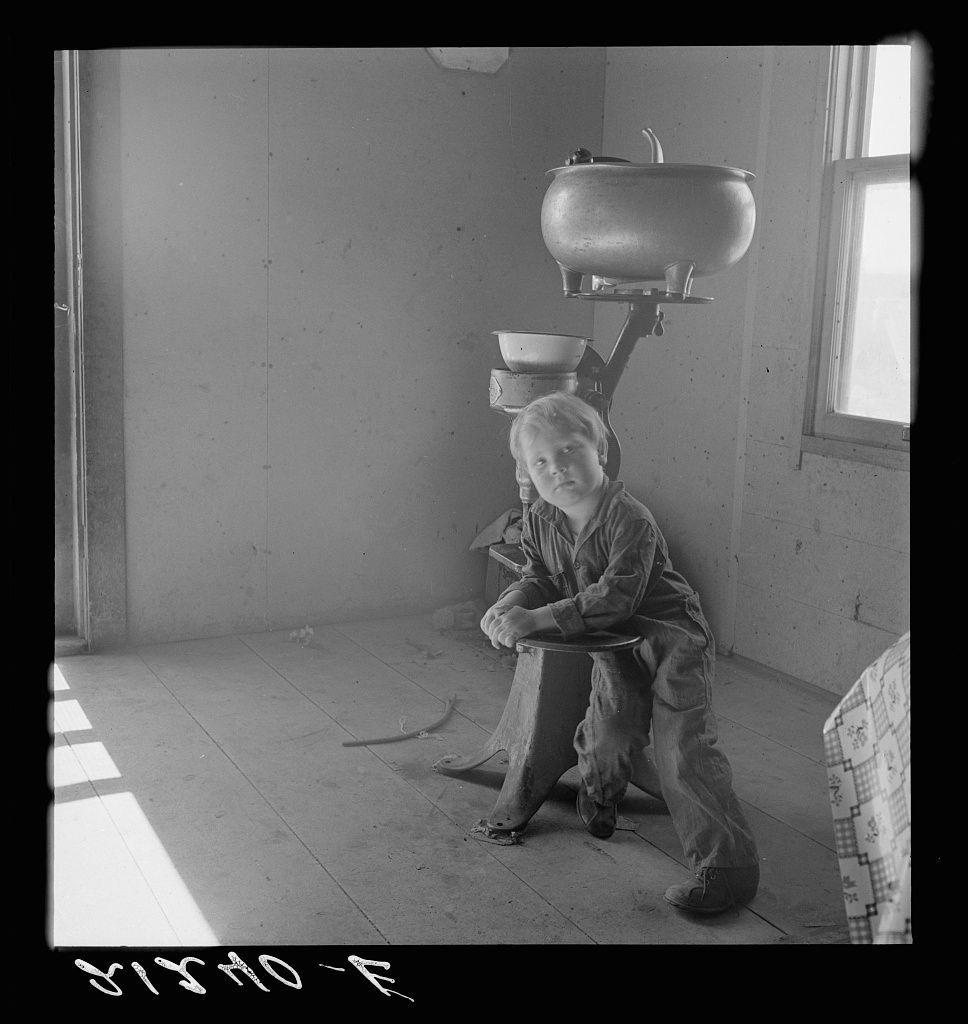
Corner of Soper kitchen. They brought separator from Montana. Has been in use fourteen years. General caption number 72. Malheur County, Oregon

#Soper #Montana #MalheurCounty #Oregon #theGreatDepression #American #DorotheaLanges #undefined #photography #DorotheaLange

https://www.loc.gov/pictures/item/2017773642/

A vintage black and white photograph captures a young child sitting next to an old-fashioned scale with large bowls on it. The setting appears rustic, possibly in the interior of a home or a simple structure, with bare concrete walls that show signs of wear and patches where paint might have peeled off.

The lighting casts shadows from outside through what seems like a window at the top right corner, suggesting natural light entering the space. On the ground beside the child is an object resembling part of a bicycle wheel, adding to the sense of a lived-in environment with various items scattered about. The flooring looks worn and uneven, indicative of frequent use or lack of maintenance.

A tablecloth partially visible in the lower right corner introduces some domesticity into the scene, though it's not clear what lies beneath it as only its edge is shown. A window can be seen on the far wall to the left, allowing light to spill into this stark room. The floor shows a patterned design that could either be part of an old rug or flooring material.

The overall composition and details suggest hardship and resilience, possibly during times like the Great Depression when such images were common in documenting American life through Dorothea Lange's lens for her work with the Farm Security Administration (FSA).
A vintage black and white photograph captures a young child sitting next to an old-fashioned scale with large bowls on it. The setting appears rustic, possibly in the interior of a home or a simple structure, with bare concrete walls that show signs of wear and patches where paint might have peeled off. The lighting casts shadows from outside through what seems like a window at the top right corner, suggesting natural light entering the space. On the ground beside the child is an object resembling part of a bicycle wheel, adding to the sense of a lived-in environment with various items scattered about. The flooring looks worn and uneven, indicative of frequent use or lack of maintenance. A tablecloth partially visible in the lower right corner introduces some domesticity into the scene, though it's not clear what lies beneath it as only its edge is shown. A window can be seen on the far wall to the left, allowing light to spill into this stark room. The floor shows a patterned design that could either be part of an old rug or flooring material. The overall composition and details suggest hardship and resilience, possibly during times like the Great Depression when such images were common in documenting American life through Dorothea Lange's lens for her work with the Farm Security Administration (FSA).
  • Copy link
  • Flag this post
  • Block
Dorothea Lange
Dorothea Lange
@DorotheaLange@mastodon.ozioso.online  ·  activity timestamp 5 days ago

Corner of Soper kitchen. They brought separator from Montana. Has been in use fourteen years. General caption number 72. Malheur County, Oregon

#Soper #Montana #MalheurCounty #Oregon #theGreatDepression #American #DorotheaLanges #undefined #photography #DorotheaLange

https://www.loc.gov/pictures/item/2017773642/

A vintage black and white photograph captures a young child sitting next to an old-fashioned scale with large bowls on it. The setting appears rustic, possibly in the interior of a home or a simple structure, with bare concrete walls that show signs of wear and patches where paint might have peeled off.

The lighting casts shadows from outside through what seems like a window at the top right corner, suggesting natural light entering the space. On the ground beside the child is an object resembling part of a bicycle wheel, adding to the sense of a lived-in environment with various items scattered about. The flooring looks worn and uneven, indicative of frequent use or lack of maintenance.

A tablecloth partially visible in the lower right corner introduces some domesticity into the scene, though it's not clear what lies beneath it as only its edge is shown. A window can be seen on the far wall to the left, allowing light to spill into this stark room. The floor shows a patterned design that could either be part of an old rug or flooring material.

The overall composition and details suggest hardship and resilience, possibly during times like the Great Depression when such images were common in documenting American life through Dorothea Lange's lens for her work with the Farm Security Administration (FSA).
A vintage black and white photograph captures a young child sitting next to an old-fashioned scale with large bowls on it. The setting appears rustic, possibly in the interior of a home or a simple structure, with bare concrete walls that show signs of wear and patches where paint might have peeled off. The lighting casts shadows from outside through what seems like a window at the top right corner, suggesting natural light entering the space. On the ground beside the child is an object resembling part of a bicycle wheel, adding to the sense of a lived-in environment with various items scattered about. The flooring looks worn and uneven, indicative of frequent use or lack of maintenance. A tablecloth partially visible in the lower right corner introduces some domesticity into the scene, though it's not clear what lies beneath it as only its edge is shown. A window can be seen on the far wall to the left, allowing light to spill into this stark room. The floor shows a patterned design that could either be part of an old rug or flooring material. The overall composition and details suggest hardship and resilience, possibly during times like the Great Depression when such images were common in documenting American life through Dorothea Lange's lens for her work with the Farm Security Administration (FSA).
  • Copy link
  • Flag this post
  • Block

Indieweb Studio

This is a relaxed, online social space for the indieweb community, brought to you by indieweb.social.

Please abide by our code of conduct and have a nice time!

Indieweb Studio: About · Code of conduct · Privacy · Users · Instances
Bonfire social · 1.0.2-alpha.34 no JS en
Automatic federation enabled
Log in Create account
Instance logo
  • Explore
  • About
  • Members
  • Code of Conduct