Discussion
Loading...

#Tag

Log in
  • Sign up
  • About
  • Code of conduct
  • Privacy
  • Users
  • Instances
  • About Bonfire
Photography Channel boosted
Dorothea Lange
Dorothea Lange
@DorotheaLange@mastodon.ozioso.online  ·  activity timestamp 2 days ago

Family living in tent while building the house around them. Near Klamath Falls, Klamath County, Oregon. See general caption number 47

#KlamathFalls #KlamathCounty #Oregon #DorotheaLange #American #WorldWarII #theGreatDepression #Lange #undefined #photography #DorotheaLange

https://www.loc.gov/pictures/item/2017773300/

The image shows a black and white photograph of an individual standing within the entrance area of what appears to be an unfinished wooden structure. The building is surrounded by an open field with sparse vegetation, indicative of rural or undeveloped land. Various construction materials such as lumber are visible on the ground around the site.

A child peers out from under a partially constructed roof that seems supported by metal framework and canvas. It's likely that they're residing within this makeshift shelter while work progresses on constructing more permanent housing nearby. The overall scene suggests hardship, displacement or temporary living conditions in what looks to be an ongoing building project amidst less developed surroundings.

The photograph captures the raw reality of human life during a time when people might have had limited access to stable housing and resources for construction due possibly economic constraints or environmental factors like natural disasters which can displace populations. It reflects themes such as resilience, adaptability in challenging circumstances and perhaps hints at socio-economic conditions that necessitated such living situations.

In the broader context of historical records, this could be indicative of events where large-scale movements led to temporary housing solutions until more durable structures were erected - pos [...]
The image shows a black and white photograph of an individual standing within the entrance area of what appears to be an unfinished wooden structure. The building is surrounded by an open field with sparse vegetation, indicative of rural or undeveloped land. Various construction materials such as lumber are visible on the ground around the site. A child peers out from under a partially constructed roof that seems supported by metal framework and canvas. It's likely that they're residing within this makeshift shelter while work progresses on constructing more permanent housing nearby. The overall scene suggests hardship, displacement or temporary living conditions in what looks to be an ongoing building project amidst less developed surroundings. The photograph captures the raw reality of human life during a time when people might have had limited access to stable housing and resources for construction due possibly economic constraints or environmental factors like natural disasters which can displace populations. It reflects themes such as resilience, adaptability in challenging circumstances and perhaps hints at socio-economic conditions that necessitated such living situations. In the broader context of historical records, this could be indicative of events where large-scale movements led to temporary housing solutions until more durable structures were erected - pos [...]
  • Copy link
  • Flag this post
  • Block
Dorothea Lange
Dorothea Lange
@DorotheaLange@mastodon.ozioso.online  ·  activity timestamp 2 days ago

Family living in tent while building the house around them. Near Klamath Falls, Klamath County, Oregon. See general caption number 47

#KlamathFalls #KlamathCounty #Oregon #DorotheaLange #American #WorldWarII #theGreatDepression #Lange #undefined #photography #DorotheaLange

https://www.loc.gov/pictures/item/2017773300/

The image shows a black and white photograph of an individual standing within the entrance area of what appears to be an unfinished wooden structure. The building is surrounded by an open field with sparse vegetation, indicative of rural or undeveloped land. Various construction materials such as lumber are visible on the ground around the site.

A child peers out from under a partially constructed roof that seems supported by metal framework and canvas. It's likely that they're residing within this makeshift shelter while work progresses on constructing more permanent housing nearby. The overall scene suggests hardship, displacement or temporary living conditions in what looks to be an ongoing building project amidst less developed surroundings.

The photograph captures the raw reality of human life during a time when people might have had limited access to stable housing and resources for construction due possibly economic constraints or environmental factors like natural disasters which can displace populations. It reflects themes such as resilience, adaptability in challenging circumstances and perhaps hints at socio-economic conditions that necessitated such living situations.

In the broader context of historical records, this could be indicative of events where large-scale movements led to temporary housing solutions until more durable structures were erected - pos [...]
The image shows a black and white photograph of an individual standing within the entrance area of what appears to be an unfinished wooden structure. The building is surrounded by an open field with sparse vegetation, indicative of rural or undeveloped land. Various construction materials such as lumber are visible on the ground around the site. A child peers out from under a partially constructed roof that seems supported by metal framework and canvas. It's likely that they're residing within this makeshift shelter while work progresses on constructing more permanent housing nearby. The overall scene suggests hardship, displacement or temporary living conditions in what looks to be an ongoing building project amidst less developed surroundings. The photograph captures the raw reality of human life during a time when people might have had limited access to stable housing and resources for construction due possibly economic constraints or environmental factors like natural disasters which can displace populations. It reflects themes such as resilience, adaptability in challenging circumstances and perhaps hints at socio-economic conditions that necessitated such living situations. In the broader context of historical records, this could be indicative of events where large-scale movements led to temporary housing solutions until more durable structures were erected - pos [...]
  • Copy link
  • Flag this post
  • Block
Photography Channel boosted
Dorothea Lange
Dorothea Lange
@DorotheaLange@mastodon.ozioso.online  ·  activity timestamp 3 days ago

Untitled photo, possibly related to: Mrs. Cleaver is raising five sons on new farm. Malheur County, Oregon

#Cleaver #MalheurCounty #Oregon #second #theGreatDepression #America #American #DustBowl #undefined #photography #DorotheaLange

https://www.loc.gov/pictures/item/2017773837/

A black and white photograph depicting three women in front of a large temporary structure. The woman on the left is wearing a patterned dress with her hand near her face, appearing to be deep in thought or possibly distressed. Behind her are two other women seated; one appears contemplative while holding something small in her hands, likely food-related items such as breads or rolls, and the second has an expression of concern or worry.

The structure behind them is a large canvas tent with vertical wooden slats providing support. The ground looks rough and unpaved, possibly indicative of outdoor rural life during economic hardship periods like the Great Depression in America when these types of structures were common due to lack of housing infrastructure. It suggests that this could be part of an agricultural community where temporary living arrangements are necessary.

The image's context is further suggested by a caption mentioning "Mrs. Cleaver" and reference to raising five sons on a new farm, placing it within the framework of rural American life during hardship times with families working in agriculture. The setting seems impoverished yet communal, highlighting themes of survival, family cohesion amidst adversity, and temporary living conditions common for migrant workers or displaced individuals due to economic pressures like crop failure or forced relocations su [...]
A black and white photograph depicting three women in front of a large temporary structure. The woman on the left is wearing a patterned dress with her hand near her face, appearing to be deep in thought or possibly distressed. Behind her are two other women seated; one appears contemplative while holding something small in her hands, likely food-related items such as breads or rolls, and the second has an expression of concern or worry. The structure behind them is a large canvas tent with vertical wooden slats providing support. The ground looks rough and unpaved, possibly indicative of outdoor rural life during economic hardship periods like the Great Depression in America when these types of structures were common due to lack of housing infrastructure. It suggests that this could be part of an agricultural community where temporary living arrangements are necessary. The image's context is further suggested by a caption mentioning "Mrs. Cleaver" and reference to raising five sons on a new farm, placing it within the framework of rural American life during hardship times with families working in agriculture. The setting seems impoverished yet communal, highlighting themes of survival, family cohesion amidst adversity, and temporary living conditions common for migrant workers or displaced individuals due to economic pressures like crop failure or forced relocations su [...]
  • Copy link
  • Flag this post
  • Block
Dorothea Lange
Dorothea Lange
@DorotheaLange@mastodon.ozioso.online  ·  activity timestamp 3 days ago

Untitled photo, possibly related to: Mrs. Cleaver is raising five sons on new farm. Malheur County, Oregon

#Cleaver #MalheurCounty #Oregon #second #theGreatDepression #America #American #DustBowl #undefined #photography #DorotheaLange

https://www.loc.gov/pictures/item/2017773837/

A black and white photograph depicting three women in front of a large temporary structure. The woman on the left is wearing a patterned dress with her hand near her face, appearing to be deep in thought or possibly distressed. Behind her are two other women seated; one appears contemplative while holding something small in her hands, likely food-related items such as breads or rolls, and the second has an expression of concern or worry.

The structure behind them is a large canvas tent with vertical wooden slats providing support. The ground looks rough and unpaved, possibly indicative of outdoor rural life during economic hardship periods like the Great Depression in America when these types of structures were common due to lack of housing infrastructure. It suggests that this could be part of an agricultural community where temporary living arrangements are necessary.

The image's context is further suggested by a caption mentioning "Mrs. Cleaver" and reference to raising five sons on a new farm, placing it within the framework of rural American life during hardship times with families working in agriculture. The setting seems impoverished yet communal, highlighting themes of survival, family cohesion amidst adversity, and temporary living conditions common for migrant workers or displaced individuals due to economic pressures like crop failure or forced relocations su [...]
A black and white photograph depicting three women in front of a large temporary structure. The woman on the left is wearing a patterned dress with her hand near her face, appearing to be deep in thought or possibly distressed. Behind her are two other women seated; one appears contemplative while holding something small in her hands, likely food-related items such as breads or rolls, and the second has an expression of concern or worry. The structure behind them is a large canvas tent with vertical wooden slats providing support. The ground looks rough and unpaved, possibly indicative of outdoor rural life during economic hardship periods like the Great Depression in America when these types of structures were common due to lack of housing infrastructure. It suggests that this could be part of an agricultural community where temporary living arrangements are necessary. The image's context is further suggested by a caption mentioning "Mrs. Cleaver" and reference to raising five sons on a new farm, placing it within the framework of rural American life during hardship times with families working in agriculture. The setting seems impoverished yet communal, highlighting themes of survival, family cohesion amidst adversity, and temporary living conditions common for migrant workers or displaced individuals due to economic pressures like crop failure or forced relocations su [...]
  • Copy link
  • Flag this post
  • Block
Photography Channel boosted
Dorothea Lange
Dorothea Lange
@DorotheaLange@mastodon.ozioso.online  ·  activity timestamp 4 days ago

Mrs. Soper tells how it was when they first came. Willow Creek area, Malheur County, Oregon. General caption number 72

#Soper #first #WillowCreek #MalheurCounty #Oregon #theDustBowl #American #theGreatDepression #undefined #photography #DorotheaLange

https://www.loc.gov/pictures/item/2017773671/

This black and white photograph captures a moment from the Dust Bowl era, depicting an individual standing in what appears to be a rural outdoor setting. The person is dressed in simple clothing with plaid patterns on both the top and bottom garment. They are holding onto their chin with one hand while supporting themselves against another object with the other, seemingly deep in thought or contemplation.
In the background, clotheslines stretch across the image, bearing what seem to be sheets of fabric drying in the sun. Another person is visible standing at a distance on the left side, engaged in an activity that's not entirely clear from this perspective.
The overall scene suggests hardship and survival during challenging times, likely relating to the migration patterns associated with droughts and dust storms prevalent in the American West during the Great Depression era.
This black and white photograph captures a moment from the Dust Bowl era, depicting an individual standing in what appears to be a rural outdoor setting. The person is dressed in simple clothing with plaid patterns on both the top and bottom garment. They are holding onto their chin with one hand while supporting themselves against another object with the other, seemingly deep in thought or contemplation. In the background, clotheslines stretch across the image, bearing what seem to be sheets of fabric drying in the sun. Another person is visible standing at a distance on the left side, engaged in an activity that's not entirely clear from this perspective. The overall scene suggests hardship and survival during challenging times, likely relating to the migration patterns associated with droughts and dust storms prevalent in the American West during the Great Depression era.
  • Copy link
  • Flag this post
  • Block
Dorothea Lange
Dorothea Lange
@DorotheaLange@mastodon.ozioso.online  ·  activity timestamp 4 days ago

Mrs. Soper tells how it was when they first came. Willow Creek area, Malheur County, Oregon. General caption number 72

#Soper #first #WillowCreek #MalheurCounty #Oregon #theDustBowl #American #theGreatDepression #undefined #photography #DorotheaLange

https://www.loc.gov/pictures/item/2017773671/

This black and white photograph captures a moment from the Dust Bowl era, depicting an individual standing in what appears to be a rural outdoor setting. The person is dressed in simple clothing with plaid patterns on both the top and bottom garment. They are holding onto their chin with one hand while supporting themselves against another object with the other, seemingly deep in thought or contemplation.
In the background, clotheslines stretch across the image, bearing what seem to be sheets of fabric drying in the sun. Another person is visible standing at a distance on the left side, engaged in an activity that's not entirely clear from this perspective.
The overall scene suggests hardship and survival during challenging times, likely relating to the migration patterns associated with droughts and dust storms prevalent in the American West during the Great Depression era.
This black and white photograph captures a moment from the Dust Bowl era, depicting an individual standing in what appears to be a rural outdoor setting. The person is dressed in simple clothing with plaid patterns on both the top and bottom garment. They are holding onto their chin with one hand while supporting themselves against another object with the other, seemingly deep in thought or contemplation. In the background, clotheslines stretch across the image, bearing what seem to be sheets of fabric drying in the sun. Another person is visible standing at a distance on the left side, engaged in an activity that's not entirely clear from this perspective. The overall scene suggests hardship and survival during challenging times, likely relating to the migration patterns associated with droughts and dust storms prevalent in the American West during the Great Depression era.
  • Copy link
  • Flag this post
  • Block
Photography Channel boosted
Dorothea Lange
Dorothea Lange
@DorotheaLange@mastodon.ozioso.online  ·  activity timestamp 5 days ago

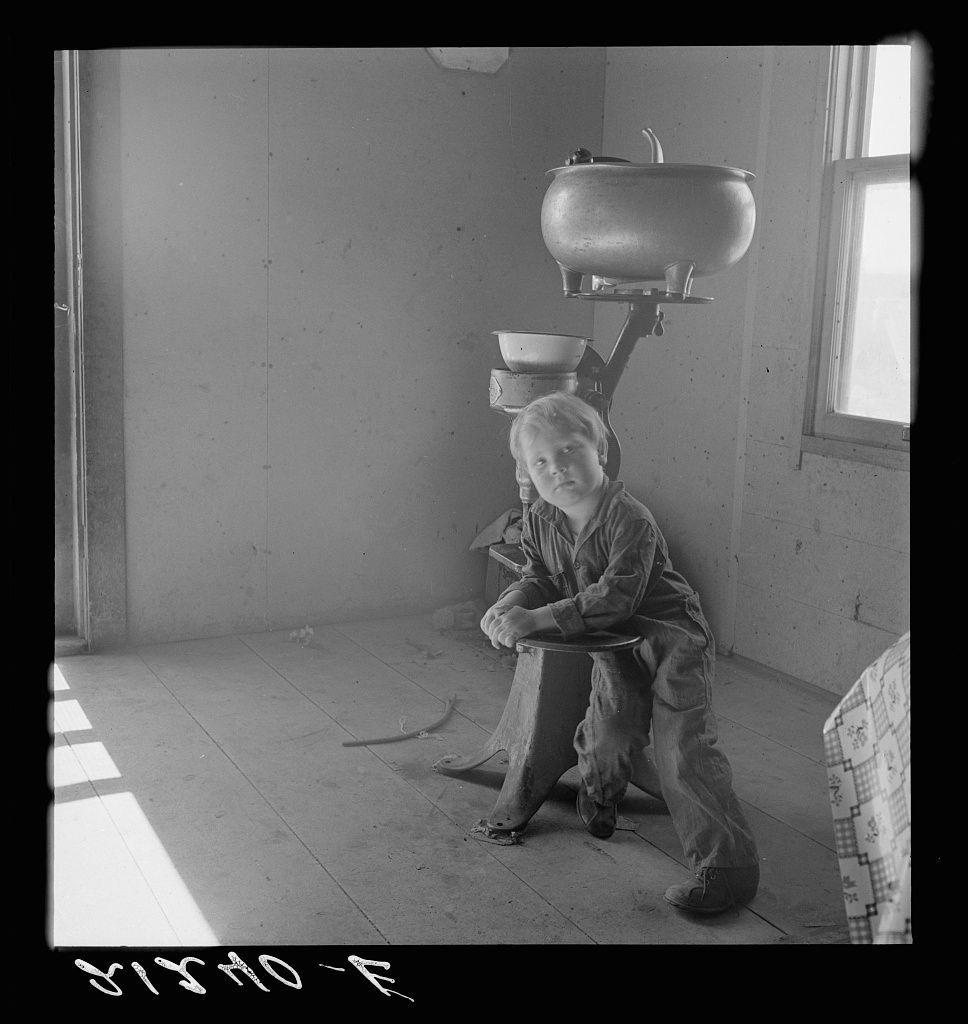
Corner of Soper kitchen. They brought separator from Montana. Has been in use fourteen years. General caption number 72. Malheur County, Oregon

#Soper #Montana #MalheurCounty #Oregon #theGreatDepression #American #DorotheaLanges #undefined #photography #DorotheaLange

https://www.loc.gov/pictures/item/2017773642/

A vintage black and white photograph captures a young child sitting next to an old-fashioned scale with large bowls on it. The setting appears rustic, possibly in the interior of a home or a simple structure, with bare concrete walls that show signs of wear and patches where paint might have peeled off.

The lighting casts shadows from outside through what seems like a window at the top right corner, suggesting natural light entering the space. On the ground beside the child is an object resembling part of a bicycle wheel, adding to the sense of a lived-in environment with various items scattered about. The flooring looks worn and uneven, indicative of frequent use or lack of maintenance.

A tablecloth partially visible in the lower right corner introduces some domesticity into the scene, though it's not clear what lies beneath it as only its edge is shown. A window can be seen on the far wall to the left, allowing light to spill into this stark room. The floor shows a patterned design that could either be part of an old rug or flooring material.

The overall composition and details suggest hardship and resilience, possibly during times like the Great Depression when such images were common in documenting American life through Dorothea Lange's lens for her work with the Farm Security Administration (FSA).
A vintage black and white photograph captures a young child sitting next to an old-fashioned scale with large bowls on it. The setting appears rustic, possibly in the interior of a home or a simple structure, with bare concrete walls that show signs of wear and patches where paint might have peeled off. The lighting casts shadows from outside through what seems like a window at the top right corner, suggesting natural light entering the space. On the ground beside the child is an object resembling part of a bicycle wheel, adding to the sense of a lived-in environment with various items scattered about. The flooring looks worn and uneven, indicative of frequent use or lack of maintenance. A tablecloth partially visible in the lower right corner introduces some domesticity into the scene, though it's not clear what lies beneath it as only its edge is shown. A window can be seen on the far wall to the left, allowing light to spill into this stark room. The floor shows a patterned design that could either be part of an old rug or flooring material. The overall composition and details suggest hardship and resilience, possibly during times like the Great Depression when such images were common in documenting American life through Dorothea Lange's lens for her work with the Farm Security Administration (FSA).
  • Copy link
  • Flag this post
  • Block
Dorothea Lange
Dorothea Lange
@DorotheaLange@mastodon.ozioso.online  ·  activity timestamp 5 days ago

Corner of Soper kitchen. They brought separator from Montana. Has been in use fourteen years. General caption number 72. Malheur County, Oregon

#Soper #Montana #MalheurCounty #Oregon #theGreatDepression #American #DorotheaLanges #undefined #photography #DorotheaLange

https://www.loc.gov/pictures/item/2017773642/

A vintage black and white photograph captures a young child sitting next to an old-fashioned scale with large bowls on it. The setting appears rustic, possibly in the interior of a home or a simple structure, with bare concrete walls that show signs of wear and patches where paint might have peeled off.

The lighting casts shadows from outside through what seems like a window at the top right corner, suggesting natural light entering the space. On the ground beside the child is an object resembling part of a bicycle wheel, adding to the sense of a lived-in environment with various items scattered about. The flooring looks worn and uneven, indicative of frequent use or lack of maintenance.

A tablecloth partially visible in the lower right corner introduces some domesticity into the scene, though it's not clear what lies beneath it as only its edge is shown. A window can be seen on the far wall to the left, allowing light to spill into this stark room. The floor shows a patterned design that could either be part of an old rug or flooring material.

The overall composition and details suggest hardship and resilience, possibly during times like the Great Depression when such images were common in documenting American life through Dorothea Lange's lens for her work with the Farm Security Administration (FSA).
A vintage black and white photograph captures a young child sitting next to an old-fashioned scale with large bowls on it. The setting appears rustic, possibly in the interior of a home or a simple structure, with bare concrete walls that show signs of wear and patches where paint might have peeled off. The lighting casts shadows from outside through what seems like a window at the top right corner, suggesting natural light entering the space. On the ground beside the child is an object resembling part of a bicycle wheel, adding to the sense of a lived-in environment with various items scattered about. The flooring looks worn and uneven, indicative of frequent use or lack of maintenance. A tablecloth partially visible in the lower right corner introduces some domesticity into the scene, though it's not clear what lies beneath it as only its edge is shown. A window can be seen on the far wall to the left, allowing light to spill into this stark room. The floor shows a patterned design that could either be part of an old rug or flooring material. The overall composition and details suggest hardship and resilience, possibly during times like the Great Depression when such images were common in documenting American life through Dorothea Lange's lens for her work with the Farm Security Administration (FSA).
  • Copy link
  • Flag this post
  • Block
Photography Channel boosted
Dorothea Lange
Dorothea Lange
@DorotheaLange@mastodon.ozioso.online  ·  activity timestamp 6 days ago

Girls of Lincoln Bench School study their reading lesson. Near Ontario, Malheur County, Oregon

#LincolnBenchSchool #Ontario #MalheurCounty #Oregon #third #America #DorotheaLanges #theGreatDepression #undefined #photography #DorotheaLange

https://www.loc.gov/pictures/item/2017773619/

The image is a black and white photograph depicting three young girls sitting on what appears to be the steps of a building, possibly in an old rural schoolhouse setting. The girl on the left has short hair with bangs, wears striped socks and sandals, while engrossed in her book. She's dressed in a patterned skirt and sweater.

In the middle is another girl with medium-length blonde hair tied back into pigtails; she seems to be deeply concentrated as well, reading from an open book that has pictures inside. Her attire includes lace-up shoes, knee-high socks, a dress adorned with floral patterns around the hemline, and her sleeves are ruffled.

The third child on the right is wearing a light-colored sweater over a dotted blouse paired with checkered sandals; she's flipping through pages of another open book. She has short hair styled upwards in what looks like curlers or pinned up at the crown before it was let down again as it appears now. Her shoes seem well-worn.

All three are sitting on individual wooden slats, perhaps a part of outdoor school furniture from an earlier era given their weathered appearance and style which suggests this could be around mid-20th century America based on clothing styles and architecture visible in the background such as shutters and doors. The setting appears to be sunny with shadows cast behind them.

The photograph exudes a sense of qui [...]
The image is a black and white photograph depicting three young girls sitting on what appears to be the steps of a building, possibly in an old rural schoolhouse setting. The girl on the left has short hair with bangs, wears striped socks and sandals, while engrossed in her book. She's dressed in a patterned skirt and sweater. In the middle is another girl with medium-length blonde hair tied back into pigtails; she seems to be deeply concentrated as well, reading from an open book that has pictures inside. Her attire includes lace-up shoes, knee-high socks, a dress adorned with floral patterns around the hemline, and her sleeves are ruffled. The third child on the right is wearing a light-colored sweater over a dotted blouse paired with checkered sandals; she's flipping through pages of another open book. She has short hair styled upwards in what looks like curlers or pinned up at the crown before it was let down again as it appears now. Her shoes seem well-worn. All three are sitting on individual wooden slats, perhaps a part of outdoor school furniture from an earlier era given their weathered appearance and style which suggests this could be around mid-20th century America based on clothing styles and architecture visible in the background such as shutters and doors. The setting appears to be sunny with shadows cast behind them. The photograph exudes a sense of qui [...]
  • Copy link
  • Flag this post
  • Block
Dorothea Lange
Dorothea Lange
@DorotheaLange@mastodon.ozioso.online  ·  activity timestamp 6 days ago

Girls of Lincoln Bench School study their reading lesson. Near Ontario, Malheur County, Oregon

#LincolnBenchSchool #Ontario #MalheurCounty #Oregon #third #America #DorotheaLanges #theGreatDepression #undefined #photography #DorotheaLange

https://www.loc.gov/pictures/item/2017773619/

The image is a black and white photograph depicting three young girls sitting on what appears to be the steps of a building, possibly in an old rural schoolhouse setting. The girl on the left has short hair with bangs, wears striped socks and sandals, while engrossed in her book. She's dressed in a patterned skirt and sweater.

In the middle is another girl with medium-length blonde hair tied back into pigtails; she seems to be deeply concentrated as well, reading from an open book that has pictures inside. Her attire includes lace-up shoes, knee-high socks, a dress adorned with floral patterns around the hemline, and her sleeves are ruffled.

The third child on the right is wearing a light-colored sweater over a dotted blouse paired with checkered sandals; she's flipping through pages of another open book. She has short hair styled upwards in what looks like curlers or pinned up at the crown before it was let down again as it appears now. Her shoes seem well-worn.

All three are sitting on individual wooden slats, perhaps a part of outdoor school furniture from an earlier era given their weathered appearance and style which suggests this could be around mid-20th century America based on clothing styles and architecture visible in the background such as shutters and doors. The setting appears to be sunny with shadows cast behind them.

The photograph exudes a sense of qui [...]
The image is a black and white photograph depicting three young girls sitting on what appears to be the steps of a building, possibly in an old rural schoolhouse setting. The girl on the left has short hair with bangs, wears striped socks and sandals, while engrossed in her book. She's dressed in a patterned skirt and sweater. In the middle is another girl with medium-length blonde hair tied back into pigtails; she seems to be deeply concentrated as well, reading from an open book that has pictures inside. Her attire includes lace-up shoes, knee-high socks, a dress adorned with floral patterns around the hemline, and her sleeves are ruffled. The third child on the right is wearing a light-colored sweater over a dotted blouse paired with checkered sandals; she's flipping through pages of another open book. She has short hair styled upwards in what looks like curlers or pinned up at the crown before it was let down again as it appears now. Her shoes seem well-worn. All three are sitting on individual wooden slats, perhaps a part of outdoor school furniture from an earlier era given their weathered appearance and style which suggests this could be around mid-20th century America based on clothing styles and architecture visible in the background such as shutters and doors. The setting appears to be sunny with shadows cast behind them. The photograph exudes a sense of qui [...]
  • Copy link
  • Flag this post
  • Block

Indieweb Studio

This is a relaxed, online social space for the indieweb community, brought to you by indieweb.social.

Please abide by our code of conduct and have a nice time!

Indieweb Studio: About · Code of conduct · Privacy · Users · Instances
Bonfire social · 1.0.2-alpha.34 no JS en
Automatic federation enabled
Log in Create account
Instance logo
  • Explore
  • About
  • Members
  • Code of Conduct